en
it
de
es
fr
nl
pt
da
no
sv
pl
ru
cs
hu
sl
tr
hr
lt
lv
et
ro
sk
bg
uk
bs
el
zh
►2.1.7. Fuel must be stored in accordance with
current safety regulations.
►►2.2. SAFETY:
►2.2.1. Never use the heater in areas with pet
-
rol, paint solvents or other highly ammable
vapours.
►2.2.2. Comply with all local legislation and
current regulations when using the heater.
►2.2.3. Heaters used near tarpaulins, curtains
or other similar covering materials must be
kept at a safe distance. It is advised to use
re-proof covering material.
►2.2.4. Only use heaters in well-ventilated ar
-
eas. Set-up a suitable open and ventilated
area, with the purpose of introducing fresh
air from outdoors, in compliance with the cur-
rent safety standards.
►2.2.5. Heaters must be powered only with
the correct voltage and frequency values as
specied on the heater’s identication plate.
►2.2.6. Only use suitable earthed extension
cable. 115v supply must be available. Please
note that the heater requires minimum
15amps for proper operation. Ensure appro-
priate gauge extension cord is used. (12/3
AWG at 50 Ft. - 10/3 AWG at 100 Ft.).
►2.2.7. The recommended safety distances
between heaters and ammable substances
are: front output = 5 ft.; side/top output = 2 ft.
►2.2.8. Avoid re hazards by placing the hot or
functioning heater on a at level surface.
►2.2.9. Always keep animals at a safe distance.
►2.2.10. Disconnect the heater from the main
power supply when not in use.
►2.2.11. When controlled by a thermostat, the
heater can turn on at any time.
►2.2.12. Never use the heater in frequently
used rooms or in bedrooms.
►2.2.13. Never block the heater’s air inlet (rear)
or the air outlet (front).
►2.2.14. Never move, handle, refuel or conduct
maintenance on the heater when it is hot or
when connected to the power supply or when
in operation.
►2.2.15. Only use original kit/hose to direct air
ow (in and out) (where applicable).
►2.2.16. Keep heater’s hot parts at as safe dis-
tance from inammable materials (including
the power supply cable).
►2.2.17. If the power supply cable is damaged,
it must be replaced by a technical service
centre, in order to prevent further risks.
3. UNPACKING
WARNING: The packaging material is not a
toy. Keep the plastic bag out of the reach of
children; danger of suffocation!
►3.1. Remove all packaging materials used to
wrap and deliver the heater and dispose them in
compliance with current regulations
►3.2. If the heater is placed on a moving platform,
make sure it is moved gently.
►3.3. Check for any damage that might have
happened during transport. If the heater looks
damaged, immediately inform the dealer from
which it was purchased.
4. ASSEMBLY
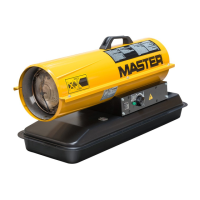
These heaters are tted with wheels, a handle and
a chimney depending on the model (PIC. 5-6).
These parts, which come with the relative nuts and
bolts, are in the heater’s packaging.
5. FUEL
WARNING: The heater only works with No.1,
No.2, Diesel or Kerosene.
In order to avoid explosions or any re hazards, use
only diesel or kerosene fuel.
Never use petrol, naphtha, paint solvents, alcohol
or any other highly inammable fuels.
Non-toxic, anti-freeze additives can be used in case
of very low temperatures.
It is advisable to use winter diesel below 41°F.
6. OPERATING PRINCIPLES
A. Combustion chamber and burner, B. Fan, C.
Motor, D. Pump, E. Tank, F. Chimney (indirect
models).
The pump draws fuel from the tank and brings it to
the operating pressure. The fuel is brought to the
nozzle that sprays it into the combustion chamber.
The combustion is carried out with a mix of air and
fuel and the ow of air generated is pushed outside
via the rotation of the fan. In direct models (PIC. 7)
combustion products ow together with heated air.
In indirect models (PIC. 8) combustion products are
directed outside through the chimney. A series of
sensors connected to an electronic control board
constantly keep the correct operation of the heater
monitored and stops the cycle in the event of
anomalies.
7. OPERATION
WARNING: Carefully read the “SAFETY
INFORMATION” before switching on the
heater.
WARNING: Exhaust gas pipe connection
must be installed following the installation
instruction on the end of this manual. The
chimney should have a minimum of 0.04” W.C.
draft to ensure safe operation of the unit. The
heater is according to CSA B140.8 - 8.3.4.2.
The vent outlet on the heater is 6” diameter.
Certied venting system must be used at
all times. All venting must correspond with
local codes. Vent cap should be installed in
situations where downdrafts occur.



 To Next Page