Need help?
Do you have a question about the Medeli SP4200 and is the answer not in the manual?
Warning regarding compliance with FCC regulations for digital devices to prevent radio interference.
Important safety and operational guidelines for power, connections, location, cleaning, and handling.
Identifies and explains the buttons and controls on the front of the instrument.
Details the various input and output jacks on the rear of the instrument.
Explains the information displayed on the instrument's LCD screen.
Instructions for attaching the music stand to the instrument.
Steps for connecting the power adapter and turning the instrument on/off.
How to connect headphones for private practice or listening.
Connecting external audio sources like amplifiers or stereo systems.
Connecting external audio players to play along with the instrument.
Connecting to computers and MIDI devices for data transfer and control.
How to connect and use a foot switch for sustain or other functions.
Connecting the optional unit pedal for piano-like control.
Connecting a microphone for vocal performances or karaoke.
Basic steps to turn on the instrument and adjust the master volume.
How to select and play the built-in demonstration songs.
Selecting and playing the instrument's built-in voices.
Selecting and playing through the instrument's rhythm styles.
Selecting and playing the built-in musical songs.
How to record your own performances as user songs.
How to select and play a single primary voice on the keyboard.
Layering two different voices simultaneously for a richer sound.
Assigning different voices to the left and right hands.
Defining the key that separates left and right-hand voices.
Customizing how the playing strength affects the sound volume.
Enabling notes to continue sounding after keys are released.
Modulating the pitch of notes using the pitch bend wheel.
Shifting the overall pitch up or down in semitone increments.
Instantly setting the entire keyboard to a piano voice.
Raising or lowering the pitch of the keyboard by an octave in Twinova mode.
Activating and playing the auto accompaniment rhythm patterns.
Engaging the auto accompaniment with chords and rhythm.
Exploring Intro, Main, Fill, and Ending sections for arrangement variety.
Using fill-ins and endings to add dynamics to accompaniment.
Navigating through Intro, Main A/B, Fill A/B, and Ending sections.
Controlling the volume balance between accompaniment and keyboard voices.
Explains the fundamental structure and components of musical chords.
Details major, minor, augmented, and diminished triad classifications.
Explains chord inversions, root position, and chord naming conventions.
Covers single-finger and multi-finger chord playing techniques.
Changing the tempo of styles and songs.
Smoothly increasing or decreasing volume during style playback.
Practicing with a steady beat using the built-in metronome.
Instantly recalling related settings for auto accompaniment.
Recalling preset panel settings for current styles.
Controlling the volume levels of individual tracks within the accompaniment.
Adding harmony notes to the right-hand melody for a richer sound.
Introducing the assistant for easier and more interesting playing.
Steps to activate the performance assistant mode.
Using the keyboard like a guitar with specific performance skills.
How to play chords, broken chords, and solos in guitar mode.
Using the assistant for piano-style performance skills.
How to return to normal playing mode after using the assistant.
Simulating sound localization and adding ambience to performances.
Using the sustain pedal for note continuation like an acoustic piano.
Using the soft pedal to alter the tone and volume of notes.
Controlling style playback start/stop with a pedal.
Cycling through registration memories using a pedal.
Adjusting the overall pitch of the keyboard in semitone steps.
Defining the key that separates left and right-hand voices.
Choosing different beat types for styles and rhythms.
Assigning functions to connected pedals.
Adjusting the sound's frequency balance with preset EQ types.
Choosing different reverb effects for sound ambience.
Controlling the intensity of the reverb effect.
Choosing different chorus effects for sound thickening.
Controlling the intensity of the chorus effect.
Choosing from various harmony types to add to melodies.
Configuring the MIDI input channel for receiving data.
Configuring the MIDI output channel for sending data.
Setting the time before the instrument automatically shuts down.
Saving current instrument settings to memory banks.
Loading previously saved panel settings from memory.
Choosing between the 8 available memory banks for saving/loading.
Preparing to record a user song, selecting tracks and parameters.
Choosing which track (Melody 1-5, Accompaniment) to record on.
How to stop recording and save the performance.
Listening to previously recorded user songs.
Erasing recorded user songs from the instrument's memory.
Navigating and playing the instrument's built-in song library.
Using rewind, fast forward, pause, and repeat functions for songs.
Introduction to the lesson mode and its controls.
Focuses on timing accuracy for performance evaluation.
Focuses on correct note pitch for performance evaluation.
Evaluates both pitch and timing accuracy for comprehensive feedback.
Learn and test chords by assigning types and roots.
Test chord playing accuracy with timed challenges.
General procedures for inserting, initializing, and navigating USB storage.
Selecting and playing MIDI files stored on a USB device.
Loading songs, styles, or memories from USB storage.
Instructions for loading various file types from a USB device.
Procedures for saving user data and deleting files from USB storage.
How to format the USB storage device for use with the instrument.
Reference table for keyboard keys and their ASCII character equivalents.
Explanation of MIDI interface, messages, and capabilities.
Transferring MIDI files and user data between PC and instrument.
Resetting the instrument to its default factory configuration.
Restoring saved panel settings to their default state.
Erasing all user-recorded songs from the instrument's memory.
Common problems and their solutions for instrument operation.
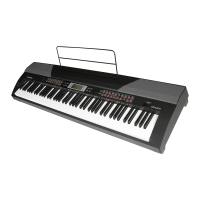
Details on LCD, keys, polyphony, voices, connectors, power, dimensions, and weight.
Lists all available piano and related keyboard instrument voices.
Lists all available chromatic percussion instrument voices.
Lists all available guitar and related stringed instrument voices.
Lists all available string and orchestral instrument voices.
Lists all available bass instrument voices.
Lists all available brass instrument voices.
Lists all available reed instrument voices.
Lists all available pipe organ and flute-like instrument voices.
Lists all available synthesizer lead sounds.
Lists all available synthesizer pad sounds.
Lists all available synthesizer sound effects.
Lists various ethnic and miscellaneous instrument voices.
Lists various sound effects for creative use.
Lists voices that combine multiple instruments.
Lists various traditional Chinese instrument voices.
Lists styles in the 8 Beat musical category.
Lists styles in the 16 Beat musical category.
Lists styles in the Pop and Ballad musical categories.
Lists styles in the Rock musical category.
Lists styles in the Ballroom musical category.
Lists styles in the Dance musical category.
Lists styles in the Soul and Funk musical categories.
Lists styles in Waltz, Traditional, and World musical categories.
Lists styles in the Country musical category.
Lists styles in Latin and Latin Dance musical categories.
Lists styles categorized under Pianist.
Lists classical pieces and tutorial songs for practice.
Lists further tutorial songs and Beyer piano exercises.
Lists the built-in demo songs available on the instrument.
Details MIDI messages transmitted and recognized by the instrument.
 General
| Keyboard | 61 keys |
|---|---|
| Display | LCD |
| Split | Yes |
| Duo (Twinova) | Yes |
| Metronome | Yes |
| Speakers | 2 x 10W |
| Touch Response | Yes |
| Transpose | Yes |
| Tuning | Yes |
| Recording | Yes |
| Effects | Reverb, Chorus |
| Connectivity | USB, MIDI, Headphones |
| Power Supply | AC adapter |

 To Next Page