This measured lead resistance will be subtracted from all
subsequent continuity tests in the (Ω) R switch position. Note that
this lead nulling will not be lost when the instrument is switched
off.
To clear any set nulling, carry out a lead resistance nulling
procedure with the leads open circuit.
Low Resistance continuity measurement (Ω) R
1. If required, firmly short test leads together and null their
resistance as described above.
2. Select
(Ω) R.
3. Firmly connect the two wire lead set terminals across the
isolated circuit.
4. Press the
TEST key. The test result is displayed. The
symbol is displayed if lead resistance nulling has been
set.
Continuity Bleeper (Ω)
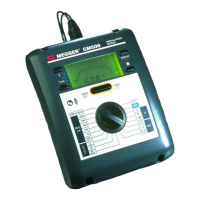
To quickly check continuity of a circuit, the CM500 bleeper will
sound continuously if the resistance between the leads is less
than 100 Ω.
Low input resistance voltmeter (Ω
)
In switch positions other than Continuity Bleeper, the supply
voltage is measured with a high input resistance. This can cause
misleading readings if cables are open circuit. In the Continuity
Bleeper
position, the input resistance is initially about 1 kΩ
. If
external voltage is measured at the terminals, the bleeper
sounds with a slow intermittent tone, and displays the voltage.
This will not damage the instrument, however thermal protective
devices will inhibit immediate use of the Continuity bleeper, for a
short period. If the ‘hot’ symbol is displayed, confirm the
bleeper operation by shorting the test leads and waiting for the
normal continuous bleeper tone.
5Ω Threshold
A lower threshold of 5 Ω can be set by pressing the TEST button.
When this is set, the bleeper will sound with a fast intermittent
tone if the resistance between the leads is between 100 Ω and
5 Ω, and continuously if the resistance is less than 5 Ω. When set
to this mode, the 500 mA fuse is used to protect the instrument
and may be ruptured by connection to a mains supply.
Method of measurement
The 2-wire lead set must be used for this measurement. A d.c.
voltage of nominally 4,5 V with a current limit of approximately
210 mA is used to measure resistance less than about 30 Ω.
Higher resistances are measured with a current limit of 2 mA.
The first measurement is made with current flowing from the
black lead to the red lead, and if
Setting A has been set, a
second measurement will be made with the current reversed.
Possible sources of error
Measurement results can be affected by the following:
• The impedance of operating circuits connected in
parallel.
• Impedance such as inductors that vary during the
measurement.
• A poor connection to the circuit under test, which can
give readings as much as 100 mΩ (0,10 Ω) high. The
best way to avoid this error is to use sharp prods and
press these firmly into the conductors being
measured.
13


 To Next Page