Care and Maintenance
General
CABLES
Always use dust caps. Mate dust caps when cables are
connected. Install dust caps when cables are disconnected.
CONSOLE
If the console is not to be used for an extended period
of time, such as over winter, disconnect and store inside.
Protect main harness 15 pin connector from the weather,
NOTE: Wrap in plastic bag and secure with tape. The
console is not weather resistant. DO NOT expose to
moisture. DO NOT pressure wash the console. Wipe clean
with damp cloth.
SERVO & SOLENOID VALVES
Flush thoroughly with clean water after each use. Drain
completely if you expect freezing temperatures.
FLOWMETER
Flush thoroughly with clean water after each use. When not
in use for an extended period of time, such as over winter,
store inside with plastic plugs installed in ends.
FLOWMETER CLEANING AND REPAIR
IMPORTANT: Opening the flowmeter will void the
Flowmeter Calibration value assigned to your unit.
However, you may need to take the flowmeter apart for
periodic cleaning or to remove an obstruction.
If you can shake the flowmeter from end-to-end to produce
a “rattling” sound (shaft-end play), or if you can blow into the
meter from either end and cause the turbine to spin freely,
your flowmeter DOES NOT need cleaning. If you CANNOT
hear the “rattling” sound or get the turbine to spin freely,
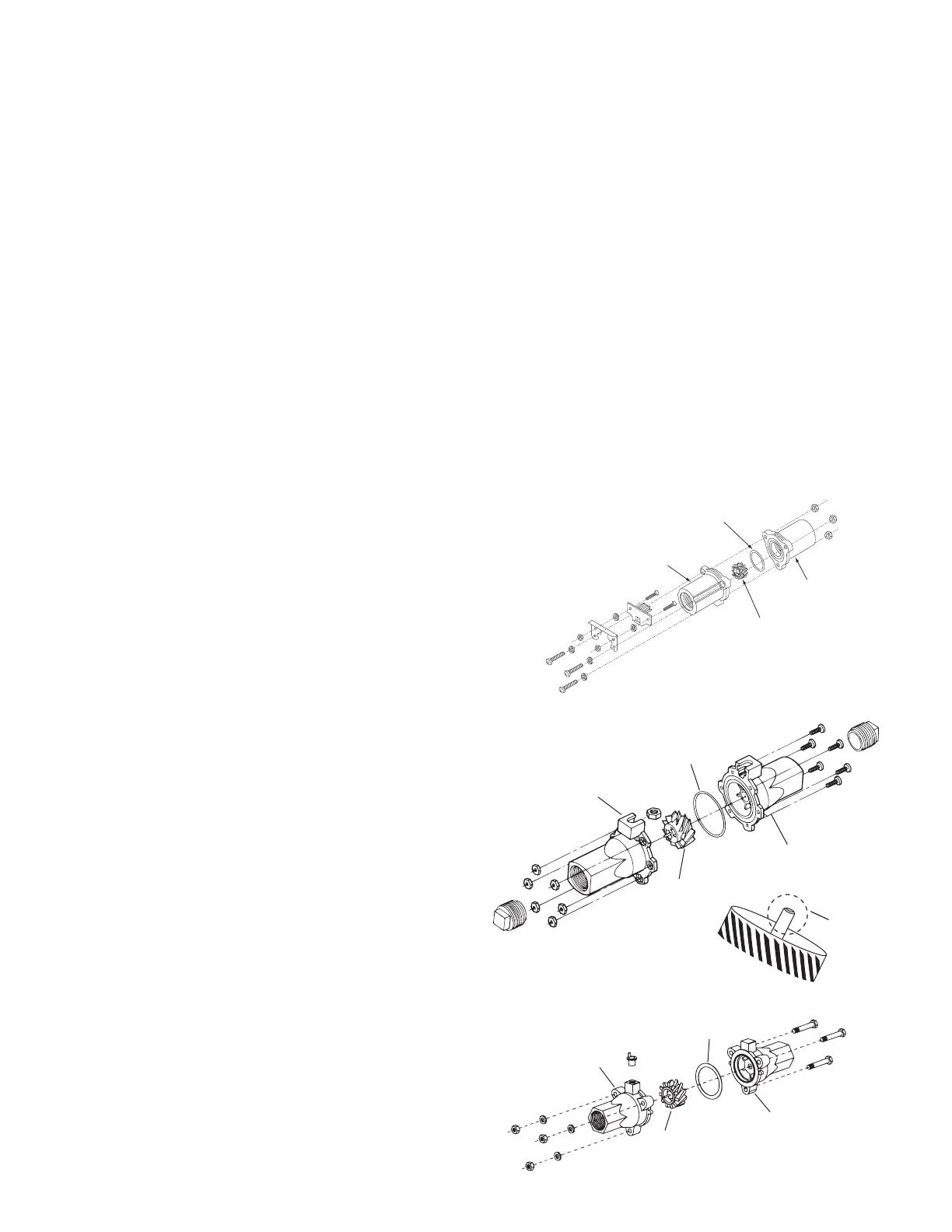
your flowmeter needs to be cleaned. See Illustrations below
for reassembly instructions.
OPENING THE FLOWMETER
Cut the calibration tag retaining wire. Remove the screws
and disassemble the flowmeter. Do not attempt to remove
the sleeve bearings from the flowmeter housing.
Use warm water and if necessary, a mild detergent and a
soft bristle brush to clean all parts. Do not use solvents or
diesel fuel to clean the flowmeter. A magnet works well for
removing fine metallic particles from the turbine.
Inspect all parts. Check for excessive bearing or shaft wear.
The shaft will wear shorter until the turbine drags on the
housing. Illustration to the right shows you what a new shaft
looks like. When the shaft is worn to the point of drag, the
turbine must be replaced.
On a flat surface, place each housing half on end. Set and
spin the turbine in each half. It should spin freely. If it does
not spin freely, remove the turbine, wipe the shaft and try
again. If is still does not spin freely, the shaft or bearings may
have excessive wear. (Service may be necessary.)
Housing FM750 GFN
Turbine
P/N 14836
Quad-ring
P/N 13783
Housing FM750 GFN
(Non Sensor)
Complete Assembly
FM750 GFN Flowmeter
Housing FM750 SS
Turbine
Gasket
Housing FM750 SS
(Non Sensor)
New Shaft
34
Complete Assembly
FM750 SS Flowmeter
COMPLETE ASSEMBLY
FM500 FLOWMETER
P/N 11971
O-RING
P/N 10605
HOUSING FM500
P/N 20187
ROTOR w/MAGNETS
P/N 10598
HOUSING FM500
P/N 20186
ASSEMBLING THE FLOWMETER
Stainless steel meters use a Teflon gasket. Sealants are
normally not required. Plastic meters use an o-ring (Quad-
ring). Apply a small amount of silicon grease for lubrication.
Gaskets and o-rings may be reused several times but
eventually may need replacement.
Place the turbine in the non-sensor housing. Position gasket
/o-ring; carefully place sensor housing over turbine. Drop all
screws into holes. Hold nuts (and lock washers on stainless
meters) in place and finger-tighten screws. Ensure proper
placement of gasket/o-ring and evenly tighten all screws.
Attach tag.
After assembly, shaking flowmeter end-to-end should
produce a “rattling” sound (shaft end play). Blowing into
the meter from either end should cause the turbine to spin
freely. If the turbine only spins from one direction, install the
flowmeter so that the liquid flows in that direction (service
may be required).
For maximum accuracy the flowmeter should be mounted
in a vertical position. Recalibration is required before field
operation.


 To Next Page