Installation Guide
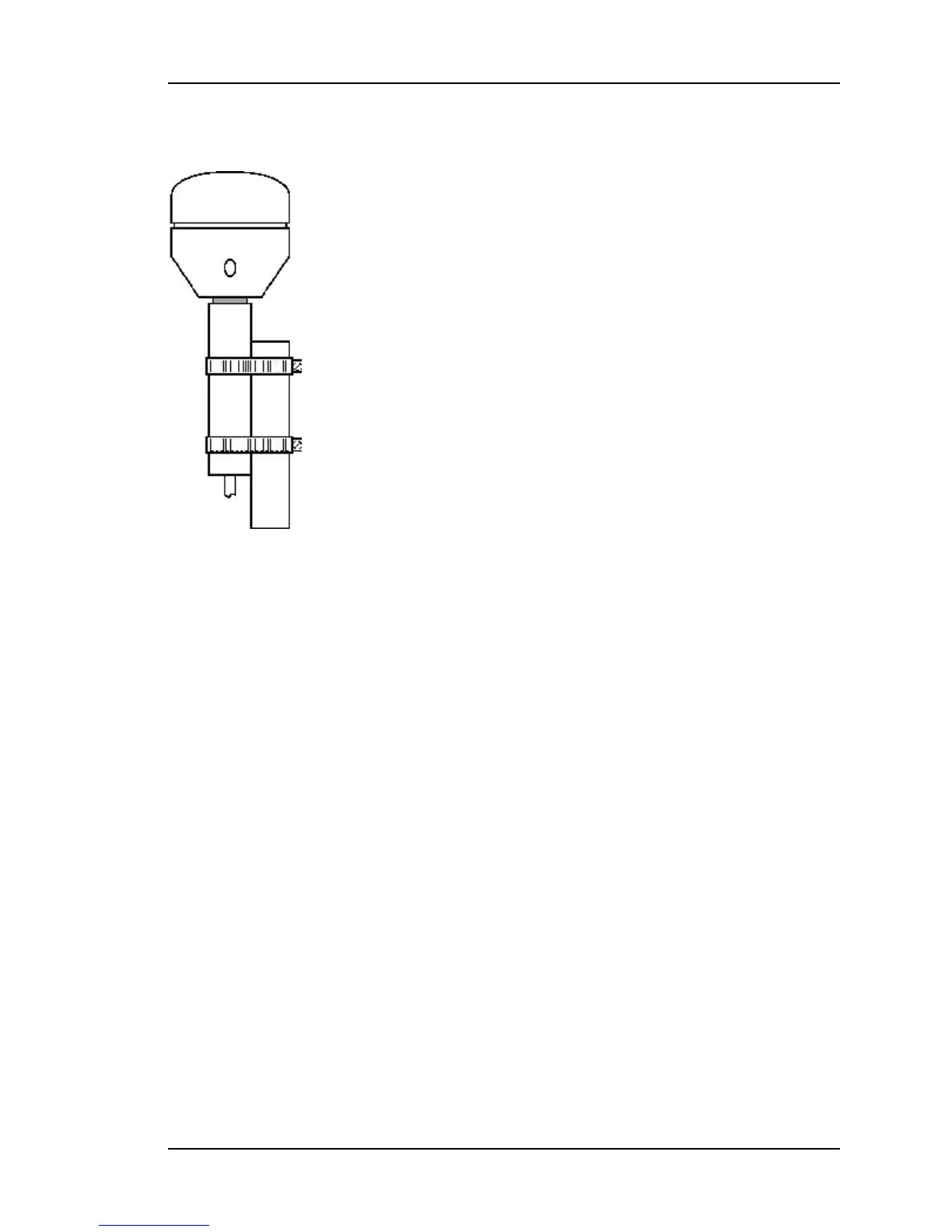
suited to attach the antenna to a vent pipe or mast affixed to the roof. The pipe must be rigid
and able to withstand high winds without flexing.
A typical roof antenna mounting.
GPS Receivers can be susceptible to reflected GPS signals called multipath signals. Mul-
tipath interference is caused by reflected signals that arrive at the antenna out of phase with
the direct signal. This interference is most pronounced at low elevation angles from 10 to 20
degrees above the horizon. The height of the mast/antenna may be extended upward to
lessen multipath interference. The antenna should also be at least three to six feet (1-2 m)
from a reflecting surface.
Use the criteria below to select a good outdoor site for the GPS antenna.
The best locations provide:
n Unobstructed views of the sky and horizon.
n Low electro-magnetic interference (EMI) and radio frequency interference (RFI) - away
from high-power lines, transmitting antennas, and powerful electrical equipment.
n Convenient access for installation and maintenance.
n Reasonable access for the antenna cable to reach the SyncServer.
n Safety from hazards to people and equipment.
Avoid:
n Overhanging foliage
n Blocked views
n Strong EMI RFI interference
n Multipath interference (caused by adjacent structures that reflect GPS signals)
Mounting structures:
n GPS antenna masts, vent pipes, or railings are usually satisfactory.
997-01520-02 Rev. G2.......................................................................... Page 101


 To Next Page