TM-716 Page 1
MSW And LMSW Series
SECTION 1 − SAFETY PRECAUTIONS FOR SERVICING
Protect yourself and others from injury — read and follow these precautions.
1.1 Symbol Usage
OM-716H - 2011−12, safety_spottm 2010−03
DANGER! − Indicates a hazardous situation which, if
not avoided, will result in death or serious injury. The
possible hazards are shown in the adjoining symbols
or explained in the text.
Indicates a hazardous situation which, if not avoided,
could result in death or serious injury. The possible
hazards are shown in the adjoining symbols or ex-
plained in the text.
NOTICE − Indicates statements not related to personal injury.
. Indicates special instructions.
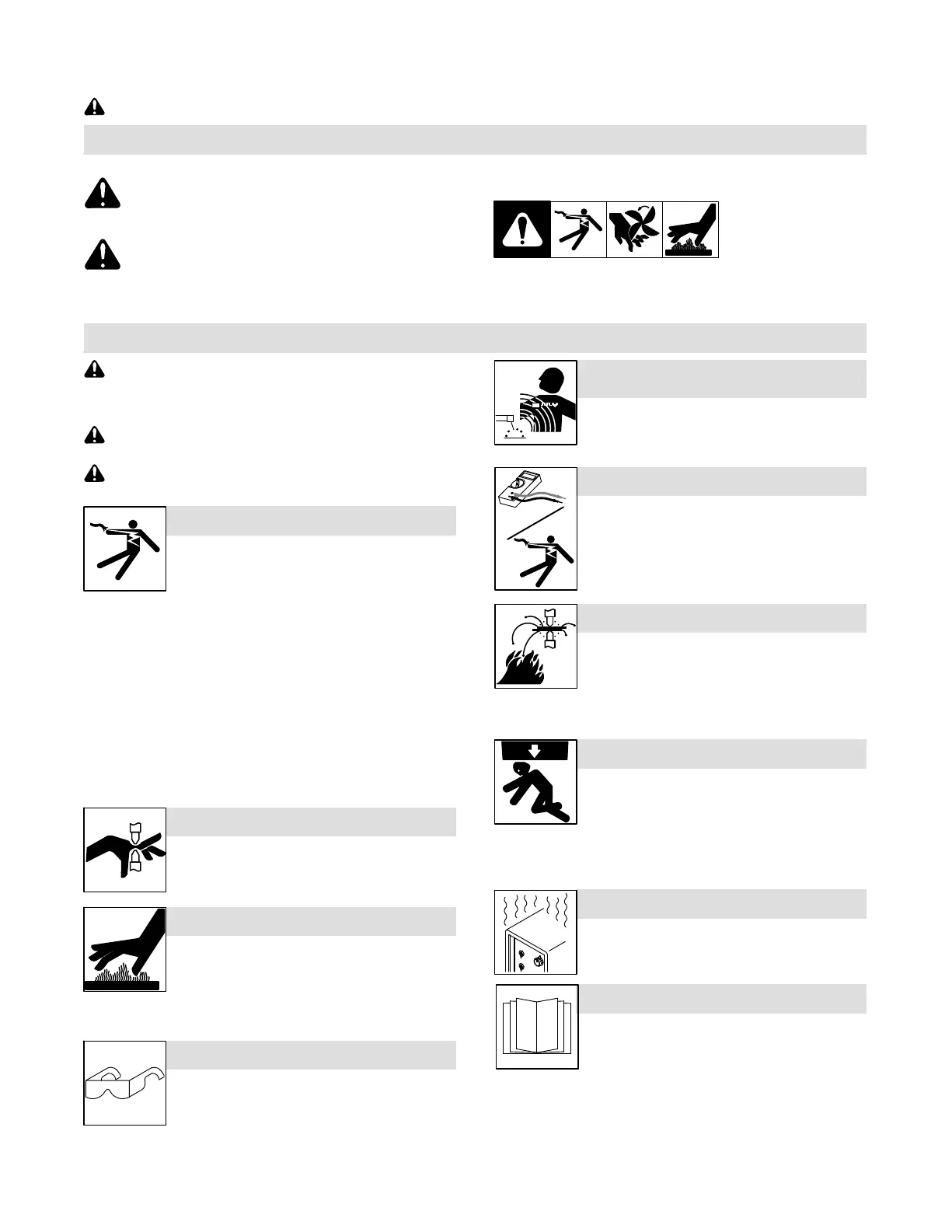
This group of symbols means Warning! Watch Out! ELECTRIC
SHOCK, MOVING PARTS, and HOT PARTS hazards. Consult sym-
bols and related instructions below for necessary actions to avoid
the hazards.
1.2 Servicing Hazards
The symbols shown below are used throughout this manual
to call attention to and identify possible hazards. When you
see the symbol, watch out, and follow the related instruc-
tions to avoid the hazard.
Only qualified persons should service, test, maintain, and
repair this unit.
During servicing, keep everybody, especially children,
away.
ELECTRIC SHOCK can kill.
D Do not touch live electrical parts.
D Turn OFF unit, and disconnect and lockout in-
put power using line disconnect switch, circuit
breakers, or by removing plug from receptacle
before servicing unless the procedure specifi-
cally requires an energized unit.
D Insulate yourself from ground by standing or working on dry in-
sulating mats big enough to prevent contact with the ground.
D Do not leave live unit unattended.
D If this procedure requires an energized unit, have only personnel
familiar with and following standard safety practices do the job.
D When testing a live unit, use the one-hand method. Do not put
both hands inside unit. Keep one hand free.
D Disconnect input power plug or conductors from deenergized
supply line BEFORE moving unit.
MOVING PARTS can injure.
D Do not put hands between tips.
D Keep away from pinch points.
D OSHA and/or local codes may require addi-
tional guarding to suit the application.
HOT PARTS can burn.
D Do not touch hot parts bare handed.
D Allow cooling period before working on
equipment.
D To handle hot parts, use proper tools and/or
wear heavy, insulated welding gloves and
clothing to prevent burns.
FLYING METAL or DIRT can injure eyes.
D Wear safety glasses with side shields or face
shield during servicing.
D Be careful not to short metal tools, parts, or
wires together during testing and servicing.
ELECTRIC AND MAGNETIC FIELDS (EMF)
can affect Implanted Medical Devices.
D Wearers of Pacemakers and other Implanted
Medical Devices should keep away from serv-
icing areas until consulting their doctor and the
device manufacturer.
SHOCK HAZARD from testing.
D Turn Off unit before making or changing meter
lead connections.
D Use at least one meter lead that has a self-
retaining spring clip such as an alligator clip.
D Read instructions for test equipment.
WELDING can cause fire or explosion.
D Protect yourself and others from flying sparks
and hot metal.
D Do not spot weld where flying sparks can
strike flammable material.
D If test welds are required, follow Safety Precautions in Owner’s
Manual and on safety label(s).
FALLING EQUIPMENT can injure.
D Use equipment of adequate capacity to lift and
support the unit.
D Follow the guidelines in the Applications
Manual for the Revised NIOSH Lifting Equa-
tion (Publication No. 94−110) when manually
lifting heavy parts or equipment.
D Secure unit during transport so it cannot tip or fall.
OVERUSE can cause OVERHEATING.
D Allow cooling period; follow rated duty cycle.
D Reduce duty cycle before starting to weld
again.
READ INSTRUCTIONS.
D Use Testing Booklet (Part No. 150 853) when
servicing this unit.
D Consult the Owner’s Manual for welding
safety precautions.
D Use only genuine replacement parts from the manufacturer.
D Read and follow all labels and the Technical Manual carefully
before installing, operating, or servicing unit. Read the safety
information at the beginning of the manual and in each section.




 To Next Page