EasyManua.ls Logo

Miller TRAILBLAZER 302 AIR PAK - User Manual

Miller TRAILBLAZER 302 AIR PAK
76 pages
Print Icon
To Next Page IconTo Next Page
Loading...
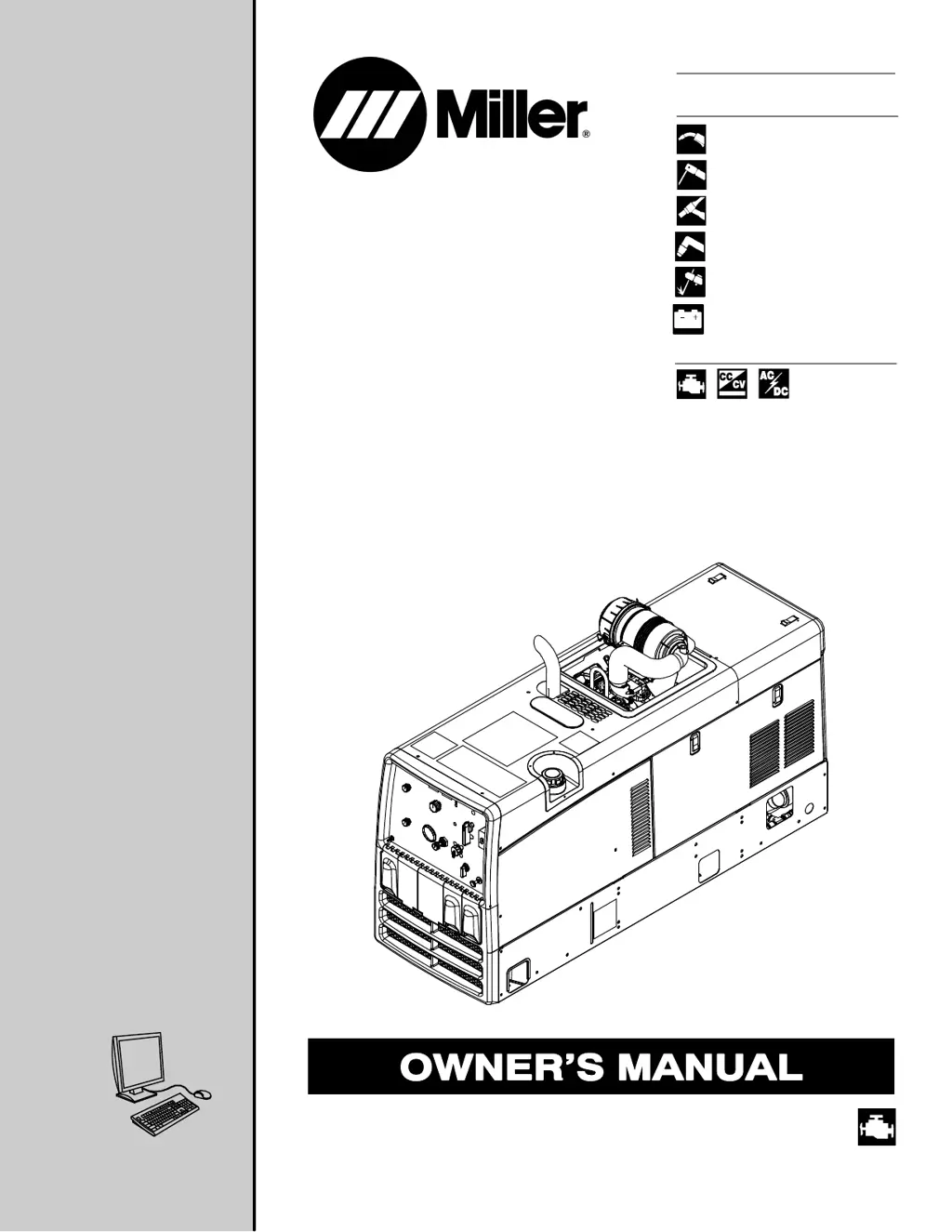
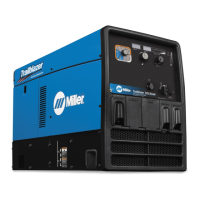
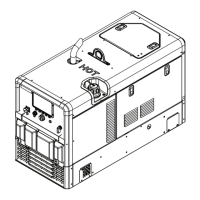
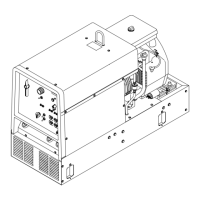
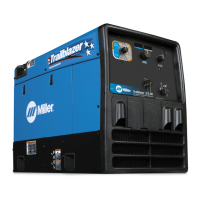
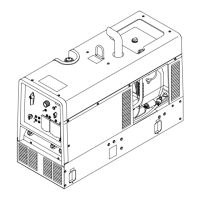
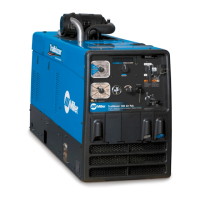
Trailblazer 302 Air Pak
Processes
Description
TIG (GTAW) Welding
Stick (SMAW) Welding
MIG (GMAW) Welding
Flux Cored (FCAW)
OM-229 930K
201111
Air Plasma Cutting and Gouging
with Spectrum
Unit
Air Carbon Arc (CAC-A) Cutting
and Gouging
Visit our website at
www.MillerWelds.com
File: Engine Drive
Engine Driven Welding Generator And
Air Compressor
Battery Charging

Table of Contents

Questions and Answers

Summary

Section 1 - Safety Precautions

1-1. Symbol Usage

Explains the meaning of DANGER, WARNING, and NOTICE symbols used in the manual.

1-2. Arc Welding Hazards

Details electrical, hot parts, and flying debris hazards during arc welding.

1-3. Engine Hazards

Covers hazards related to the engine, including battery explosion, fuel, and moving parts.

1-4. Hydraulic Hazards

Details dangers associated with hydraulic equipment and fluid.

1-5. Compressed Air Hazards

Outlines risks associated with compressed air systems.

1-6. Additional Symbols For Installation, Operation, And Maintenance

Explains symbols related to installation, operation, and maintenance.

1-7. California Proposition 65 Warnings

Provides warnings required by California Proposition 65 regarding chemicals.

1-8. Principal Safety Standards

Lists key safety standards and organizations.

1-9. EMF Information

Discusses electromagnetic field (EMF) information and precautions.

Section 3 - Definitions

3-1. Symbol Definitions

Defines various symbols used in the manual.

Section 4 - Specifications

4-1. Weld, Power, And Engine Specifications

Lists technical specifications for welding, power, and engine.

4-2. Air Compressor Specifications

Details specifications for the air compressor system.

4-3. Battery Charger Specifications

Provides specifications for the battery charging system.

4-4. Sound Level Table - 7 Meter (23 Ft)

Presents sound level data at different operating conditions.

4-5. Dimensions, Weights, and Operating Angles

Lists physical dimensions, weight, and operating angle limits.

4-6. Fuel Consumption Curves

Shows fuel consumption rates for welding, auxiliary power, and compressor.

4-7. Generator Power Curve

Illustrates the AC generator power output capability.

4-8. Duty Cycle

Explains duty cycle and its impact on welding operations.

4-9. Stick And MIG Mode Volt-Ampere Curves

Shows voltage and amperage output curves for Stick and MIG modes.

4-10. TIG Mode Volt-Ampere Curves

Displays voltage and amperage output curves for TIG welding.

Section 5 - Installation

5-1. Serial Number And Rating Label Location

Explains where to find serial and rating information.

5-2. Installing Welding Generator

Provides guidance on moving, mounting, and positioning the generator.

5-3. Grounding Generator To Truck Or Trailer Frame

Details procedures for grounding the generator to a vehicle frame.

5-4. Engine Prestart Checks

Lists essential checks before starting the engine.

5-5. Compressor Prestart Checks

Outlines pre-operation checks for the air compressor.

5-6. Connecting the Battery

Instructions for connecting the battery to the unit.

5-7. Installing Exhaust Pipe

Guidance on correctly installing the exhaust pipe.

5-8. Weld Output Terminals

Identifies and explains the weld output terminals.

5-9. Connecting To Weld Output Terminals

Details how to connect weld cables to output terminals.

5-10. Selecting Weld Cable Sizes

Provides a guide for selecting appropriate weld cable sizes.

5-11. Remote Receptacle Information

Describes the remote receptacle and its socket functions.

5-12. Connecting To The Air Compressor

Instructions for connecting the air compressor hose.

Section 6 - Operating Welding Generator

6-1. Engine Controls

Explains the function of various engine control switches and settings.

6-2. Engine Cold Weather Operation

Provides guidance for operating the engine in cold weather conditions.

6-3. Voltage;Amperage Control

Details how to use the voltage and amperage control knob.

6-4. Process;Contactor Switch

Explains the functions of the process and contactor switch.

6-5. Stick Scratch Start

Describes the procedure for starting a stick weld arc.

6-6. Lift-Arc TIG With Auto-Crater And Auto-Stop

Explains the Lift-Arc TIG process with Auto-Crater and Auto-Stop features.

6-7. Remote Voltage;Amperage Control

Details how to connect and use a remote voltage/amperage control.

Section 7 - Compressor Operation

7-1. Air Compressor Switch

Explains the operation of the air compressor switch and displays.

7-2. Air Compressor Gauge And Regulator

Details the air compressor pressure gauge and regulator adjustment.

7-3. Air Compressor Overload Protection

Discusses overload protection mechanisms for the compressor.

7-4. Compressor Blow Down

Explains the compressor blow down procedure.

7-5. Compressor Cold Weather Operation (Models With Air Dryer)

Provides instructions for operating the compressor in cold weather.

Section 8 - Battery Charging

8-1. Battery Charging Guidelines

General guidelines for safe and effective battery charging.

8-2. Connecting Uninstalled Battery To Battery Charge Receptacle

Step-by-step instructions for connecting an external battery.

8-3. Connecting Installed Battery To Battery Charge Receptacle

Instructions for connecting a battery already installed in a vehicle.

8-4. Setting Battery Charge Controls

How to set up controls for battery charging.

8-5. Setting Battery Jump-Start Controls

How to set up controls for jump-starting a battery.

Section 9 - Operating Auxiliary Equipment

9-1. Generator Power Receptacles And Supplementary Protectors

Details the generator's power receptacles and protective devices.

9-2. Simultaneous Weld And Power

Shows combined weld and power output capabilities.

9-3. Wiring Instructions For Optional 240 Volt, Single-Phase Plug (NEMA 14-50 P)

Instructions for wiring a 240V plug for various load types.

Section 10 - Generator;Engine Maintenance

10-1. Maintenance Label

Explains the engine maintenance schedule and label information.

10-2. Routine Generator;Engine Maintenance

Outlines routine maintenance tasks and schedules.

10-3. Servicing Air Cleaner

Instructions for cleaning or replacing the air cleaner element.

10-4. Changing Engine Oil, Oil Filter, And Fuel Filter

Steps for changing engine oil, oil filter, and fuel filter.

10-5. Overload Protection

Details overload protection devices and their functions.

10-6. Servicing Optional Spark Arrestor

Instructions for servicing the optional spark arrestor.

Section 11 - Air Compressor Maintenance

11-1. Maintenance

Overview of air compressor maintenance schedule.

11-2. Replacing Optional Air Dryer Filter (Separator)

Steps for replacing the air dryer filter.

11-3. Compressor Maintenance Label

Explains the compressor maintenance label information.

11-4. Servicing Compressor Air Cleaner And Air;Oil Separator

Instructions for servicing the air cleaner and air/oil separator.

11-5. Changing Air Compressor Oil And Filter

Steps for changing the compressor oil and filter.

Section 12 - Troubleshooting

12-1. Front Panel Display Code Information

Explains codes displayed on the front panel.

12-2. Front Panel Display Code Information For Battery Charger

Details display codes specific to the battery charger function.

12-3. Welding Troubleshooting

Provides troubleshooting steps for welding output issues.

12-4. Generator Power Troubleshooting

Troubleshooting tips for generator power output problems.

12-5. Engine Troubleshooting

Troubleshooting steps for engine-related issues.

12-6. Compressor Troubleshooting

Steps for troubleshooting air compressor problems.

12-7. Battery Charge;Jump Troubleshooting

Troubleshooting for battery charging and jump-start functions.

Section 13 - Parts List

13-1. Recommended Spare Parts

Lists recommended spare parts for the equipment.

Section 14 - Electrical Diagrams

Figure 14-1. Circuit Diagram For Welding Generator

Presents the overall circuit diagram for the welding generator.

Section 15 - Generator Power Guidelines

15-1. Selecting Equipment

Guidance on selecting appropriate electrical equipment.

15-2. Grounding Generator To Truck Or Trailer Frame

Procedures for grounding the generator to a vehicle frame.

15-3. Grounding When Supplying Building Systems

Instructions for grounding the generator to building systems.

15-4. How Much Power Does Equipment Require?

Explains how to calculate power requirements for equipment.

15-5. Approximate Power Requirements For Industrial Motors

Lists approximate power needs for various industrial motors.

15-6. Approximate Power Requirements For Farm;Home Equipment

Shows approximate power requirements for farm/home equipment.

15-7. Approximate Power Requirements For Contractor Equipment

Lists approximate power requirements for contractor equipment.

15-8. Power Required To Start Motor

Details power needs for starting single-phase induction motors.

15-9. How Much Power Can Generator Supply?

Discusses generator output capacity and load management.

15-10. Typical Connections To Supply Standby Power

Illustrates typical connections for standby power supply.

15-11. Selecting Extension Cord (Use Shortest Cord Possible)

Guide for selecting appropriate extension cords based on load and length.

Miller TRAILBLAZER 302 AIR PAK Specifications

General IconGeneral
Air CompressorYes
Fuel Capacity12 gallons
Welding ProcessesStick (SMAW), TIG (GTAW), MIG (GMAW), Flux-Cored (FCAW)
Generator Power10, 000 Watts
EngineKohler
Welding Amperage Range300 A
Dimensions56 in.
Rated Output300 A
Generator Output13, 000 watts peak
Voltage Output120/240V
TypeEngine Driven Welding Generator

Related product manuals