Charging termination modes:
1. Temperature Arise Detection (T/t), JP1 jumper in the default position. The battery temperature increases more
quickly when the battery is fully charged. If the speed of temperature increase inside the battery pack exceeds a certain
value then the charging process is terminated. The charging controller (U5) samples the thermistor voltage (NTC)
every 34 sec., and compares it to the value measured two samples earlier. If the voltage has fallen 16mV 4mV or
more, the fast charge is terminated.
2. Peak Voltage Detection (PVD), JP1 jumper in the other possible position: The battery’s voltage decreases slightly
when it is fully charged. In this charging-mode, the microcontroller checks the battery voltage and terminates the
charging process in the event that the voltage on the battery pack decreases by more than the preset limit, that limit is
configured by the position of the jumper: In this mode, the battery’s voltage is the criteria for terminating the charging
process. If the voltage decreases by 36mV 4mV in 34 seconds this means that the battery is fully charged, and the
controller then terminates the charging process.
3. Decrease Voltage Detection (-V), no JP8 jumper. This mode is correspondent to the PVD-mode, but at higher
sensibility, because the charging process ends at a voltage decrease of 18mV 2mV in 34 seconds.
Caution
In case high power while charging is required (i.e. when printing), the battery’s voltage decreases. In this case
using the modes Peak voltage Detection or -V the charging process will be terminated, although the battery is
not fully charged.
The factory setting is designed for the T/t Termination mode and is not to be changed to avoid the above-
mentioned problems!
Charging phases:
1. After connecting the battery charger to the unit, the CHARGE_LED starts flashing for few seconds. In this period,
the battery is charged in pulses at a low frequency and the battery’s response is monitored. If the LED continues to
flash this shows that the battery’s temperature is out of range or the battery voltage is too low. In this case, the
controller enters the charge pending state and waits for both conditions to fall (temperature) or rise (voltage) within
their allowed limits. There is no time limit on the charge pending state; the charger remains in this state for as long as
the voltage or temperature conditions are outside of the allowed limits. If the voltage is too high, the controller goes to
the battery absent state and waits until a new charge cycle is started.
2. If everything is in order (battery temperature, temperature rising, battery voltage etc.) then the fast charging process
starts, the LED lights continuously. In the following 10 minutes, the battery is charged at a lower rate to initialize
slowly the chemical reaction inside the battery pack. After about 10 minutes, high-frequent pulses at the full current
rate of 1A charge the battery.
3. At the end of the regular charging process, the CHARGE_LED lights green continuously. Now it can be assumed that
the battery is fully charged.
4. If after completing the charging process the battery charger is still connected, a so-called Pulse-Trickle-Function is
activated that gives a very low charge to compensate the self-discharging of the battery while it is idle connected to the
charger.
2.1.2. Room temperature sensor
(IC7) DALLAS DS 18B20 to measure the ambient (room) temperature to enable the calculation of the BTPS conversion
factor.
2.1.3. USB communication port
Version 2.0.
2.1.4. Oximetry port
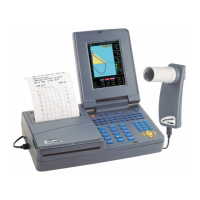
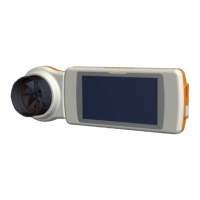
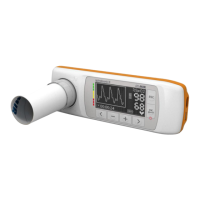
Many sensors can be used on Spirolab
based on the type of test to be performed and on the patient characteristics.
The manufacturer provides the most frequently used sensor with the device, which has the following features:


 To Next Page