-27-
Braking Systems - Hydraulic
Hydraulic Disc Brakes
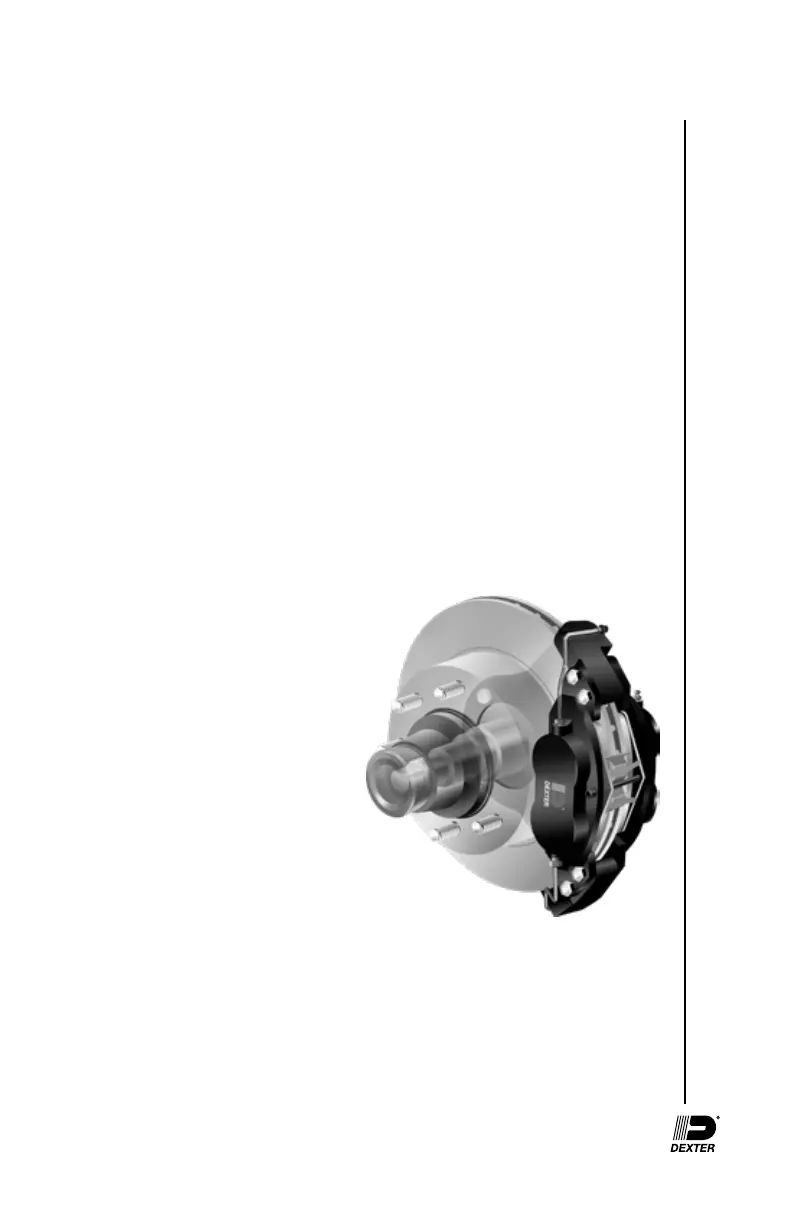
Dexter manufactures two types of disc brakes, the oating caliper and the
xed caliper brake. With both styles, the disc brake uses friction pads astride a
ventilated rotor which is attached to the wheel hub. When the brake is actuated,
the pads are pressed against the sides of the rotor causing drag to slow the
rotating disc. This action converts the kinetic energy (motion) into heat. The heat
is dissipated rapidly by the ventilated disc.
The oating caliper brake uses piston(s) situated on one side of the brake
rotor. Hydraulic uid pressure pushes against the piston(s) to apply the inboard
brake pad. As the inboard pad exerts force against the rotating rotor surface,
the caliper moves laterally towards the trailer frame and in turn applies an
equivalent force to the outboard brake pad against the rotor surface. As the
lining material wears, the caliper will automatically maintain the proper lining to
rotor clearance. The oating caliper design is used on Dexter 3,500 lb., 10,000
lb. and 12,000 lb. axle models.
The xed caliper method uses pistons situated on both sides of the rotor. During
actuation, hydraulic pressure pushes against the pistons to apply the inboard
and outboard brake pads equally to decelerate the rotating rotor. The caliper is
xed and stays stationary during brake
actuation and brake adjustment. Brake
pad to rotor clearance is maintained
as lining wear occurs via the brake
piston and internal caliper seal. The
xed caliper design is used on the
Dexter 6,000, 7,000 and 8,000 lb. axle
models.
Disc brake effectiveness is the same
going either in a forward or reverse
direction. All Dexter disc brakes should
be actuated with a braking system that
is capable of providing a maximum
hydraulic pressure of 1,600 psi.


 To Next Page