8
NON OPTIMAL combustion, the flame is too stretched and a large
amount of burning pellets are blown out of the burner.
• Regulation on models with FCS: Reduce the MCS Calibration
setting one point at a time (from 0 to +5) until the example 3
condition is achieved.
• Manual regulation on models without FCS: Reduce the Fan
Calibration setting one point at a time (from 0 to +5). If it is not
enough, increase the Auger Calibration setting one point at a
time (from 0 to -5) until the example 3 condition is achieved.
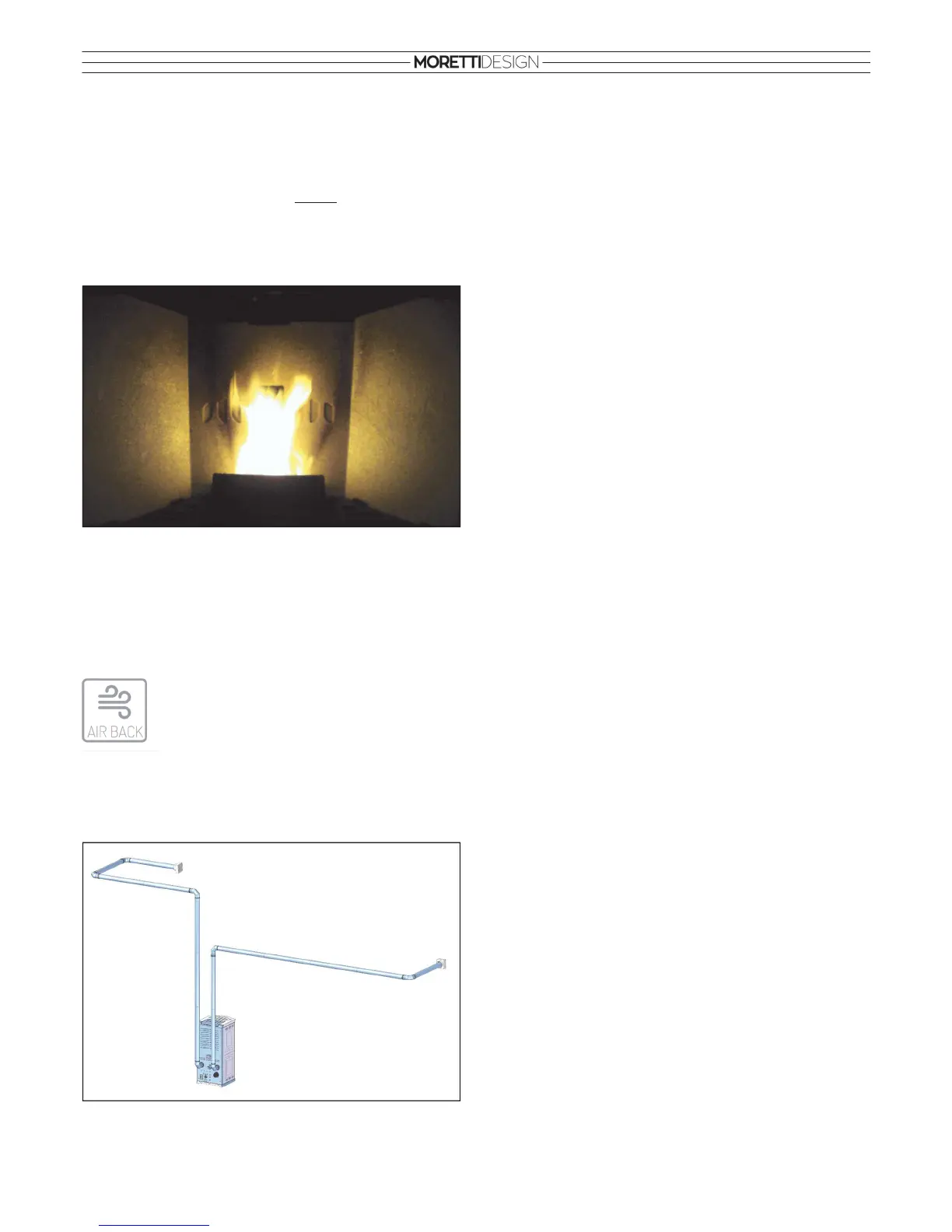
Example 3
OPTIMAL combustion, the flame is vibrant of a yellow/white colour with
a small amount of burning pellets inside the burner. It is not necessary to
adjust any settings in the Calibration menu.
For all three of the examples, it is advised to evaluate on the spot all
necessary adjustments.
CONNECTION AND DESCRIPTION ON HOW A
DUCTED STOVE OPERATES
Ducted pellet stoves include, in addition to the front
ventilator, also ventilators dedicated for ducting warm air.
There are models where there is only one ventilator
installed, these stoves are equipped with a single hot air
duct, while there are other models where there are two
ventilators installed, these stoves are equipped with two
hot air ducts.
The ducts for conveying warm air from the stoves output (80 mm) must
not exceed 7 meters in length and must not have more than 4 curved
sections. We recommend the use of smooth insulated rigid steel pipes.
YES
Optional
For a proper use of a ducted stove, it is appropriate that for each ducted
output a room sensor (model NTC 10k at 25°) or an ON/OFF thermostat
or a wireless thermostat is connected. A stove without the above
components connected can never go into Modulation. Observe the
technical data sheet on the product manual in order to verify where the
connecters for connecting the sensors or thermostats are located on the
back of the stove.
How a ducted stove operates
Assuming to use a stove with two ducted outputs complete with
thermostats or sensors connected, if we set one of the thermostats at
18°C, the other at 19°C, the local room temperature thermostat at 20°C
and the combustion power at P5, the behaviour of the stove will be the
following:
When one of the three environments reaches the set temperature, the
fan for that environment will run at minimum power while the stove will
automatically lower the combustion power level to P4 and the other fans
will run at the speed of the new power level set (P4).
When a second room reaches the set temperature, the fan relative to
that environment will run at minimum power as the stove will
automatically lower the combustion power level to P3 and the remaining
fan will run at the speed of the new power level set (P3).
When the third and last environment reaches the set temperature, the
relative fan will operate at a minimum and the stove will go into
Modulation.
That being said, if the ducted outputs are not connected to a thermostat,
the fans will always run at the set power level and the stove will never go
into Modulated.
The fans of the ducted outputs can not be excluded or deactivated,
because if they are switched off it would cause an overheating of the
stove with possible damage to the structure of the stove itself and the
fans.
The fan speeds can not be adjusted by the user, for each combustion
power level the fans turn at a relative speed.
Pot: Auto setting on ducted stoves
It is possible to select automatic combustion (Pot: Auto) in the same way
a combustion power is selected. By selecting Pot: Auto on a ducted
stove, the system automatically regulates the combustion power level
and adjusts it to the room temperature set on the display radio. As a
result, the speed of the heating fans (front + ducts) will adjust to the
power level as the room temperature approaches the set temperature.
Once the room temperature reaches the one set on the display radio, the
ducted stove heating fans (front + ducts) will run at the minimum speed.
EXAMPLE


 To Next Page