3
Description of the stove
The pellet stove is a heat generator capable of heating air
through the combustion of wooden pellets. The fuel is
loaded in an automated manner. The air present in the
environment is heated by the flame, produced by the
combustion of the pellets, and circulates in the room thanks to the
ventilator. This ventilator emits warm air directly into the room where the
stove is installed.
The safe use of the heater is guaranteed by the fact that on all Moretti
Design products, CE certified systems are installed and they control all
functions and parameters. The advanced software allows for the user a
more simple and immediate comprehension of the heaters functions.
The presence of a thermostat on all Moretti Design products allows the
user to program the on/off switching function of the stove. The large
pellet tank allows for a long period fuel loading procedure, avoiding this
way that the user has to refill the tank too often. The large ash drawer
allows the user to empty it just once a week when it is filled with ash (the
frequency of the operation may vary depending on how long the stove is
used and the quality of the pellets).
INSTALLATION
The stove must be placed on a floor with an adequate load
capacity. If the building does not meet this requirement,
appropriate measures (e.g. load distribution plate) must be taken.
The installation of the stove must ensure an easy access for
cleaning the heater, the flue and the chimney.
The presence of extraction fans in the same room or environment
where the appliance is installed in, can cause problems and should
therefore be avoided.
It is prohibited to install the stove in a small rooms or bedrooms. It
is forbidden to install the stove in rooms exposed to a high risk of
fire, in rooms with an explosive atmosphere or where other heat
generators are already present whose simultaneous presence is
not compatible according to standard regulations.
All local regulations and European standards must be met when the
stove is installed.
Supply conditions and unpacking
The stove is delivered packed together with its aesthetic components. To
unpack the stove, cut the straps and remove the box. Use the proper
equipment for lifting the appliance from the wooden pallet.
Assembling
For the installation of the stove, contact an authorized technician (the
penalty otherwise would be the void of the warranty).
Combustion air
A poor combustion can be caused by poor air circulation in the room and
this often occurs in modern homes that have sealed doors and windows.
The situation also becomes problematic when, on the contrary, there are
air currents inside the room (generated for example by fans). To avoid
this type of disadvantage, it is recommended to install a permanent
ventilation grid in a window or near the stove.
If there is no possibility of connecting the air intake directly to the outside
(see next paragraph), it is imperative to drill a hole on the wall for the
combustion air inlet for both health and safety reasons. It is
recommended the installation of an air grid over the opening and it must
be kept clean.
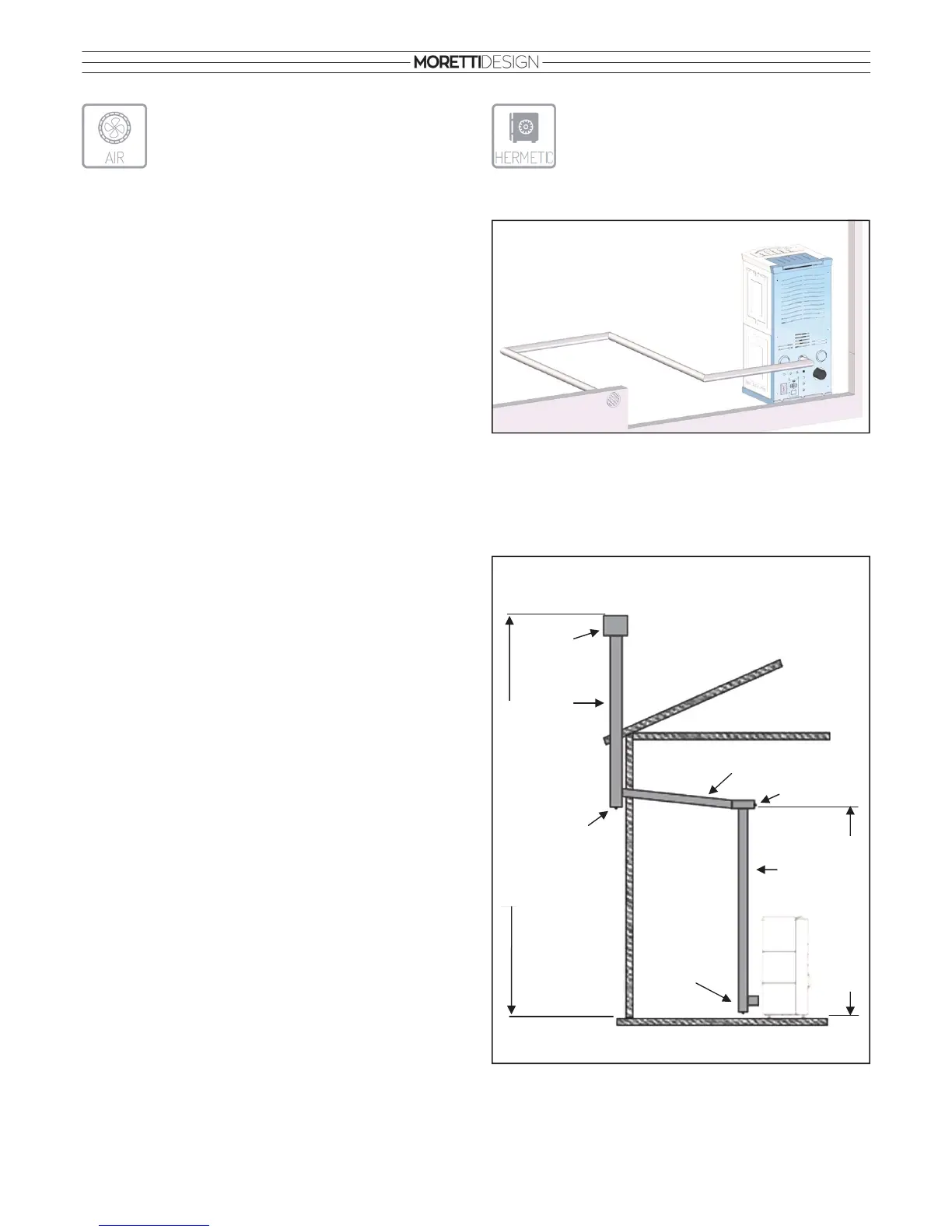
Combustion air for a hermetic installation
The air required for the combustion must be drawn
directly from the outside through a tube with a 60mm
diameter. The tube must not exceed 5m in length and
must not have more than 4 curves with a 90° angle. It is
recommended the installation of an air grid over the opening and it must
be kept clean (see the following example).
Fume exhaust
To extract the exhaust fumes, a flue must be installed in compliance with
standard regulations. The stove was not designed to share the flue with
other appliances.
Installation examples
EXAMPLE
DIMENSIONAL LIMITS
PROTECTION
CAP
INSULATED
CHIMNEY
FLUE
INSULATED “T” WITH
INSPECTION CAP
MAXIMUM LENGTH OF HORIZONTAL
STRETCH 3 METERS
MINIMUM SLOPE 5%
“T” WITH
INSPECTION
CAP
CHIMNEY
FLUE
“T” WITH
INSPECTION CAP
MINIMUM TOTAL HEIGHT 4 METERS
MINIMUM HEIGHT 1,5 METERS



 To Next Page