2-19
2.10 OPERATOR’S SEAT Applicable to Cab Specifications
• Adjust the operator’s seat before operations. Always adjust the operator’s seat after it has been used by another
operator.
• Adjust the operator’s seat so that you can operate the travel lever easily with your back against the seat backrest.
• Never adjust the seat when traveling.
• Always lower the armrest before starting operation. The armrest is installed to prevent the danger of the operator
falling from the operator’s seat if the machine tips at an angle when traveling.
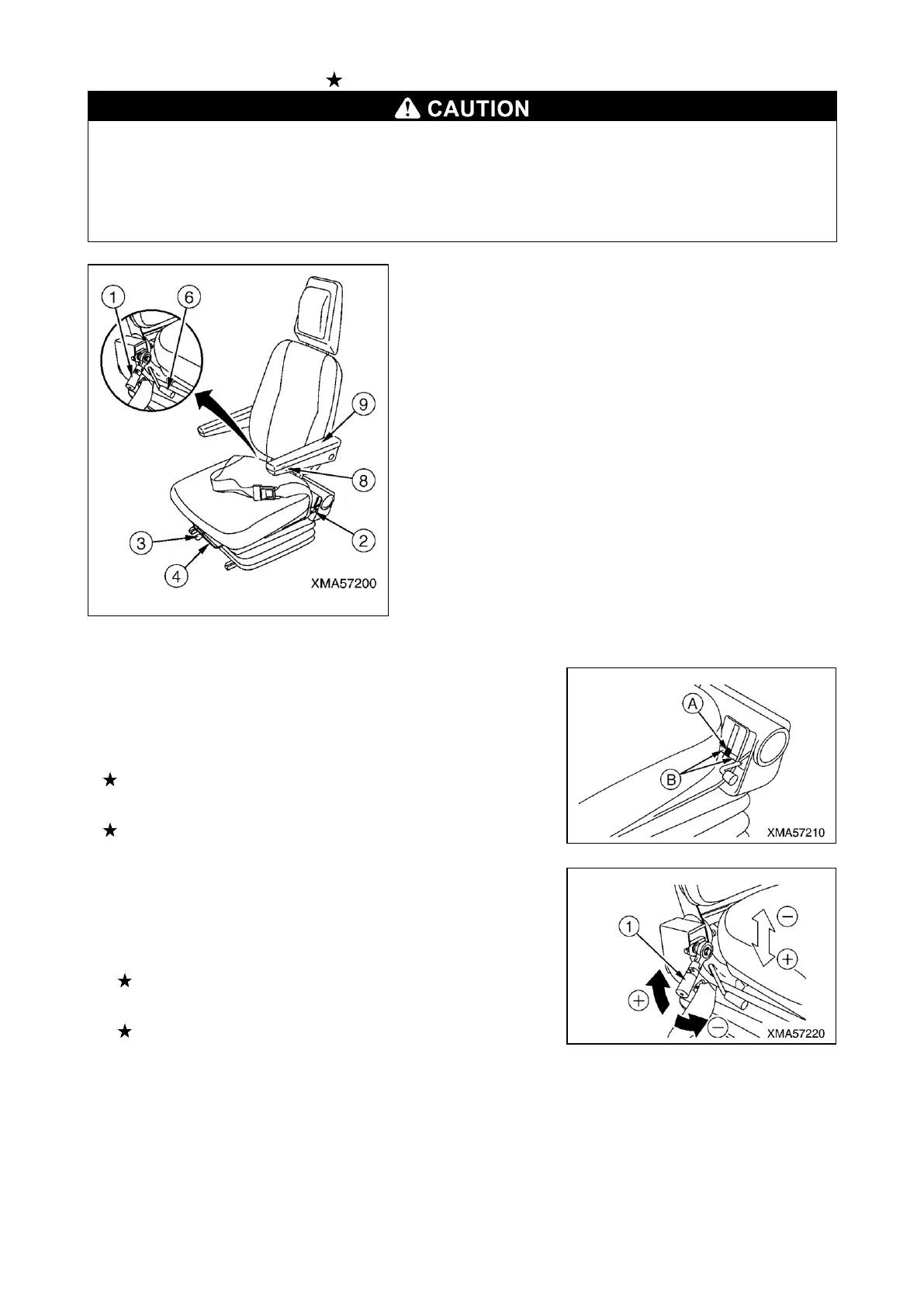
(1) Suspension adjustment lever
(2) Reclining adjustment lever
(3) Front-rear slide lever
(4) Seat front height adjustment lever
(6) Seat rear height adjustment lever
(8) Arm rest height adjustment dial
(9) Arm rest
[1] ADJUSTMENT OF SEAT SUSPENSION (hardness)
Sit in the seat, use suspension adjustment lever (1) at the seat right back side
to adjust the suspension.
1. Sit in the seat, make sure that indicator (A) (in red) at the left side of the seat
aligns with red line (B) on the frame.
That indicator (A) aligns with red line (B) brings the most comfortable
hardness of the seat.
The position of indicator (A) changes according to the weight of an
operator on the seat. A lighter weight can move the indicator below red
line (B), and a heavier weight can move it above red line (B).
2. Sit in the seat, and if indicator (A) does not aligns with red line (B), use lever
(1) to adjust the suspension.
(1) Stretch and rotate the grip of lever (1) to select mark "+" or "-" in black.
"+": Select this if indicator (A) is below red line (B). The seat becomes
harder.
"-": Select this if indicator (A) is above red line (B). The seat becomes
softer.
(2) Hold the grip of lever (1) to move it up and down while looking at indicator
(A), and keep moving it until gauge (A) aligns with red line (B).


 To Next Page