Operation
C2 Contour Air Drill August 2014 5-21
Opener Hydraulics
The Contour openers can be operated using two methods as described in the operators manual as Normal Operation
and Pressure Adjustment (On the go).
The following is the oil ow for both operating types and can be used for problem diagnosis.
Normal Operation
The opener ball valve is in the unlocked position. This ball valve is open. The operation valve is screwed in fully to
the operating position. This needle valve is closed.
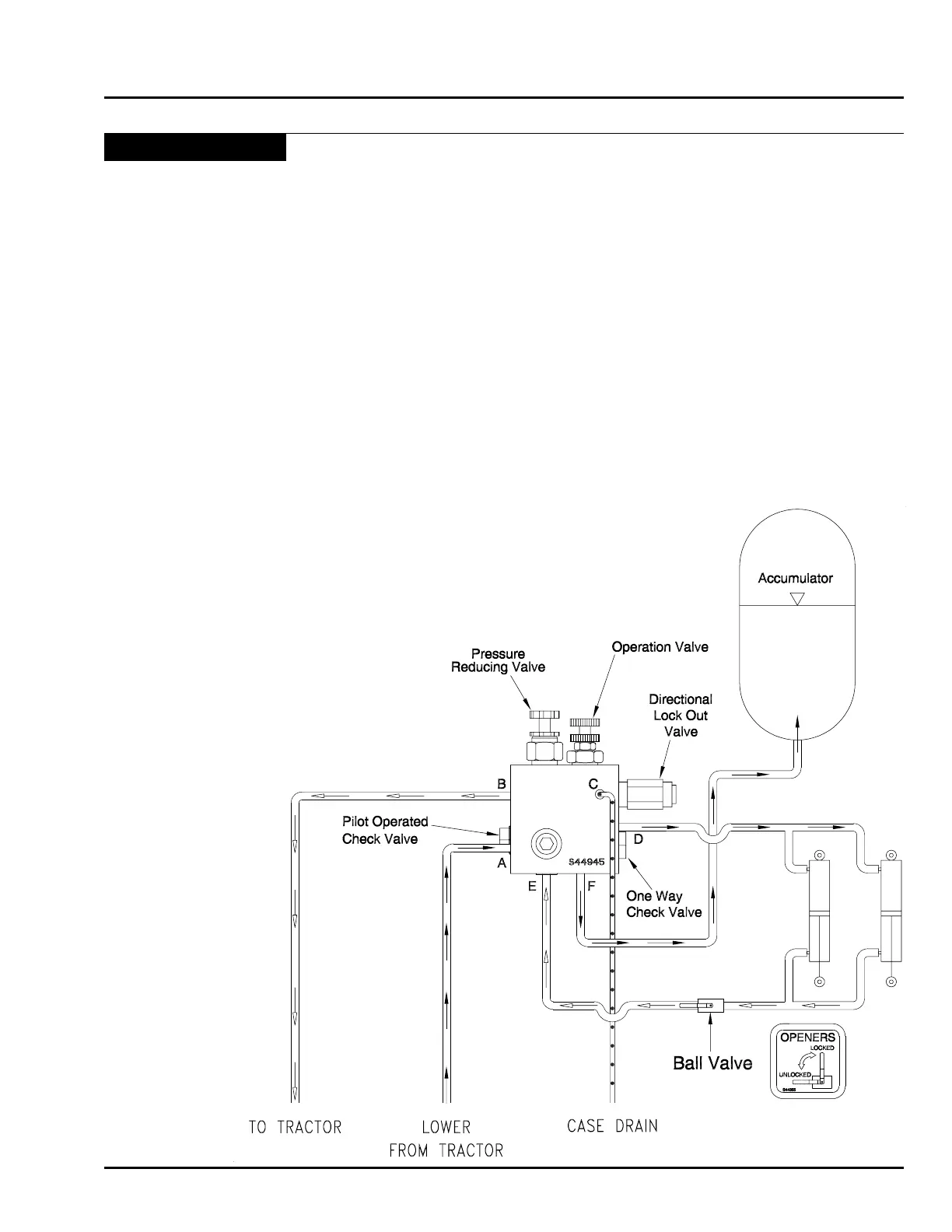
To lower the openers, oil ows through the hose to port “A” of valve block. The oil is allowed to ow simultaneously
through ports “D” and “F”. Port “F” charges up the accumulator to operating pressure set by the pressure valve. Port
“D” charges the butt end of the opener cylinders causing the openers to lower.
Once the operating pressure is reached the oil will stop owing.
From port “A” of valve block, oil ows through the pressure reducing valve, to the pilot operated check valve unseating
the check valve and out of Port “D” to the butt end of the opener cylinders causing the openers to lower. Simultaneously,
oil ows from the check valve through the directional lock out valve and out of Port “F” to the accumulator.
When all of the opener cylinders are extended to working position, the hydraulic pressure
continues to build in the accumulator, hydraulic lines, cylinders and at the reducing valve.
When the pressure has risen to what the reducing valve has been set to the reducing
valve closes, preventing a further increase in pressure.
When the hydraulic ow to the pilot operated check valve is stopped, the check valve
seats, holding the pressure in the opener circuit.
The oil returning from the gland side of the
cylinders ows to the opener ball valve into
port “E” of the valve block and out of port “B”
back to the tractor.


 To Next Page