The MSA V-TEC® Personal Fall Limiter (PFL) is a crucial component in fall protection systems, designed to connect a full body harness to an anchor point. It is intended for single-user applications within a weight range of 77–310 lbs (35–140 kg), including the user, clothing, and tools. The device is specifically for non-leading edge applications, and its use in leading edge scenarios is strictly prohibited due to the risk of webbing breakage.
Function Description:
The V-TEC PFL acts as a retractable type fall arrester, automatically extending and retracting its lifeline to allow freedom of movement while maintaining tension. In the event of a fall, the device is designed to lock on, arresting the fall and deploying an internal energy absorber to mitigate fall arrest forces. The PFL includes a load indicator that deploys if the device has been subjected to fall arrest forces, signaling that it must be removed from service.
Important Technical Specifications:
- Lifeline Construction: The lifeline is made of HMPE, measuring 2/3" (17 mm) wide and 0.06" (1.4 mm) thick.
- Case Material: The PFL case is constructed from Polycarbonate.
- Drum Material: The drum is made of Stainless Steel / Nylon.
- Internal Components: The chassis, pawl, swivel assembly, and main spring are all made of Stainless Steel.
- Connectors: Connectors are available in Steel or Aluminum.
- Structure Strength: The device is designed to withstand a structure strength of 12 kN.
- Energy Absorber: The energy absorber complies with NBR 14629:2020 and IRAM 3605 standards.
- Operating Temperature Range: The PFL is designed to operate within a temperature range of -40°F to 130°F (-40°C to 54°C).
- Standards Compliance: The product may comply with various standards, including NBR 16325:2014, NBR 15836:2020, NBR 15837:2020, NBR 14628:2020, and IRAM 3605, as indicated on the product label.
- Fall Clearance: Specific fall clearance charts are provided for 1.8 m / 6 ft length V-TEC PFLs (both single and twin leg configurations), illustrating the required clearance for safe use in non-leading edge applications. For a 1.8m PFL, the fall clearance chart shows a minimum clearance of 1.8m (6ft) directly below the anchorage, increasing with horizontal offset.
Usage Features:
- Harness Attachment: The V-TEC PFL can be attached to an approved full body harness. A single leg PFL connects via a carabiner through the back D-ring. For twin leg PFLs, a V-TEC TwinLink connector is used to attach two PFLs side-by-side, either just below the rear D-ring or through a dedicated PFL tunnel on the harness. The TwinLink connector ensures proper separation of the PFLs.
- Anchorage: The PFL must be connected to an anchorage capable of supporting the required load, as detailed in the product specifications. Users must ensure compatibility with flexible anchors (e.g., anchor lines, horizontal lifelines, rails, or cantilever structures) as these can affect the PFL's lock-on ability.
- Retraction: The lifeline should extract and retract smoothly without hesitation. If retraction issues occur, the lifeline should be fully extracted and slowly allowed to retract. Persistent issues require contacting MSA.
- Twin Leg Connection (100% Tie-Off): The twin-leg configuration facilitates 100% tie-off transitions, allowing users to remain connected to an anchorage at all times when moving. One leg must always be attached to an anchorage before disconnecting the other. Dual connections are only for transitions; working with both legs connected to a single anchorage is prohibited. Dual connections to anchorages of different elevations must be utilized if not for 100% tie-off transitions.
- Swing Fall Prevention: Users must work directly under the anchorage to minimize swing fall hazards. Obstructions in the fall path must be removed.
- RFID: The device includes a scannable RFID tag for identification and tracking.
- Non-Leading Edge Use Only: This PFL is strictly for non-leading edge applications. Contact with an edge during use or a fall can cause the webbing to break.
Maintenance Features:
- Pre-Use Checks: Before each use, a series of checks must be performed. These include verifying labels are legible, checking the examination date, inspecting the lifeline for damage (fraying, cuts, discoloration, heat exposure), ensuring the energy absorber housing is intact, testing lifeline extraction and retraction for smoothness, and confirming the device locks on when pulled sharply (repeated three times). Connectors and their gates must also be checked for correct operation.
- Periodic Examinations: In addition to pre-use checks, periodic examinations must be conducted by a competent person (not the user) at least annually. The frequency may increase based on usage:
- Infrequent to light use: Annually (12 months)
- Moderate to heavy use: Semi-annually to annually (6-12 months)
- Severe to continuous use: Quarterly to semi-annually (3-6 months)
A record of these examinations must be kept.
- Cleaning: The PFL exterior and lifelines can be cleaned with a damp cloth and warm water (max 40°C), then allowed to air dry. Excessive dirt or paint buildup can compromise retraction and strength.
- Lubrication: Moving parts of snaphooks and carabiners may require periodic lubrication. Silicon or PTFE-based lubricants are recommended, or care must be taken to avoid contact between mineral oils and the PFL case. Over-lubrication should be avoided, and excess wiped off.
- Storage: When not in use, the PFL should be stored in a cool, dry, clean environment, away from heat, steam, harmful fumes, corrosive agents, rodents, dust, oil, and direct sunlight. The lifeline must be fully retracted during storage to prevent weakening of the retraction spring. The lifeline should be guided back into the unit slowly to prevent damage to internal parts or the connector.
- Removal from Service: A PFL that has arrested a fall, fails an inspection, or has a deployed load indicator must be immediately removed from service, tagged "UNUSABLE," and disposed of according to local regulations. Even if the energy absorber does not visibly deploy after a fall, the device must still be removed from service.
- Non-Repairable: The V-TEC PFL is not repairable. Its maximum product life depends on passing pre-use checks and periodic examinations, with service life potentially reduced by usage frequency, environmental conditions, or local regulations.
- No Alterations: No alterations, additions, or unauthorized repairs are permitted.

 Need help?
 General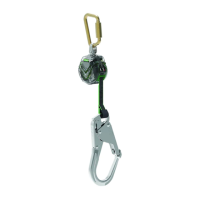

 To Next Page