3.11.2 Ductforoutdoorairinlet
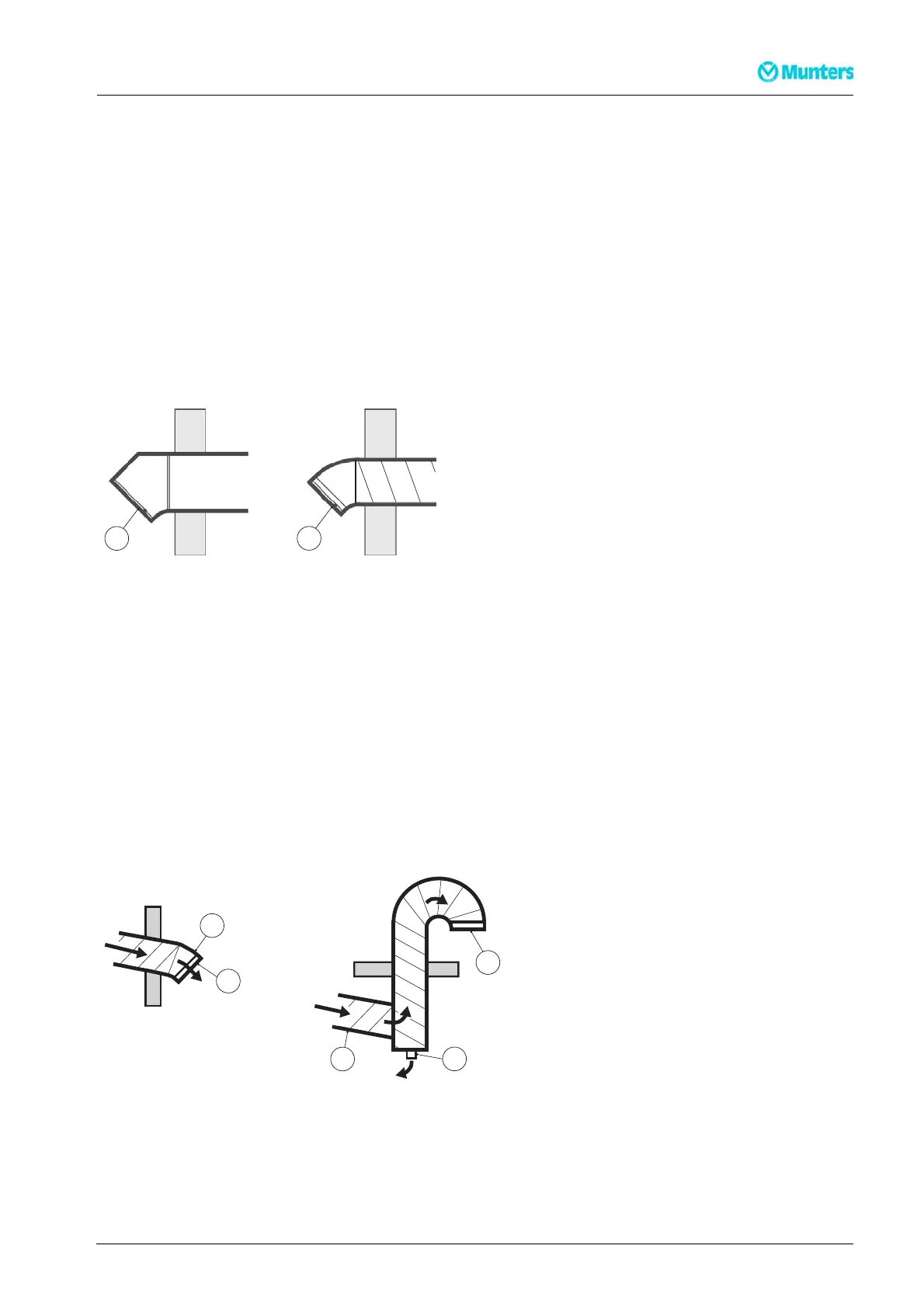
When bringing ambient air from outdoors into the dehumidifier, the inlet duct opening must be located
suffi ciently high above ground level to prevent dust and debris from e ntering.
The ducting must be designed to prevent rain and snow from being drawn into the dehumidifier. The air
inlet must be located away from possible contaminants such as engine exhaust gases, steam and harmful
vapours.
To prevent the wet (outlet) air f
rom humidifying t he r eactivation ( inlet) air, the air inlet for reactivation must
be located at least 2 m from the w
et air outlet.
Attach a w ire net w ith a mesh width of approximately 10 m m in the out er end of the duct to prevent animals
from entering the dehum idifier ducting.
A
B
C
C
Figure 3.4 Outdoor air inlet design
A. Rectangular ducting
B. Round ducting
C. Wire netting
3.11.3 Ductforwetairoutlet
The material for the wet air duct must withstand corrosion and temperatures of up to 100 °C. The wet air
ducting must always be insulated if there is a risk of condensation. The wet air leaving the dehumidifier will
easily cause c ondensation on the inside of the duct walls due to the high moisture content.
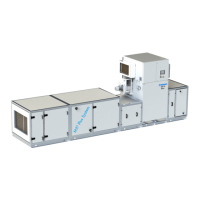
Horizontal ducts must be installed sloping downwards (away from the dehumidifier) to drain away possible
condensation. The duct slope must be at least 2 cm/m. In addition, drainage holes (5 mm) should be made at
low points in the duct to prevent water accumulation.
Attach a w ire net w ith a mesh width of approximately 10 m m in the out er end of the duct to prevent animals
from entering the dehum idifier ducting.
A
B
C
C
D
D
E
Figure 3.5 Wet air outlet des ign
A. Horizontal wet air outlet
B. Vertical wet a ir outlet
C. Wire netting
D. Downward slope
E. Condensate drainage
190TEN–108 9–G1412
Installation
25



 To Next Page