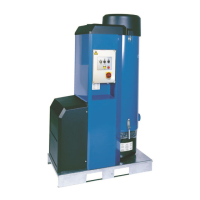
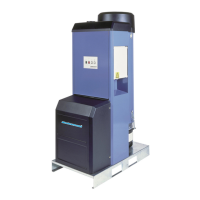
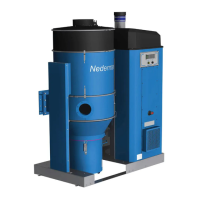
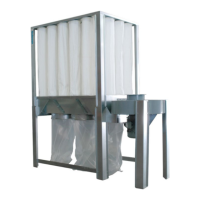
E-PAK 150 DX/300 DX/500 DX
35
EN
Figure 8 shows the normal connections to E-PAK 150 DX/300 DX/500 DX, as
follows:
1. PS cable for remote start/stop.
2. Incoming 3-phase power supply with Protective Earth (PE) conductor.
3. Maintenance switch.
4. Vent duct ange.
5. Isolation device.
6. Vacuum duct from workstations.
7. Power cable.
8. Duct between the unit and isolation device.
9. Water and dirt trap. Compressed air supply is to be clean and dry.
10. Compressed air valve, size G1/4" or G1/2".
11. Compressed air line, Ø 6 mm nylon hose.
8.3 Electrical installation
WARNING! Risk of electric shock.
Work with electric equipment is to be carried out by a qualied electrician.
NOTE! National and local electric regulations are to be followed.
For electrical data, see Section ‘5.3.2 Electrical data’. Column F1 gives the
recommended mains fuses (slow) for different supply voltages.
Column S1F gives the settings for the overload relay. These are set when the
unit is tested before delivery but should be veried when installing the unit.
The setting is equivalent to 0.58×the nominal current of the motor.
For the power circuit, control circuit and terminal connection diagrams, see the
following gures:
• Power circuit diagram, E-PAK 150 DX Figure 19.
• Power circuit diagram, E-PAK 300 DX/500 DX Figure 20.
• Control circuit diagram, E-PAK 150 DX Figure 21.
• Control circuit diagram, E-PAK 300 DX/500 DX Figure 22.
• Terminal connection diagram,
E-PAK 150 DX/300 DX/500 DX Figure 23.
8.3.1 General requirements
The following items are minimum requirements to ensure the proper function
and required level of protection with regards to equipment category, the EC
directives and standards listed in ‘Directives’ in Chapter 1 Declaration of
conformity:
• Take proper measures to avoid all types of electrical stray currents to
and/or from the duct system and electrical wiring.
• Check that the input voltage and frequency to the unit are correct.
• A lightning conductor is to be installed if the unit is installed outdoors.
The installation of the lightning conductor is to follow national and local
regulations for such a protection device.


 To Next Page
 Loading...