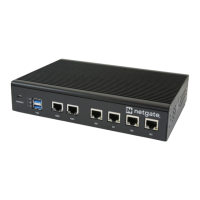
Security Gateway Manual Netgate-8300
When connecting different devices to these interfaces the peer should typically be set to autonegotiate, not to a specific
speed or duplex value. The exception to this is if the peer interface has the same limitation, in which case both peers
should select the same negotiation speed.
Networking Ports with Add-on Cards
The current add-on network cards offered by Netgate all utilize the ice(4) driver regardless of speed and port type.
These cards also all contain two ports each. The add-on cards get probed before the on-board ports, shifting the OS
device names of the on-board ports. The default interface assignment code takes this into account when the cards are
present on new/fresh installations and after a factory reset.
Warning: Adding an add-on card utilizing the ice(4) driver to an existing installation will cause the port as-
signments to be incorrect and may result in the WAN, LAN, and other ports being assigned to different physical
interfaces.
There are two add-on expansion card slots on the Netgate 8300 device and they can both be populated with network
cards, for a total of either two or four additional network ports.
The following table shows the default interface assignments for a Netgate 8300 containing a single two-port add-on
card using the ice(4) driver:
Table 1: Interface assignments with a single two-port ice(4) add-on
card
Label Assigned Name Device Name Type Speed
P0 P0 ice2 SFP+ 10 Gbps/1 Gbps
P1 P1 ice3 SFP+ 10 Gbps/1 Gbps
P2 P2 ice4 SFP+ 10 Gbps/1 Gbps
P3 P3 ice5 SFP+ 10 Gbps/1 Gbps
P4 P4 ice6 SFP+ 1 Gbps
P5 P5 ice7 SFP+ 1 Gbps
P6 P6 ice8 SFP+ 1 Gbps
P7 P7 ice9 SFP+ 1 Gbps
P8 P8 igc2 RJ45 2.5 Gbps
P9 P9LAN igc1 RJ45 2.5 Gbps
P10 P10WAN igc0 RJ45 2.5 Gbps
n/a ADDON0 ice0 Varies Varies
n/a ADDON1 ice1 Varies Varies
The following table shows the default interface assignments for a Netgate 8300 containing two two-port add-on cards
using the ice(4) driver:
© Copyright 2024 Rubicon Communications LLC 18



 To Next Page