NI cDAQ-9178/9174 User Guide and Specifications 36 ni.com
Single Pulse-Width Measurement
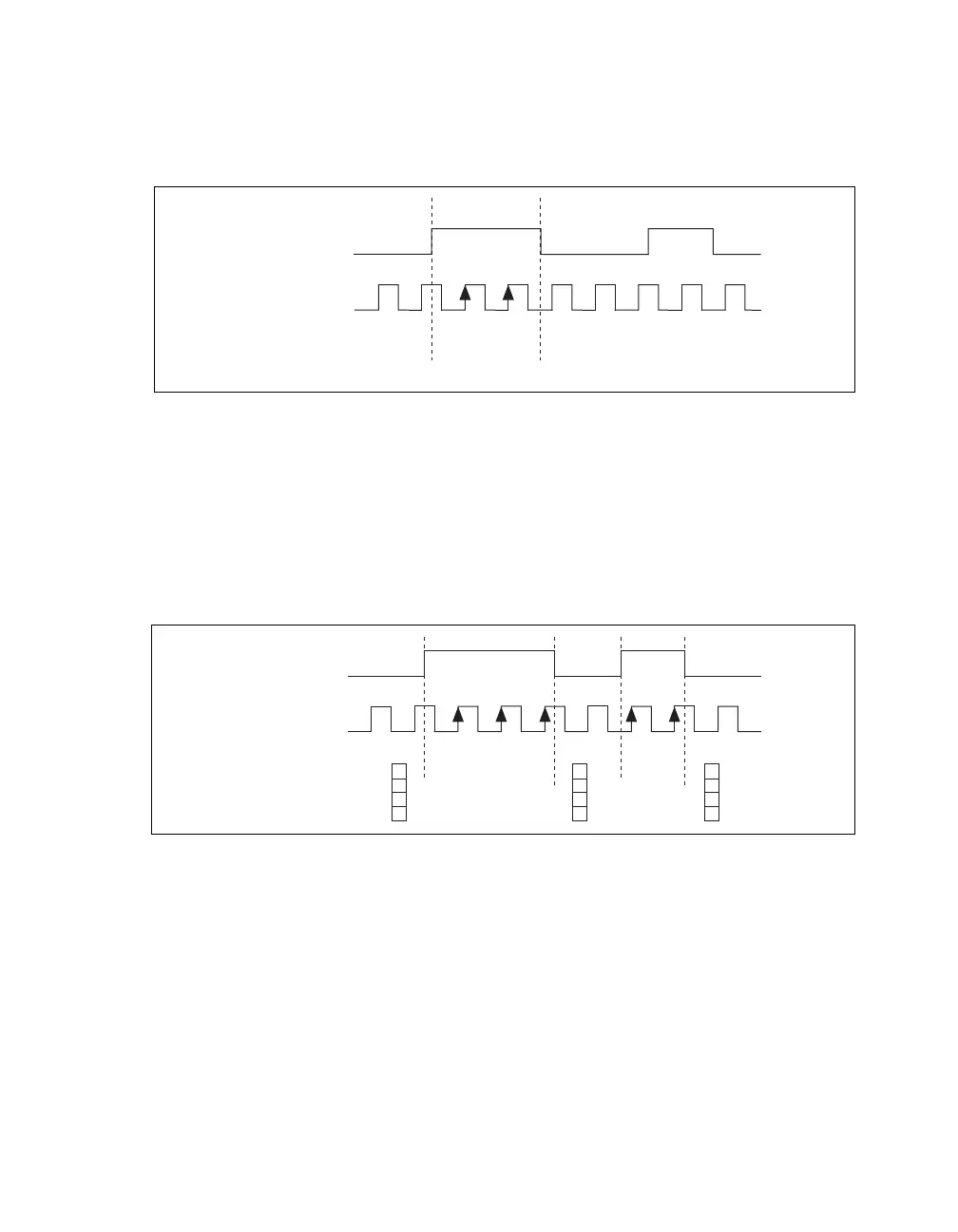
With single pulse-width measurement, the counter counts the number of edges on the Source input while
the Gate input remains active. When the Gate input goes inactive, the counter stores the count in the
FIFO and ignores other edges on the Gate and Source inputs. Software then reads the stored count.
Figure 24 shows an example of a single pulse-width measurement.
Figure 24. Single Pulse-Width Measurement
Implicit Buffered Pulse-Width Measurement
An implicit buffered pulse-width measurement is similar to single pulse-width measurement, but
buffered pulse-width measurement takes measurements over multiple pulses.
The counter counts the number of edges on the Source input while the Gate input remains active. On
each trailing edge of the Gate signal, the counter stores the count in the counter FIFO. The USB-STC3
transfers the sampled values to host memory using a high-speed data stream.
Figure 25 shows an example of an implicit buffered pulse-width measurement.
Figure 25. Implicit Buffered Pulse-Width Measurement
Sample Clocked Buffered Pulse-Width Measurement
A sample clocked buffered pulse-width measurement is similar to single pulse-width measurement, but
buffered pulse-width measurement takes measurements over multiple pulses correlated to a sample
clock.
The counter counts the number of edges on the Source input while the Gate input remains active. On
each sample clock edge, the counter stores the count in the FIFO of the last pulse width to complete.
The USB-STC3 transfers the sampled values to host memory using a high-speed data stream.
SOURCE
GATE
Counter Value
Latched Value
10
2
2
SOURCE
GATE
Counter Value
Buffer
10 3
3
2
212
3
3
2


 To Next Page