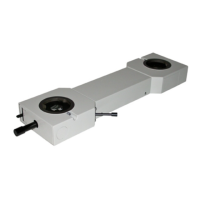
The Olympus U-UCD8 Universal Condenser is an advanced optical component designed for various microscopy applications, particularly in research settings. It is compatible with Olympus BX40, BX50, BX60, BX41, BX51, and BX52 series microscopes. This condenser supports a wide range of observation methods, including brightfield, darkfield, phase contrast, Nomarski differential interference contrast (DIC), and simple polarized light observation.
Function Description:
The U-UCD8 condenser is a versatile unit that allows for the integration of different optical elements to achieve various contrast techniques. It features an 8-position turret, accommodating three small optical elements and five large optical elements. This design enables users to quickly switch between observation modes by rotating the turret. The condenser also includes a swing-out top lens, which is crucial for adapting to different objective magnifications and observation types.
For brightfield observation, the condenser facilitates standard illumination. For phase contrast, specific phase contrast rings (U-PH1S, U-PH2S, U-PH3S, U-PH3) are engaged to enhance contrast in transparent specimens. Nomarski DIC observation requires the use of DIC prisms (U-DIC10S, U-DP10S, U-DIC20, U-DIC40, U-DIC60, U-DIC100, U-DPA20, U-DPA40, U-DPO40S, U-DPO60S) in conjunction with transmitted light DIC sliders (U-DICT, U-DICTS, U-DICTHC, U-DICTHR) and an analyzer (U-ANT or U-AN). Darkfield observation is achieved by engaging a darkfield ring (U-DFA), which blocks direct light and illuminates the specimen with oblique light. Simple polarized light observation (KPO) utilizes a polarizer and an analyzer to visualize birefringent structures.
The condenser's design allows for precise control over illumination parameters. It incorporates an aperture iris diaphragm, which controls the numerical aperture (N.A.) of the illuminator, and a field iris diaphragm, which defines the illuminated area. These diaphragms are essential for optimizing image contrast, resolution, and depth of focus for each observation method and objective.
Important Technical Specifications:
- Applicable Microscopes: BX40, BX50, BX60, BX41, BX51, BX52 series.
- Applicable Microscopy: Transmitted light (brightfield, darkfield, phase contrast, DIC, polarizer light).
- Top Lens Type: Achromat-Aplanat, swing-out type (interchangeable).
- Numerical Aperture (N.A.):
- Dry type top lens (U-TLD): 0.9 (top lens in), 0.2 (top lens out).
- Immersion type top lens (U-TLO): 1.4 (top lens in, when immersed in oil), 0.02 (top lens out).
- Applicable Slide Thickness:
- Dry type top lens: 0.9 to 1.4 mm.
- Immersion type top lens: 0.9 to 1.2 mm.
- Working Distance:
- Dry type top lens: 1.5 mm (with 1.2 mm slide).
- Immersion type top lens: 0.6 mm (with 1.2 mm slide).
- Illumination Field:
- Dry type top lens: φ 3 mm (top lens in), φ 14 mm (top lens out).
- Immersion type top lens: φ 1.5 mm (top lens in), φ 14 mm (top lens out).
- Focal Length:
- Dry type top lens: 13.5 mm (top lens in), 231 mm (top lens out).
- Immersion type top lens: 8.8 mm (top lens in), 231 mm (top lens out).
- Turret: 8 positions (3 small, 5 large), for attaching optical elements.
- Slider: Polarizer (360° rotatable).
- Aperture Iris Diaphragm: φ 2.8 to 21 mm.
- Mounting: Detachable, circular dovetail, attached with clamping screw.
- Dimensions: 147.5 (W) x 131 (D) x 75.5 (H) mm (top lens in).
- Weight: 600 grams.
Usage Features:
- Versatile Observation: The U-UCD8 supports a comprehensive range of observation techniques, making it suitable for diverse research applications requiring different contrast methods.
- Interchangeable Top Lenses: Users can choose between dry type (U-TLD) and oil immersion type (U-TLO) top lenses based on the specific observation requirements, with the oil immersion lens recommended for 20X or higher magnification objectives.
- Optical Element Mounting: The condenser turret has designated positions for various optical elements. Positions 1 and 3 are for U-DIC10S or U-DP10S. Position 2 is for U-PH1S, U-PH2S, or U-PH3S. Positions 4 and 8 are for U-DFA and U-PH3, or DIC optical elements when not in use. Positions 5-7 are exclusively for DIC optical elements, as they lack a centering mechanism.
- Centering Mechanism: Optical elements in positions 1, 2, 3, 4, and 8 are equipped with centering mechanisms, allowing for precise alignment of the condenser's optical path with the objective.
- Polarizer Integration: The condenser includes a rotatable polarizer, which can be engaged or disengaged from the light path using a handling knob. This is crucial for DIC and polarized light observations.
- DIC Observation Flexibility: For Nomarski DIC, the manual provides detailed tables outlining compatible DIC sliders (U-DICT, U-DICTS, U-DICTHC, U-DICTHR) and DIC prisms for various objectives and top lenses (U-TLD, U-TLO). It also specifies when to use the BFP1 position for certain UIS2 and UIS series objectives.
- Field and Aperture Iris Diaphragm Control: The ability to adjust both field and aperture iris diaphragms allows for fine-tuning of illumination, critical for achieving optimal image quality across different observation modes.
- Number Stickers: Number stickers are provided to label the optical element positions on the turret, aiding in quick identification and selection of the correct element.
Maintenance Features:
- Cleaning: All glass components should be cleaned gently with gauze. For fingerprints or oil smudges, a mixture of ether (70%) and alcohol (30%) is recommended. Users are cautioned about the flammability of these solvents and advised to use them in a well-ventilated room, away from open flames or electrical sparks.
- Storage: Unused optical elements and index plates should be stored in a case to protect them from dust and damage.
- Non-Disassembly: Users are explicitly warned against disassembling any part of the attachment, as this could lead to malfunction or reduced performance.
- Top Lens Handling: When replacing the top lens, care must be taken not to apply excessive force to the top lens arm. The top lens should be rotated clockwise until it lightly contacts the lens holder, without overtightening.
- Condenser Holder Adjustment: Before engaging or disengaging the top lens, the condenser holder should be lowered to prevent the slide glass from impeding the operation and to allow for cleaning of any oil on the top lens.
- Turret Cover Removal: When removing the turret cover to mount optical elements, care must be taken to prevent damage to the top lens and the dust protective glass.
- Optical Element Mounting: When inserting phase contrast or darkfield rings, the spring inside the turret should be slightly depressed with the side of the ring. It is important not to push the ring sit plate inside the element frame and to tighten the centering screw lightly to avoid deforming the mount frame.
- Number Sticker Application: To ensure good adhesion of the number stickers, the attaching grooves should be cleaned with an ether-alcohol mixture to remove any stains or oil. The stickers should be attached according to the specified orientation for different microscope series (e.g., upside down for IX/IX2 series, or as low as possible for BX51WI).

 Need help?
 General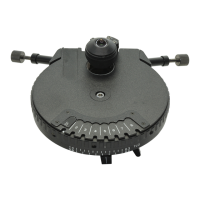

 To Next Page