EN9
EN
10. How to Calculate Weekly Averages
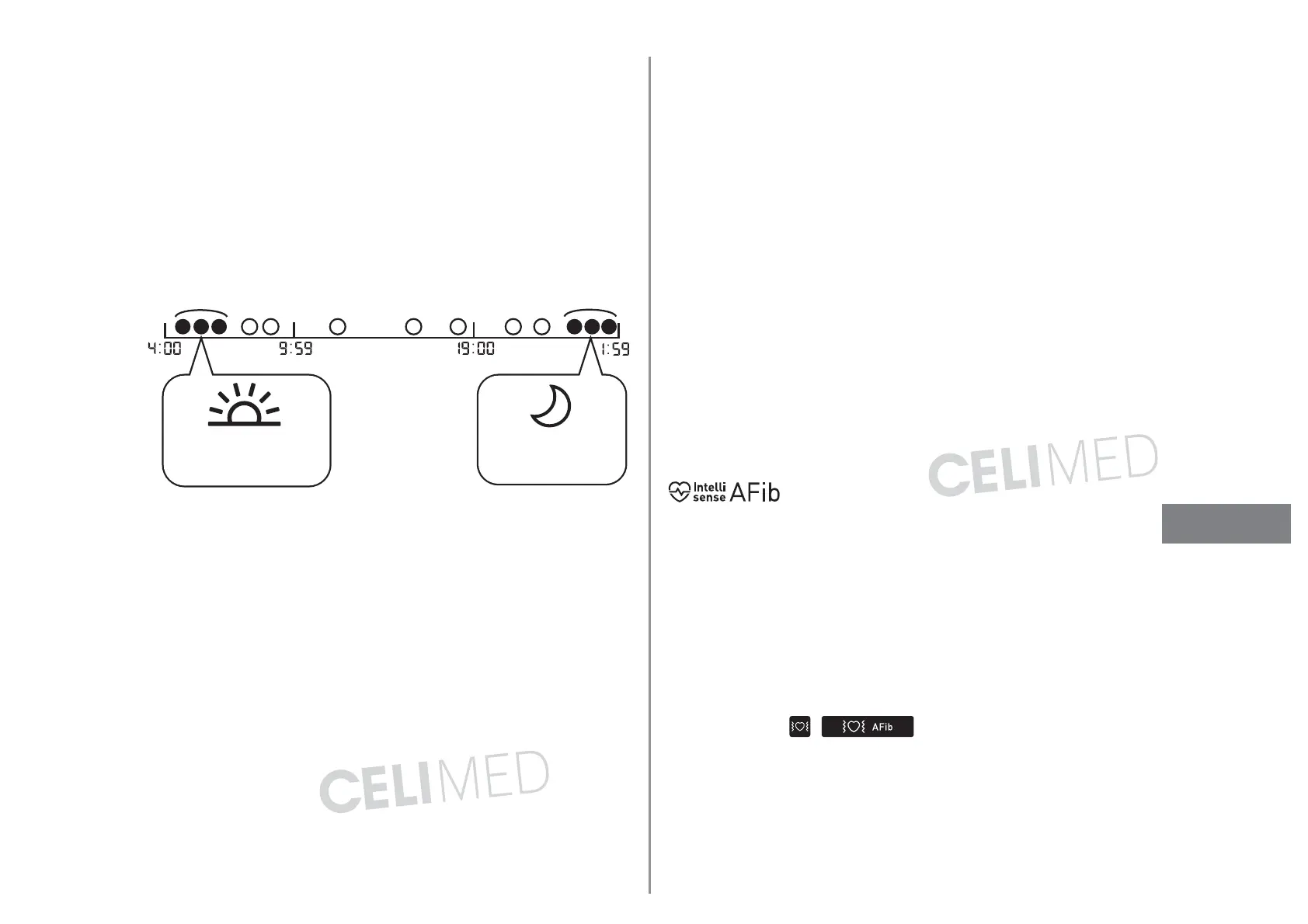
Morning Weekly Average Calculation
This is the average for the measurements taken during the morning (4:00-9:59)
between Sunday and Saturday. The 2 or 3 readings taken within the first
10minute timeframe in the morning between 4:00-9:59 will be used to
calculate the morning average for each day.
Evening Weekly Average Calculation
This is the average for the measurements taken during the evening (19:00-1:59)
between Sunday and Saturday. The 2 or 3 readings taken within the last
10minute timeframe in the evening between 19:00-1:59 will be used to
calculate the evening average for each day.
Within 10 min.
Measurements
in the morning
Measurements
in the evening
Within 10 min.
11. Additional Information
What is Blood Pressure?
Blood pressure is a measure of the force of blood flowing against the walls of
the arteries. Arterial blood pressure is constantly changing during the course of
the heart’s cycle.
The highest pressure in the c ycle is called the Systolic Blood Pressure; the lowest
is the Diastolic Blood Pressure. Both pressures, the Systolic and Diastolic, are
necessary to enable a physician to evaluate the status of a patient’s blood pressure.
What is Arrhythmia?
Arrhythmia is a condition where the heartbeat rhythm is abnormal due to flaws in
the bio-electrical system that drives the heartbeat. Typical symptoms are skipped
heartbeats, premature contraction, an abnormally rapid (tachycardia) or slow
(bradycardia) pulse.
What is AFib?
Atrial fibrillation (AFib) means the most common type of non-sinus
tachyarrhythmia. This symptom may create blood clots. This can lead to major
health problems, including strokes, transient ischemic attacks (TIAs), and
pulmonary emboli (PEs); depending which chamber of the heart has the blood
clot in it.
Possible AFib Detection
OMRON’s trademarked technology alerts you once possible AFib is detected,
even with a single measurement.
The monitor will notify you of a possibility of AFib if your monitor determines
an irregularity from pulse to pulse intervals during a measurement.
The possible AFib screening feature ONLY evaluates for a possibility of AFib
after taking a measurement. It does NOT continuously monitor your heart
and therefore cannot alert you if AFib happens at any other time. This monitor
cannot detect all forms of AFib. If the irregularity of the heart rhythm is too
small, it may not be detected. For example, if there is an abnormality in the
conduction between the atria and the ventricle, the heart rhythm may be in
sinus rhythm, in which case a possibility of AFib
cannot be detected by this
monitor.
The state in which “
/ ” symbol is displayed can influence
your blood pressure measurements and make it difficult to get an accurate
reading. If this occurs, it is recommended that you consult with your physician.
EN



 To Next Page