Glossary
150
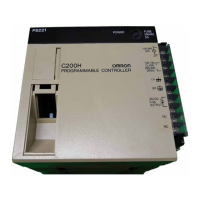
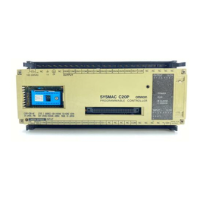
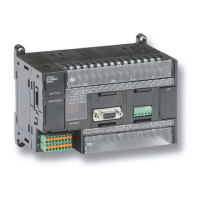
Programmable Controller A small, computer-like device that can control peripheral equipment, such as
an electric door or quality control devices, based on programming and pe-
ripheral input devices. Any process that can be controlled using electrical
signals can be controlled by a PC. PCs can be used independently or net-
worked together into a system to control more complex operations.
programming device A peripheral device used to write programs and to input a program to a PC or
to alter or monitor a program already stored in the PC. There are dedicated
programming devices, such as Programming Consoles, and there are non-
dedicated programming devices, such as a host computer.
PROM [P(rogrammable) R(ead) O(nly) M(emory)] A type of ROM into which the pro-
gram or data may be written after manufacture, by a customer, but which is
fixed from that time on.
PROM Writer
A PROM W
riter is a device used to write data to ROM, PROM, and EPROM
storage chips.
Proximity Switch A switch that uses magnetic induction to measure the distance of a metallic
object from the front of the switch.
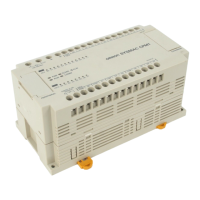
Rack PC A PC that is composed of Units mounted to one or more Racks. This configu-
ration is the most flexible, and most large PCs are Rack PCs. A Rack PC is
the opposite of a Package-type PC, which has all of the basic I/O, storage,
and control functions built into a single package.
RAM [R(andom) A(ccess) M(emory)] RAM will not retain data when power is dis-
connected. Therefore data should not be stored in RAM.
register/registered Storing text and graphics in the RAM/ROM card from a personal computer or
the ASCII Unit. Graphics that have been written to the RAM/ROM card are
referred to as registered messages.
Remote I/O Unit A Unit that extends the distance an Expansion I/O Unit can be from the CPU.
ROM [R(ead) O(nly) M(emory)] A type of digital storage that cannot be written to. A
ROM chip is manufactured with its program or data already stored in it, and it
can never be changed. However, the program or data can be read as many
times as desired.
switching capacity The voltage/current that relay can switch ON and OFF.
stepping motor An output device that rotates according to signals from the Control System.
The rotation is very precise and occurs in pre-defined “steps”.
switch An input device that sends either an ON or OFF signal to the Control System.
A switch can be operated either by a person or by the movement of a piece
of equipment or material.
system configuration The arrangement in which Units in a System are connected. This term refers
to the conceptual arrangement and wiring together of all the devices needed
to comprise the System. In OMRON terminology, system configuration is
used to describe the arrangement and connection of the Units comprising a
Control System that includes one or more PCs.
Downloaded from Elcodis.com electronic components distributor



 To Next Page