10 OPAL-RT Technologies OP5700 User Manual
Introduction
System Interconnection Details
CONFIGURATION OPTIONS
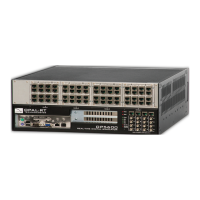
The OP5700 is available in a number of CPU configurations that are factory configured according to the
customer’s processing requirement.
Product Configuration Description
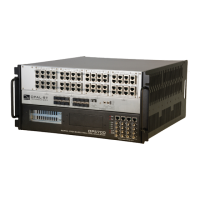
OP5707-4 OP5700 RCP/HIL Virtex7 FPGA-based Real-Time Simulator - 4 cores (5U, Xeon E5, 4 Cores, 3.0 GHz,
10M, 16GB, 512GB SSD)
OP5707-8 OP5700 RCP/HIL Virtex7 FPGA-based Real-Time Simulator - 8 cores (5U, Xeon E5, 8 Cores, 3.2 GHz,
20M, 16GB, 512GB SSD)
OP5707-16 OP5700 RCP/HIL Virtex7 FPGA-based Real-Time Simulator - 16 cores (5U, Xeon E5, 2x8 Cores, 3.2
GHz, 2x20M, 2x16GB, 512GB SSD)
OP5707-32 OP5700 RCP/HIL Virtex7 FPGA-based Real-Time Simulator - 32 cores (5U, Xeon E5, 2x16 Cores, 2.3
GHz, 2x40M, 2x16GB, 512GB SSD)
The OP5700 is built with the same FPGA and I/O architecture as the OP5607 I/O expansion
chassis (OP5600 family of products), therefore the FPGA programming files (bitstreams)
are fully compatible.
SYSTEM INTERCONNECTION DETAILS
There are two standard modes of operation available for the SFP ports, both based on the Xilinx
Aurora communication protocol:
Generic Aurora communication: this mode is enabled using the RT-XSG blockset’s Generic Aurora
blocks in the FPGA programming file’s Simulink model. These blocks are used to exchange data
with 3rd-party devices or with other OPAL-RT systems The data communication layer (data packing/
unpacking) must be configured by the user according to the targeted application. The communication
speed is configurable between 1 and 5 GBps and the SFP transceivers should be selected accordingly.
OPAL-RT MUlti-System Expansion link (MUSE): this mode encapsulates the Aurora protocol within a
network protocol designed by OPAL-RT for inter-system communication. The communication speed
is set to 5Gbps by default, but downgrades automatically to the speed of the other port, if that port is
used at a lower speed for 3rd party device connection.
The MUSE mode is selected in the RT-XSG block by setting the synthesis manager architecture option
to <remote>. In this mode, the unit must be connected to another OPAL-RT system that is connected
in ‘central’ mode, and it then becomes a remote expansion unit (similar to an OP4520 or OP4200).


 To Next Page