124 Driv in g and op era tio n
Hand brake
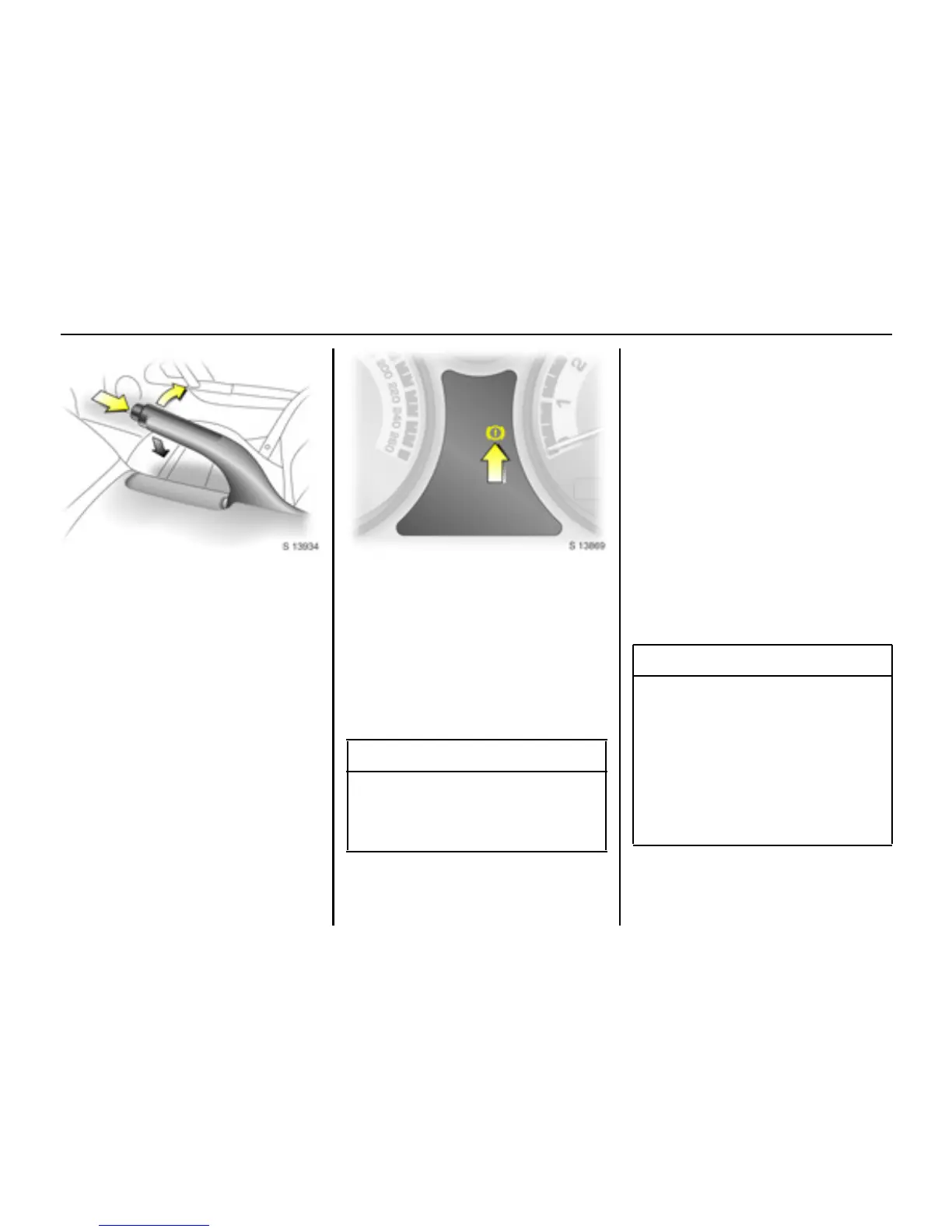
Always apply ha nd brake firmly . On slopes,
apply the hand brake as firmly as possible.
The mechanical hand b ra ke affects the
rear wheel brakes. They automatically
engage when the lever is pulled.
To release the hand brake, lift handle
slig htly, press release button and lower
handle all the way down.
To re duce the ope ra ting forces of the hand
brake, depress the foot brake at the sa me
time.
Control ind icator R for brak e sy st em
Illum inates when the ignition is switched on
if the hand brake is applied or if the brake/
clutch fluid level is too low.
Flashes at speeds over 8 km/h (5 m ph) if
ha nd brake is applied. Release hand brake
bef or e cont in u ing jo urn ey , to av o id
overheating and damag ing the brake
system. See also page 70.
Brake and clutch fluid – see page 156.
ABS u
The AB S (Anti-lock Brake System )
continuously monitors the brake system
and p reven ts the whee ls from lock ing,
independently of the type of road surface
and the tyre grip.
It starts to regulate the braking pressure as
soon as a wheel shows a tendency to lock.
The vehicle rema ins s tee rable, eve n in the
event of very heavy braking, for insta nce
on bends or when swerving to avoid an
obs tacle. Ev en in the c ase of full-on
brak ing, the ABS makes it possible to drive
round an obstacle w ithout releasing the
brak es.
ABS control is mad e ap parent throug h a
pulse in the brake pedal and the noise of
the regulation process.
9 Warning
If the control indicator illuminates when
the hand brake is not ap plied: Stop.
Interrupt your journey immediately.
Consult a workshop.
9 Warnin g
For optimum braking, keep the brake
pedal fully dep ressed throughout the
braking process, despite the fact that
the pedal is pulsa ting. Do not reduce
the pressure on the pedal.
Do not let this special safety feature
tempt you into ta king risks w hen driving.
Traffic safety can only be achieved by
adopting a responsible d riving style.








 To Next Page