OPTIMUM
MASCHINEN - GERMANY
Description of the basic operation
15 / 06 / 2011 Page 27Description of the basic operation Digital position display DPA 2000/ DPA 2000S ; Version 2.1.2
© 2011
GB
Note:
- During the process of inputting numerals, the indicator light beside the key flashes;
- In order to perform the same function on the Y or Z and Z0 axes, repeat the same
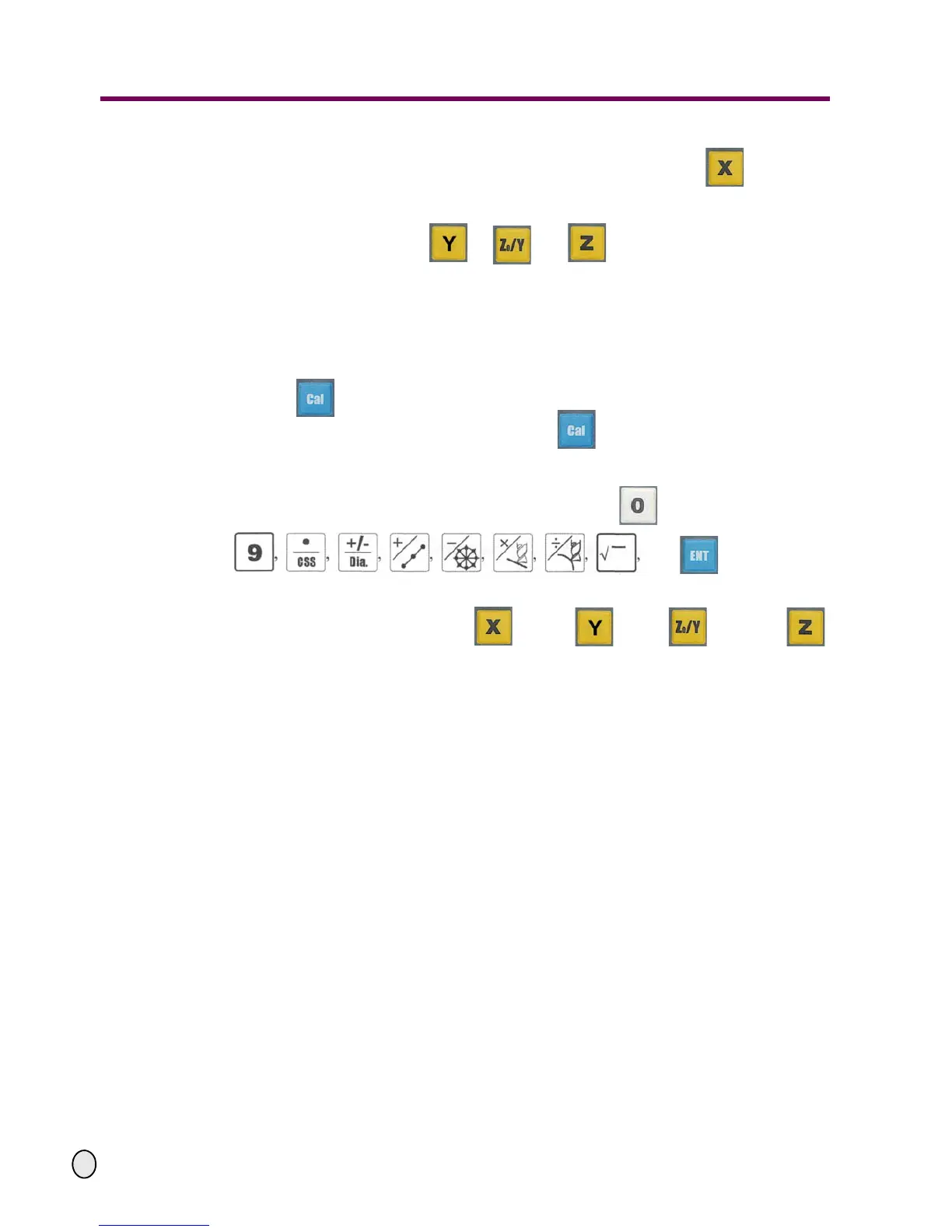
procedures by pressing the or and keys respectively in step 2;
- If you do not need to change the initial values of the axis, then omit steps 4 and 5;
- By the above procedures, the reference mark position of the reading device can be taken
as the origin of the selected coordinates.
4.11 Calculator function
Operation procedures:
Press the key and enter the calculator function. The „Calculation“
indicator light on the upper right flashes. Press the key again to exit the calculator
function.
In the calculator function status, you can enter operations such as addition, subtraction, mul-
tiplication, division, squaring root and numerals, and display the calculation results on the
display window at the upper right by pressing the keys from to
and respectively.
Transferring the calculation results:
By pressing any of the axes keys (the key, the key the key and the
key), you can transfer the value of the calculation result to the corresponding axis.
The following functions are performed when the position display is in the milling function (the
milling indicator light is illuminated) and the display is at the standard display.
4.12 Dividing hole along an oblique line function
Function introduction: To perform the dividing hole along an oblique line operation on the
selected coordinate layer.
A description for the parameters needs to be defined:
The angle of the oblique line (L-A): The inclination between the line segment to be divided
equally and the X-axis along the positive direction (on the X-Y plane, an inclination between
it and the Y-axis along the positive direction).
The length of the oblique line (L-d): The length of the line segment will be divided to equal
parts.
Number of holes to be divided (LNo. H): The number of points to divide the line segment to
equal parts, n points to divide the line segment into n-1 equal segments.


 To Next Page