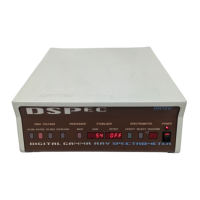
DSPEC 50
®
and DSPEC 502
®
Digital Gamma-Ray Spectrometer User’s Manual 932502G / 0618
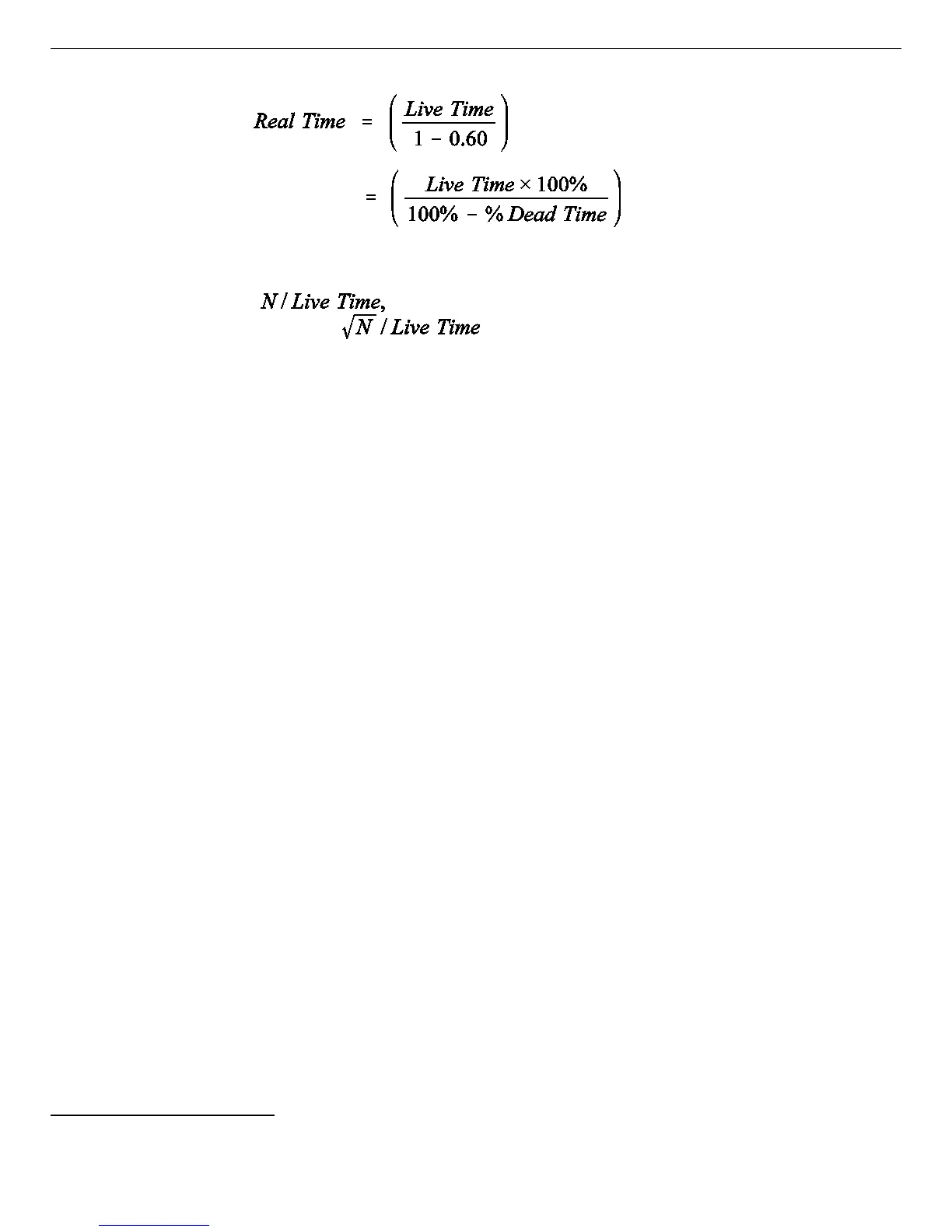
If the N counts in the gamma-ray peak in the spectrum are divided by the elapsed live time, the
resulting counting rate, is now corrected for dead-time losses. The standard
deviation in that counting rate is .
Unfortunately, extending the counting time to make up for losses due to system-busy results in
an incorrect result if the gamma-ray flux is changing as a function of time. If an isotope with a
very short half-life is placed in front of the detector, the spectrometer might start out with a very
high dead time, but the isotope will decay during the count and the dead time will be zero by the
end of the count. If the spectrometer extends the counting time to make up for the lost counts, it
will no longer be counting the same source as when the losses occurred. As a result, the number
of counts in the peak will not be correct.
When a supported ORTEC MCB operates in ZDT
7
mode, it adjusts for the dead-time losses by
taking very short acquisitions and applying a correction in real time — that is, as the data are
coming in — to the number of counts in the spectrum. This technique allows the gamma-ray flux
to change while the acquisition is in progress, yet the total counts recorded in each of the peaks
are correct. The resulting spectrum has no dead time at all — in ZDT mode, the data are correc-
ted, not the acquisition time. Thus, the net counts in a peak are divided by the real time to
determine the count rate.
ZDT mode has a unique feature in that it can store both the corrected spectrum and the uncor-
rected spectrum, or the corrected spectrum and the uncertainty spectrum. Therefore, supported
MCBs allow you to choose between three ZDT Mode settings on the ADC tab under MCB
Properties...: Off, NORM_CORR, and CORR_ERR.
Table 1 shows which spectra are collected in the three possible ZDT modes.
1.6.1. Off — Uncorrected Spectrum Only
In this mode, only the uncorrected spectrum (live time and real time with dead-time losses) —
also called the live-time-corrected or LTC spectrum — is collected and stored in the .SPC file.
The LTC spectrum can be used to determine exactly how many pulses at any energy were
7
Patent number 6,327,549.
10



 To Next Page