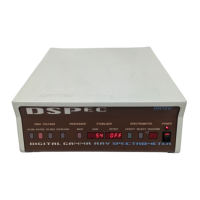
DSPEC 50
®
and DSPEC 502
®
Digital Gamma-Ray Spectrometer User’s Manual 932502G / 0618
4.3.1. “Training” the Resolution Enhancer
The Resolution Enhancer can help reduce the low-side peak tailing that results from increased
charge trapping (but not other causes); see the discussion in Section 1.3. It operates by measur-
ing the rise time (collection time) of the pulses and adjusting the gain based on the rise time.
This is done on each pulse. The gain adjustment value for the rise time is stored in a table. The
values in the table must be set by “training” the Resolution Enhancer. Marking the Resolution
Enhancer checkbox enables/disables the “learning” mode. Note that, once trained, the
enhancer operates continuously until disabled as discussed in Step (13) below. To train the
enhancer:
1) Set the bias, gain, rise time, flattop, and PZ as you would for data collection.
2) If you wish to use LFR Mode, turn it on.
3) If you wish to use Enhanced Throughput Mode, turn it on and either accept the
automatically calculated, highest-throughput protection time, based on the current rise time
and flattop; or enter the desired setting. (The latter might require one or more data
acquisitions. When finished, proceed to Step 4).
4) Clear the MCB and acquire a well-isolated peak.
5) Mark the Resolution Enhancer checkbox to turn on the learning mode.
6) You will now use the gain stabilization section of the Stabilizer tab to configure the
Resolution Enhancer (the gain stabilizer is disabled in the learning mode). Enter the Center
channel and Width of the peak acquired in Step 4; the maximum Width is 255 channels. If
you wish, use the Suggest button. The selected region should be as narrow as possible but
should completely include the peak.
7) Click Initialize to clear all the Resolution Enhancer settings. Initialization does not change
the current Center channel and Width.
8) Clear the MCB, re-start acquisition, and monitor the FWHM of the target peak, using the
Peak Info command (available by right-clicking in the spectrum window) to show the
FWHM and peak counts. Collect about 5000 counts in the peak and record the FWHM.
Clear the data and collect another 5000 counts, recording the FWHM. Repeat until the
FWHM no longer changes. Typically, the more charge trapping exhibited by the detector,
the longer the data collection time.
9) When you are satisfied that the FWHM has reached the best possible value, clear the MCB
and collect another spectrum for confirmation.
48



 To Next Page