10
2005 Doctor Martin Luther King Jr Street
Indianapolis, IN 46202
Rev 07-2021
Preparation of shaft sections:
Before beginning the installation of
the shaft sections, inspect them for
straightness: verify that they have not
been bent in shipping or handling. Set a
pair of rollers or vee-blocks on a firm
base next to the pump site to support one
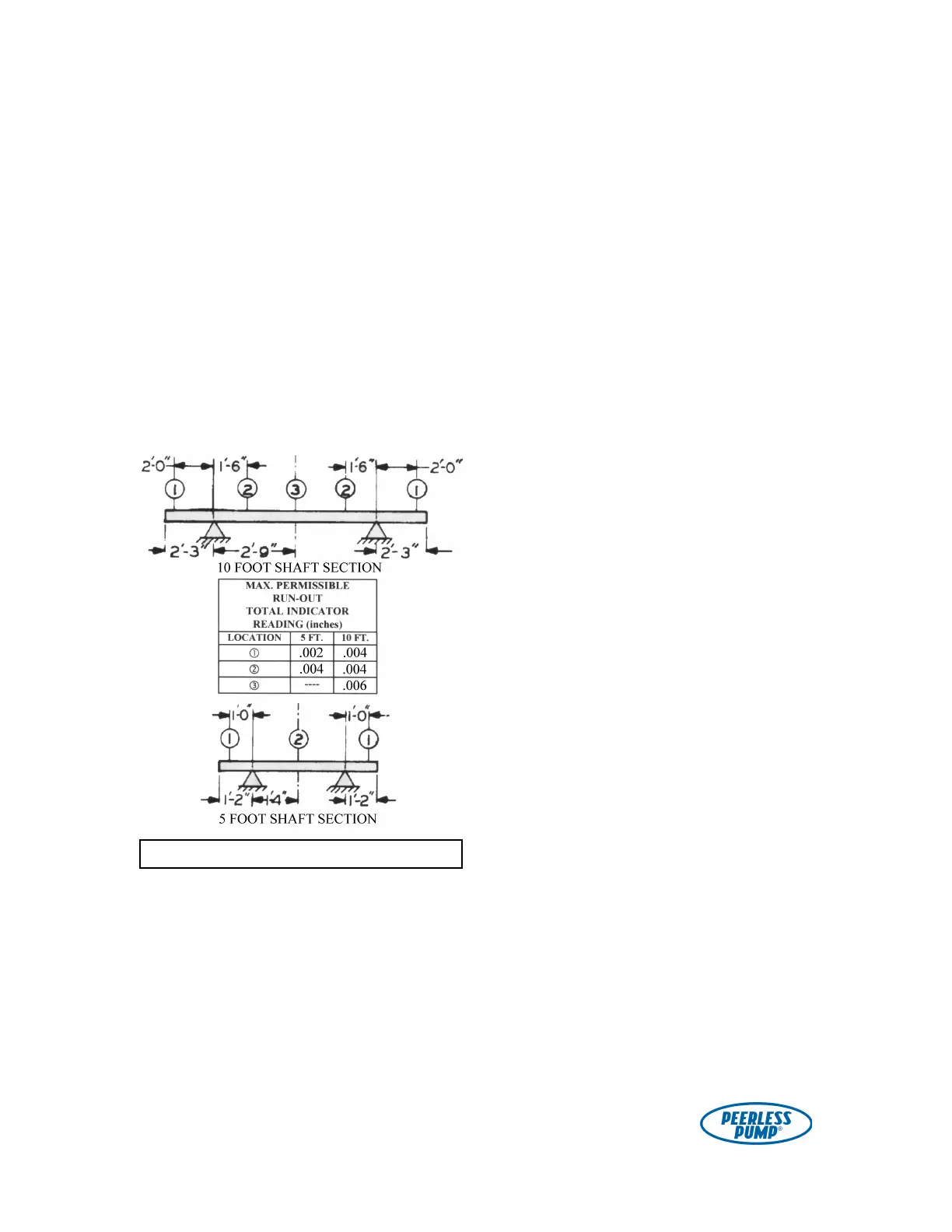
shaft section as shown in Fig. 2.
Provide a solid mounting for a dial
indicator at the points labeled 1, 2, and 3
in Fig. 2. Place a shaft on the rollers or
vee-blocks and rotate it slowly by hand
while checking the eccentricity (run-out)
at points 1, 2 and 3.
Check all of the shaft sections in
this manner. Do not use any shaft
section that exceeds the limits given in
Fig. 2. Rejected shaft sections may be
straightened.
All re-straightened shaft sections
must have a cleanup cut machined on
both ends. Re-straightened shaft
sections must be rechecked for
eccentricity.
Larger shafts and shafts for non-
threaded (split-ring) couplings may have
an internal threaded section on one end;
this end goes up. In a flanged column
pump, the intermediate column sections
have identical ends; either end may be
upward. However, the top and bottom
sections may not have identical ends.
Refer to the assembly drawing for the
proper orientation.
The preferred method is to install
the shaft and couple it, then install the
tube and column over the shaft--
provided that head room permits. If
head room is limited, insert the shaft and
tube sections into the column sections so
that the shaft extends about a foot above
the top end of the column. This will
make it convenient for tying later.
When inserting the shaft and tube
sections into the column sections, take
care not to bend the shaft or damage
the threads.
Figure 2. Verification of



 To Next Page