
 Need help?
Do you have a question about the Pentair STA-RITE and is the answer not in the manual?
Details safety alert symbols (DANGER, WARNING, CAUTION, NOTICE) and general safety advice.
Provides guidelines for safe electrical connections, wiring, and grounding.
Covers risks of explosion, heavy parts, burns, freezing, and general work area safety.
Informs about chemicals known to cause cancer or reproductive harm in California.
Outlines the terms, conditions, and periods of the product warranty.
Instructions on safely lifting the motor and pump assembly using appropriate equipment.
Guidance on selecting an optimal and accessible installation site for the pump.
Requirements for a stable and substantial concrete foundation to support the pump.
Recommendations for system piping size, velocity, and alignment with pump connections.
Specific recommendations for suction piping and lift installations, including NPSHA.
Guidelines for proper discharge piping, including pipe sizing and check valve selection.
Detailed steps for safely connecting the pump motor to the power supply.
Essential checks, including rotational direction, before initial pump operation.
Procedures for filling the pump and suction line with water before operation.
Steps for safely starting the pump after it has been primed.
Instructions on how to safely shut down the pump.
General precautions and advice during normal pump operation.
Steps to take if the pump loses its prime and needs to be re-primed.
Information on lubricating motor bearings and the liquid end's lubrication needs.
Guidance on periodically verifying pump output and performance.
Monitoring vibration, noise, and temperature for operational health.
Advice on protecting the pump from environmental conditions like freezing and moisture.
Identification and description of the various parts of the pump assembly.
Step-by-step instructions for safely removing the mechanical shaft seal.
Step-by-step instructions for correctly installing the mechanical shaft seal.
Information on how to locate the pump nameplate and order correct replacement parts.
Identifies common electrical problems, their probable causes, and corrective actions.
Identifies common mechanical problems, their probable causes, and corrective actions.
Identifies common system issues, their probable causes, and corrective actions.
This document is an owner's manual for a Pentair Sta-Rite Close Coupled Motor Drive Centrifugal Pump, providing essential information for its installation, operation, and maintenance.
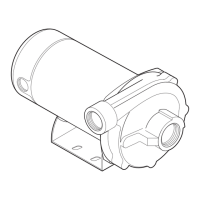
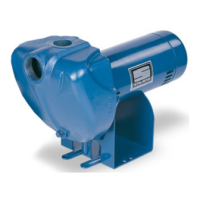
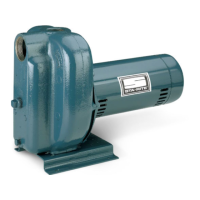
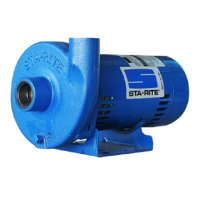
The Pentair Sta-Rite Close Coupled Motor Drive Centrifugal Pump is designed to move liquids, primarily water, within a system. As a centrifugal pump, it operates by converting rotational kinetic energy into the hydrodynamic energy of the fluid flow. The "close coupled" design indicates that the pump impeller is directly mounted on the motor shaft, resulting in a compact unit that minimizes alignment issues and simplifies installation compared to flexibly coupled pump and motor assemblies. This type of pump is suitable for various applications where reliable fluid transfer and pressure boosting are required. The manual emphasizes that the pump is intended for pumping water only and warns against using it with salt water, flammable liquids, or chemicals, which could lead to fire or explosion hazards.
The manual outlines several key usage features and considerations for the pump:
The manual emphasizes several maintenance aspects to ensure continuous and satisfactory operation:
 General
| Model | STA-RITE |
|---|---|
| Category | Water Pump |
| Brand | Pentair |
| Seal Type | Mechanical |
| Motor Type | TEFC (Totally Enclosed Fan Cooled) |


 To Next Page