27
Chapter 7: General TRUE-IPV® Therapy Protocol for Adults
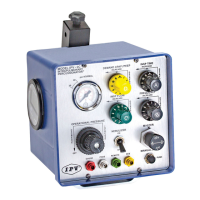
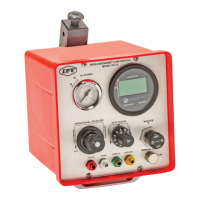
1. Connect IPV®-1C to 50-80 psi (3.5-5.5 BAR) gas power source.
Master switch is “OFF”.
2. Patient should be in an upright, comfortable armchair or lying with head
and shoulders elevated by pillows.
NOTE: Patient’s gravitational position is not a factor with TRUE-IPV®.
3. Auscultate patient for breath sounds, heart and respiratory rate
or follow institution guidelines.
4. Connect Phasitron®5 breathing circuit kit as indicated in Instructions for Use.
5. Put prescribed medications into nebulizer and add diluent as directed by
physician to a maximum of 20 cc. If no medications are prescribed, use
normal saline or sterile water as directed by physician.
6. Rotate FREQUENCY control knob arrow full counterclockwise
to the EASY position.
7. Turn IPV®-1C Master switch “ON”. Rotate OPERATIONAL PRESSURE control
regulator knob for an operating pressure of 30 to 35 psi (2.1-2.4 Bar).
8. If needed, allow patient to observe and feel pulses from Phasitron® 5
on their hand before either connecting to the airway or breathing
through the mouthpiece.
9. When using a mouthpiece, the patient should be instructed to inhale and
exhale through the pulses. Most patients will initially allow percussive
bursts of air to leak through their nose at the expense of an observable
chest movement (wiggle).
10. Start to notice the chest movement (wiggle) as the patient exhales through
the mouthpiece. Advise the patient to relax, taking normal (spontaneous)
breaths through the pulses whenever they desire.
When a patient has an articial airway, the process is similar. The patient
must be observed carefully for signs of distress. While cheek fatigue will
be less of a consideration, pauses or breaks may still be necessary for
the patient.
11. Instruct patient to keep their lips and cheeks splinted to avoid nasal
air venting. As the patient learns to prevent air from leaking out of the
lip seal around the mouthpiece, the PERCUSSION control knob arrow
can be gradually rotated clockwise toward the index (12:00).
12. With some patients, the clinician may have to use an appropriate mechanical
airway to administer therapy such as a mask.
(Continued on p.28)


 To Next Page