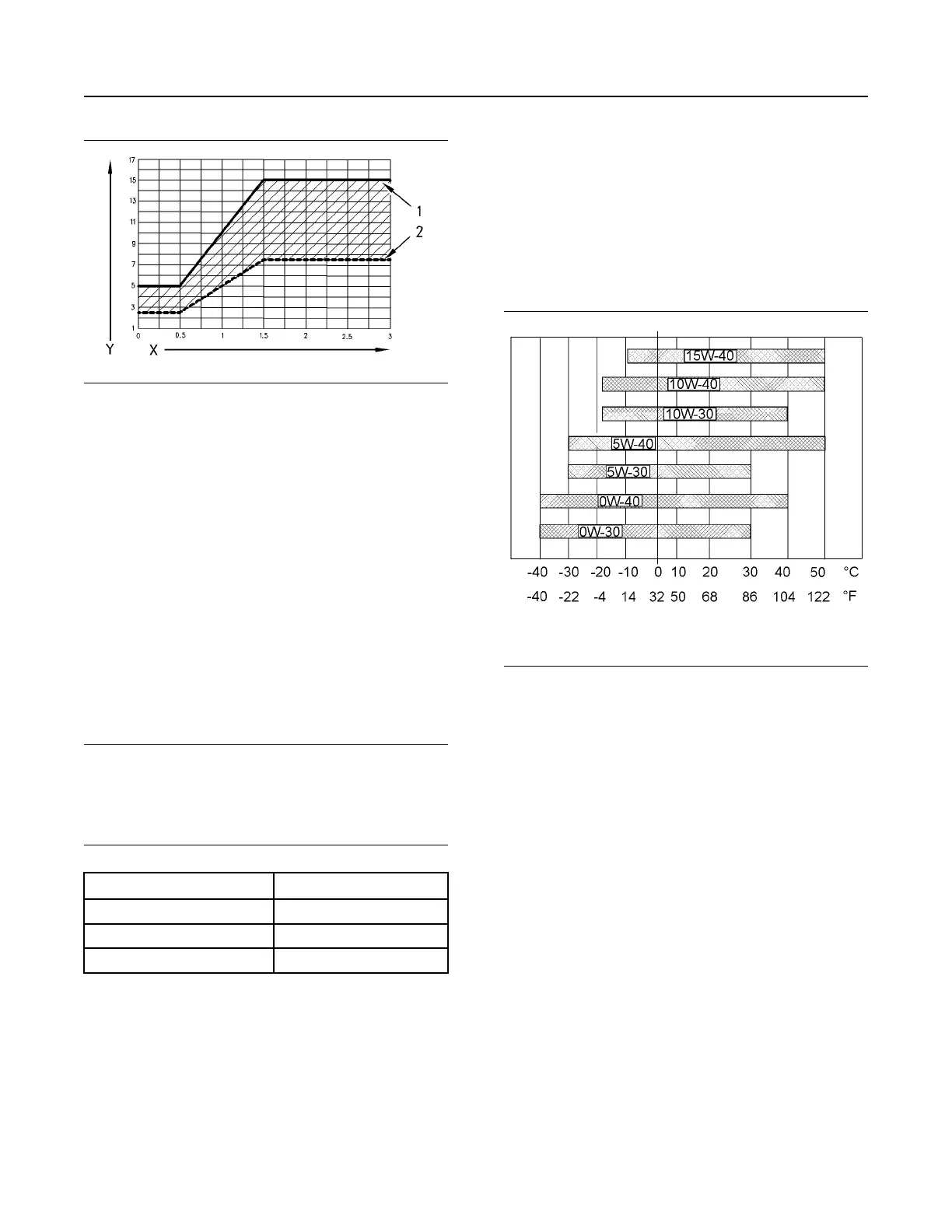
Illustration 27 g00799818
(Y) TBN by “ASTM D2896”
(X) Percentage of fuel sulfur by weight
(1) TBN of new oil
(2) Change the oil when the TBN deteriorates to 50 percent of the
original TBN.
Use the following guidelines for fuel sulfur levels that
exceed 1.5 percent:
• Choose an oil with the highest TBN that meets one
of these classifications: API CH-4 and API CI-4.
• Reduce the oil change interval. Base the oil
change interval on the oil analysis. Ensure that the
oil analysis includes the condition of the oil and a
wear metal analysis.
Excessive piston deposits can be produced by an oil
with a high TBN. These deposits can lead to a loss of
control of the oil consumption and to the polishing of
the cylinder bore.
NOTICE
Operating Direct Injection (DI) diesel engines with fuel
sulphur levels over 0.5 percent will require shortened
oil change intervals. Shortened oil change intervals
will help maintain adequate wear protection.
Table 20
Percentage of Sulfur in the fuel Oil change interval
Lower than 0.5 Normal
0.5 to 1.0 0.75 of normal
Greater than 1.0 0.50 of normal
Lubricant Viscosity Recommendations
for Direct Injection (DI) Diesel Engines
The correct SAE viscosity grade of oil is determined
by the minimum ambient temperature during cold
engine start-up, and the maximum ambient
temperature during engine operation.
Refer to illustration28 (minimum temperature) in
order to determine the required oil viscosity for
starting a cold engine.
Refer to illustration 28 (maximum temperature) in
order to select the oil viscosity for engine operation at
the highest ambient temperature that is anticipated.
Generally, use the highest oil viscosity that is
available to meet the requirement for the temperature
at start-up.
Illustration 28 g03329687
Synthetic Base Stock Oil
Synthetic base oils are acceptable for use in these
engines if these oils meet the performance
requirements that are specified for the engine.
Synthetic base oils generally perform better than
conventional oils in the following two areas:
• Synthetic base oils have improved flow at low
temperatures especially in arctic conditions.
• Synthetic base oils have improved oxidation
stability especially at high operating temperatures.
Some synthetic base oils have performance
characteristics that enhance the service life of the oil.
Perkins does not recommend the automatic
extending of the oil change intervals for any type of
oil.
42 SEBU7833
Refill Capacities
Fluid Recommendations






 To Next Page