42 SEBU8191-01
Maintenance Section
Aftercooler Core - Inspect
Personal injury can result from air pressure.
Personal injury can result without following prop-
er procedure. When using pressure air, we ar a pro-
tective face shield and protective c lothing.
Maximum air pressure at the nozzle must be less
than 205 kPa (30 psi) for cleaning purposes.
7. Dry the core with compressed air. Direct the air in
the reverse direction of the normal flow.
8. Inspect the core in order to ensure cleanliness.
Pressure test the core. If necessary, repair the
core.
9. Install the core. Refer to the OEM information for
the correct procedure.
10. After cleaning, run the engine. This will help in
the removal of debris and drying of the core. Stop
the engine.
i024152
36
Afte rc ooler Core - Ins pect
Note: A
djust the frequency of cleaning according to
the effects of the operating environment.
Inspe
ct the aftercooler for these items: damaged fins,
corrosion, dirt, grease, insects, leaves, oil, and other
debris. Clean the aftercooler, if necessary.
For air-to-air aftercoolers, use the same methods that
are used for cleaning radiators.
Per
sonal injury can result from air pressure.
Personal injury can result without following prop-
er p
rocedure. When using pressure air, wear a pro-
tective face shield and protective c lothing.
Ma
ximum air pressure at the nozzle must be less
than 205 kPa (30 psi) for cleaning purposes.
Af
ter cleaning, start the engine and run the engine.
This will help in the removal of debris and drying of
the core. Stop the engine.
Inspect the fins for damage. Bent fins may be opened
with a “comb”.
Note: If parts o
f the aftercooler system are repaired
or replaced, a leak test is highly recommended.
Inspect these
items for good condition: Welds,
mounting brackets, air lines, connections, clamps,
and seals. Make repairs, if necessary.
i02322311
Alternator - Inspect
Perkins recommends a scheduled inspection of
the alternator. Inspect the alternator for loose
connections and correct battery charging. Check the
ammeter (if equipped) during engine operation in
order to ensure correct battery performance and/or
correct performance of the electrical system. Make
repairs, as required.
Check the alternator and the battery charger for
correct operation. If the batteries are correctly
charged, the ammeter reading should be very near
zero. All batteries should be kept charged. The
batteries should be kept warm because temperature
affects the cranking power. If the battery is too cold,
the battery will not crank the engine. When the
engine is not run for long periods of time or if the
engine is run for short periods, the batteries may not
fully charge. A battery with a low charge will freeze
more easily than a battery with a full charge.
i0246
3737
Alternator Pulley - Check
1. Isol
ate the electrical supply to the engine.
g01237956
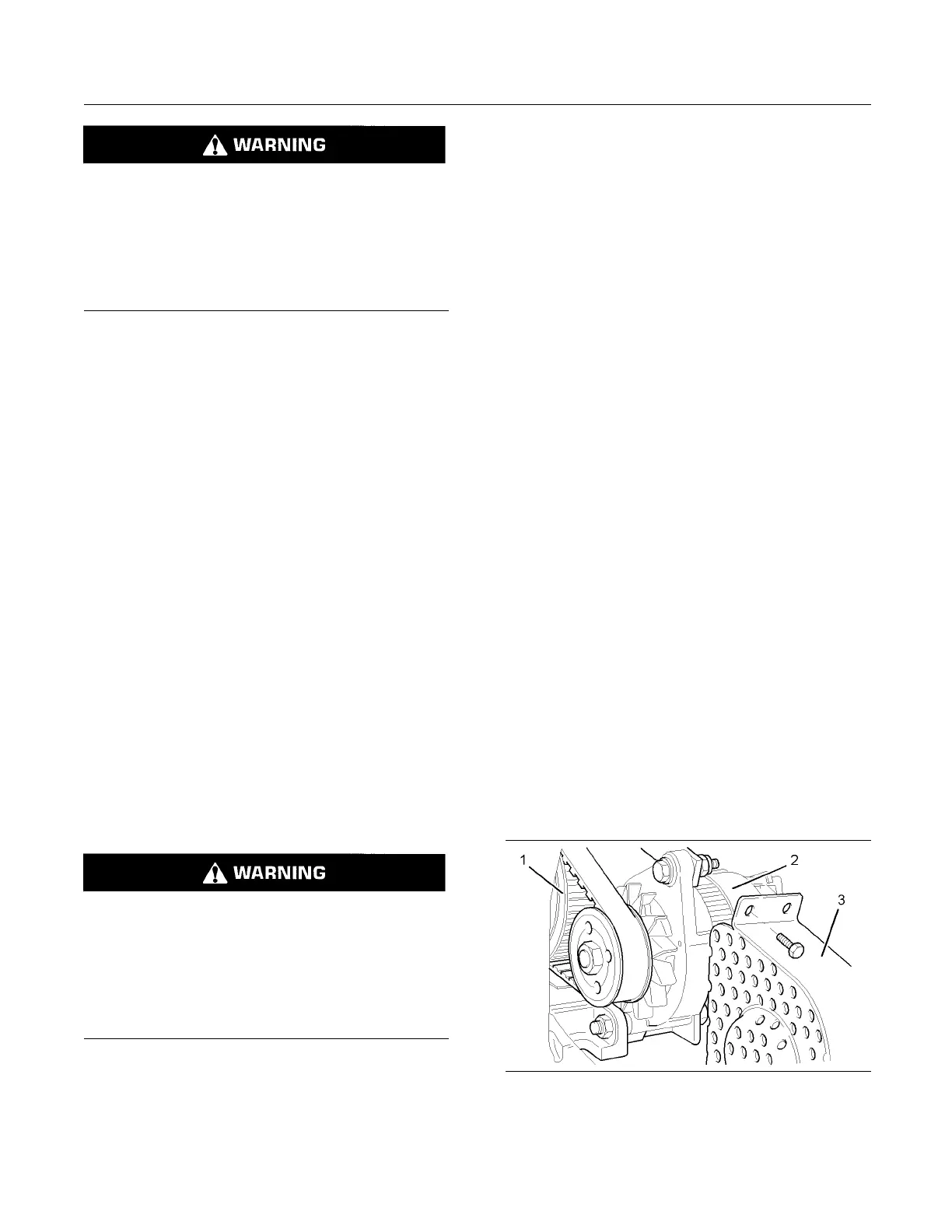
Illustration 28
Typ ical example
2. Remove the guard (3) in order to gain access to
the drive pulley (1) for the alternator (2).



 To Next Page