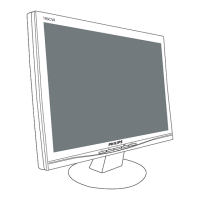
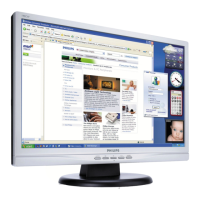
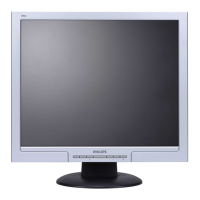
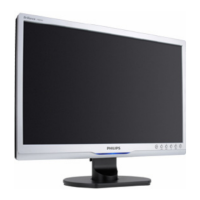
190CW9 LCD 15
FAQs (Frequently Asked Questionis)
devices (usually a mouse and modem), one Enhanced Parallel
Port add-on (scanner or video camera, for example), and a
joystick. More and more peripherals for multimedia computers
come on the market every day. With USB, up to 127 devices can
run simultaneously on one computer. USB permits "hot plug-in."
No need to shut down, plug in, reboot and run set up to install
peripherals. No need to go through the reverse process to unplug
a device. Bottom line: USB transforms today's "Plug-and-Pray"
into true Plug-and-Play!
Please refer to glossary for more information about USB
Q:WhatisaUSBhub?
A: A USB hub provides additional connections to the Universal
Serial Bus. A hub's upstream port connects a hub to the host,
usually a PC. Multiple downstream ports in a hub allows
connection to another hub or device, such as a USB keyboard,
camera or printer
LCD Panel Technology
Q: What is a Liquid Crystal Display?
A: A Liquid Crystal Display (LCD) is an optical device that is
commonly used to display ASCII characters and images on
digital items such as watches, calculators, portable game
consoles, etc. LCD is the technology used for displays in
notebooks and other small computers. Like light-emitting diode
and gas-plasma technologies, LCD allows displays to be much
thinner than cathode ray tube (CRT) technology. LCD consumes
much less power than LED and gas-displays because it works on
the principle of blocking light rather than emitting it.
Q:WhatdifferentiatespassivematrixLCDsfromactive
matrix LCDs?
A: An LCD is made with either a passive matrix or an active
matrix display grid. An active matrix has a transistor located at
each pixel intersection, requiring less current to control the
luminance of a pixel. For this reason, the current in an active
matrix display can be switched on and off more frequently,
improving the screen refresh time (your mouse pointer will
appear to move more smoothly across the screen, for example).
The passive matrix LCD has a grid of conductors with pixels
located at each intersection in the grid.
Q: What are the advantages of TFT LCD compared with
CRT?
A: In a CRT monitor, a gun shoots electrons and general light by
colliding polarized electrons on fluorescent glass. Therefore,
CRT monitors basically operate with an analog RGB signal. A
TFT LCD monitor is a device that displays an input image by
operating a liquid crystal panel. The TFT has a fundamentally
different structure than a CRT: Each cell has an active matrix
structure and independent active elements. A TFT LCD has two
glass panels and the space between them is filled with liquid
crystal. When each cell is connected with electrodes and
impressed with voltage, the molecular structure of the liquid
crystal is altered and controls the amount of inlet lighting to
display images. A TFT LCD has several advantages over a CRT,
since it can be very thin and no flickering occurs because it does
not use the scanning method.
Q: Why is vertical frequency of 60Hz optimal for an LCD
monitor?
A: Unlike a CDT monitor, the TFT LCD panel has a fixed
resolution. For example, an XGA monitor has 1024x3 (R, G, B) x
768 pixels and a higher resolution may not be available without
additional software processing. The panel is designed to optimize
the display for a 65MHz dot clock, one of the standards for XGA
displays. Since the vertical/horizontal frequency for this dot clock
is 60Hz/48kHz, the optimum frequency for this monitor is 60Hz.
Q: What kind of wide-angle technology is available? How
does it work?
A: The TFT LCD panel is an element that controls/displays the
inlet of a backlight using the dual-refraction of a liquid crystal.
Using the property that the projection of inlet light refracts toward
the major axis of the liquid element, it controls the direction of
inlet light and displays it. Since the refraction ratio of inlet light on
liquid crystal varies with the inlet angle of the light, the viewing
angle of a TFT is much narrower than that of a CDT. Usually, the
viewing angle refers to the point where the contrast ration is 10.
Many ways to widen the viewing angle are currently being
developed and the most common approach is to use a wide
viewing angle film, which widens the viewing angle by varying the
refraction ratio. IPS (In Plane Switching) or MVA (Multi Vertical
Aligned) is also used to give a wider viewing angle.
Q: Why is there no flicker on an LCD Monitor?
A: Technically speaking, LCDs do flicker, but the cause of the
phenomenon is different from that of a CRT monitor -- and it has
no impact of the ease of viewing. Flickering in an LCD monitor
relates to usually undetectable luminance caused by the
difference between positive and negative voltage. On the other
hand, CRT flickering that can irritate the human eye occurs when
the on/off action of the fluorescent object becomes visible. Since
the reaction speed of liquid crystal in an LCD panel is much
slower, this troublesome form of flickering is not present in an
LCD display.
Q: Why is an LCD monitor virtually low of Electro Magnetic
Interference?
A: Unlike a CRT, an LCD monitor does not have key parts that
generate Electro Magnetic Interference, especially magnetic
fields. Also, since an LCD display utilizes relatively low power, its
power supply is extremely quiet.
Ergonomics, Ecology and Safety
Standards
Q: What is the CE mark?
A: The CE (Conformité Européenne) mark is required to be
displayed on all regulated products offered for sale on the
European market. This 'CE' mark means that a product complies
with the relevant European Directive. A European Directive is a
European 'Law' that relates to health, safety, environment and
consumer protection, much the same as the U.S. National
Electrical Code and UL Standards.
Q: Does the LCD monitor conform to general safety
standards?
A: Yes. Philips LCD monitors conform to the guidelines of MPR-II
and TCO 99/03 standards for the control of radiation,
electromagnetic waves, energy reduction, electrical safety in the
work environment and recyclability. The specification page
provides detailed data on saf ety standards.
Q: After I change new PC, I found this information on screen,
how can I do?
A: Because you activate Theft Deterrence function in
SmartControl II. Please contact IT manager or Philips Service
Center.
http://www.wjel.net



 To Next Page