EasyManua.ls Logo

Philips PCL304 - Processor; Memory; Ram

Philips PCL304
82 pages
Print Icon
To Next Page IconTo Next Page
To Previous Page IconTo Previous Page
Loading...
2-2
2.2.1
Processor
The
central
processing
unit
consists
out
of
a
80C386SX
mi-
croprocessor
and
an
optional
80C387SX
numeric
coproces-
sor.
:
The
800386
generates
24
address
bits
and
16
data
bits.
The
24
address
bits
are
generated
by
23
dedicated
address
lines
A1
-
A23,
with
AO
being
derived
from
the
mic-
roprocessor
byte
low
enable
signal.
The
80C386SxX
instruc-
tion
set
is
a
superset
of
the
8086/8088
and
also
includes
the
instruction
set
of
the
80186.
The
80C386SxX
is
object
code
compatible
with
the
8086,
80286
and
80386
microprocessor.
2.2.2
Memory
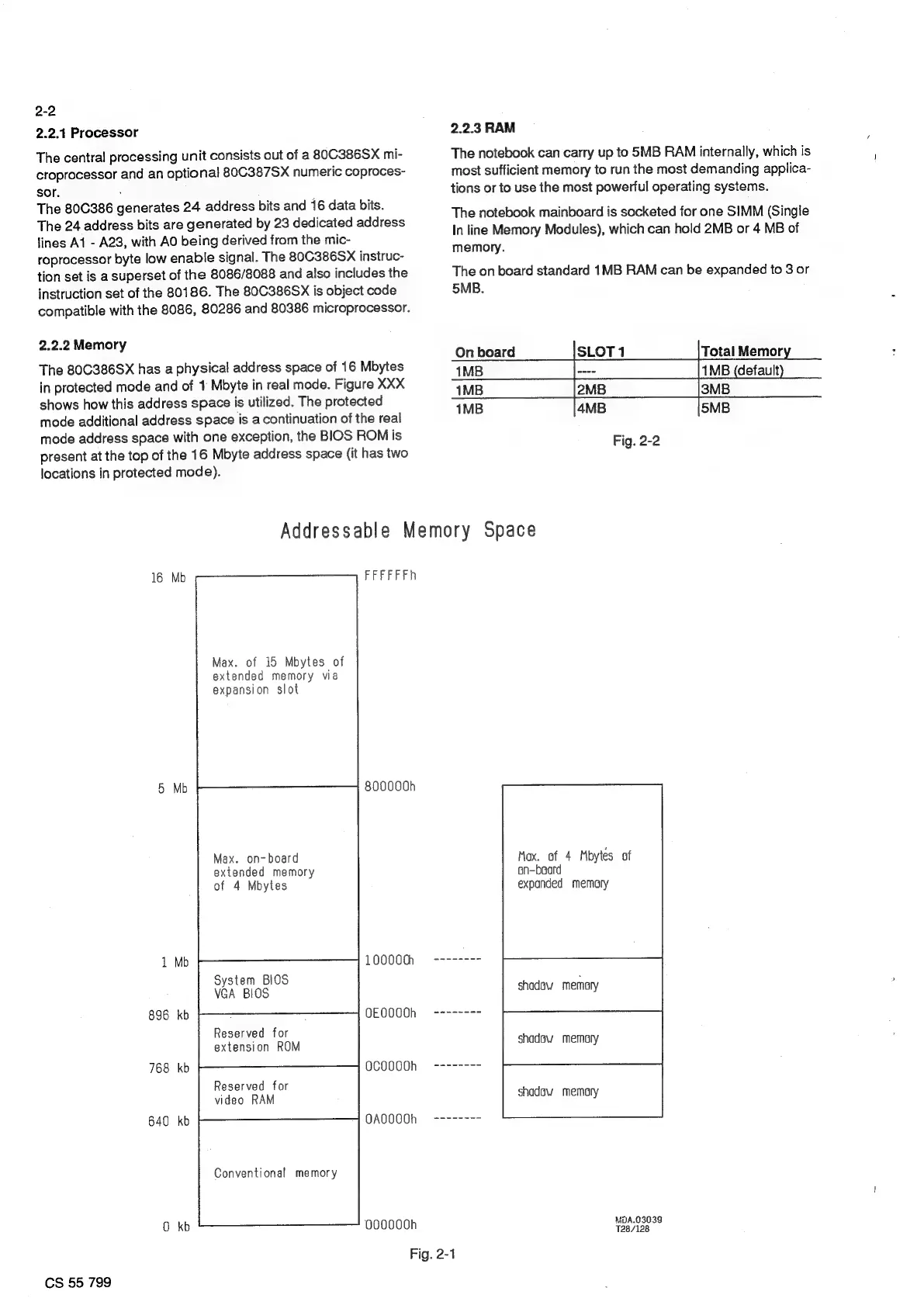
The
80C386SX
has
a
physical
address
space
of
16
Mbytes
in
protected
mode
and
of
1
Mbyte
in
real
mode.
Figure
XXX
shows
how
this
address
space
is
utilized.
The
protected
mode
additional
address
space
is
a
continuation
of
the
real
mode
address
space
with
one
exception,
the
BIOS
ROM
is
present
at
the
top
of
the
16
Mbyte
address
space
(it
has
two
locations
in
protected
mode).
2.2.3
RAM
The
notebook
can
carry
up
to
5MB
RAM
internally,
which
is
most
sufficient
memory
to
run
the
most
demanding
applica-
tions
or
to
use
the
most
powerful
operating
systems.
The
notebook
mainboard
is
socketed
for
one
SIMM
(Single
In
line
Memory
Modules),
which
can
hold
2MB
or
4
MB
of
memory.
The
on
board
standard
1MB
RAM
can
be
expanded
to
3
or
5MB.
On
board
Addressable
Memory
Space
16
Mb
FFFFFFR
Max.
of
15
Mbytes
of
extended
memory
via
expansion
slot
5
Mb
800000h
Max.
on-board
extended
memory
of
4
Mbytes
System
BIOS
VGA
BIOS
896
kb
Reserved
for
extension
ROM
768
kb
Reserved
for
video
RAM
640
kb
Conventional
memory
000000h
Fig.
2-1
CS
55
799
10000
----
OAQO00h
----
Mox.
of
4
Mbytes
of
an-beard
expanded
memory
shadaw
memo
shadow
mema
shadaw
memo
MDA.03039
728/128

Related product manuals