EasyManua.ls Logo

Philips PCL304 - Rom; Serial & Parallel Port Assignments

Philips PCL304
82 pages
Print Icon
To Next Page IconTo Next Page
To Previous Page IconTo Previous Page
Loading...
The
system
board
can
consists
of
the
following
memory
types:
Conventional
Memory:
This
is
the
memory
from
OKB
to
640KB
and
is
used
in
Real
Made
by,
e.g.,
DOS.
Extended
Memory:
This
is
all
addressable
memory
above
the
1MB
border
and
can
only
be
accessed
by
the
CPU
when
it
is
working
in
pro-
tected
mode.
Expanded
Memory:
Expanded
memory
is
not
addressable
by
the
CPU,
but
must
be
mapped
via
I/O
into
addressable
memory
within
the
first
1MB
of
address
space
in
memory
page
frames
of
16KB.
The
chips
in
this
system
support
LIM-EMS
4.0.
Shadow
Memory:
This
is
memory
between
640KB
and
1MB
which
is
normally
not
accessible
unless
the
chips
in
the
system
are
program-
med
to
enable
this
memory
to
copy
ROM
into.
It
can
also
be
mapped
to
addressable
memory
for
use
as
normal
RAM.
NOTE:
An
expansion
board,
connected
via
an
expansion
box,
with
expanded
memory
can
NOT
co-exist
with
the
on-board
ex-
panded
memory.
Only
one
of
the
two,
together
with
its
dri-
ver,
may
be
installed.
2.2.4
ROM
The
system
board
contains
one,
128K
by
8-bit
EPROM
mo-
dule.
The
ROM
is
not
parity
checked
and
has
an
access
time
of
200ns.
The
ROM
is
a
combined
BIOS
containing
the
system
BIOS
and
video
BIOS.
It
also
contains
the
power
on
testing
and
boot
loader.
To
gain
faster
access,
the
BIOS
can
be
copied
to
RAM
du-
ring
power
on
(refer
to
section
4.1).
The
system
BIOS
is
present
at
the
following
location:
At
the
top
of
the
first
1
Mbyte
of
address
space
(0F0000
h
-
OFFFFF
h)
The
video
BIOS
is
present
at
the
following
location:
In
the
area
from
512
Kbyte
to
576
Kbyte
(0E0000
h
-
OEFFFF
h)
2.2.5
VO
Connections
On
the
main
board,
the
following
Input/Output
connections
are
provided:
CN2:
Expansion
slot
connector.
This
connector
is
located
at
the
rear
side
of
the
notebook.
CN11:
20-pin
flexible
flat
cable
diskette
drive
controi/data
connector.
CN6:
44-pin
header,
AT-bus
connector,
used
to
connect
AT-
embedded
hard
disk
drives
DB-9P,
serial
port
connector.
Via
the
SETUP
program
this
port
can
be
disabled,
or
can
be
configured
as
PORT
1.
PORT
1
has
the
base
I/O
address
3F8h.
For
COM
port
assignments,
refer
to
subsection
2.2.4.1.
CN:
2-3
Ji:
DP-25P,
serial
port
connector.
Via
the
SETUP
program
this
port
can
be
disabled,
or
can
be
config/ted
as
PORT
2.
PORT
2
has
the
base
I/O
address
of
2F8h.
For
COM
port
assignments,
refer
to
subsection
2.2.4.1.
DB-25S,
parallel
port
connector.
Via
the
SETUP
pro-
gram
this
port
can
be
disabled,
or
can
be
Ā¢Onfigured
as
PORT
2.
PORT
2
has
the
base
I/O
address
378h.
For
LPT
port
assignments,
refer
to
subsection
2.2.4.1.
CN4:
CN1:
DB-15S,
analog
video
connector.
This
pot
can
be
disabled/
enabled
via
software,
[Fn]
+
[F10}.
CN14:
6-pin,
Mini-Din
type
keypad
connector.
This
port
sup-
ports
AT
compatible
types
only.
CN13:
6-pin,
Mini-Din
type
PS/2
Mouse
connector.
This
port
supports
PS/2
compatible
types
only.
2.2.6
Serial
And
Parallel
Port
Assignments
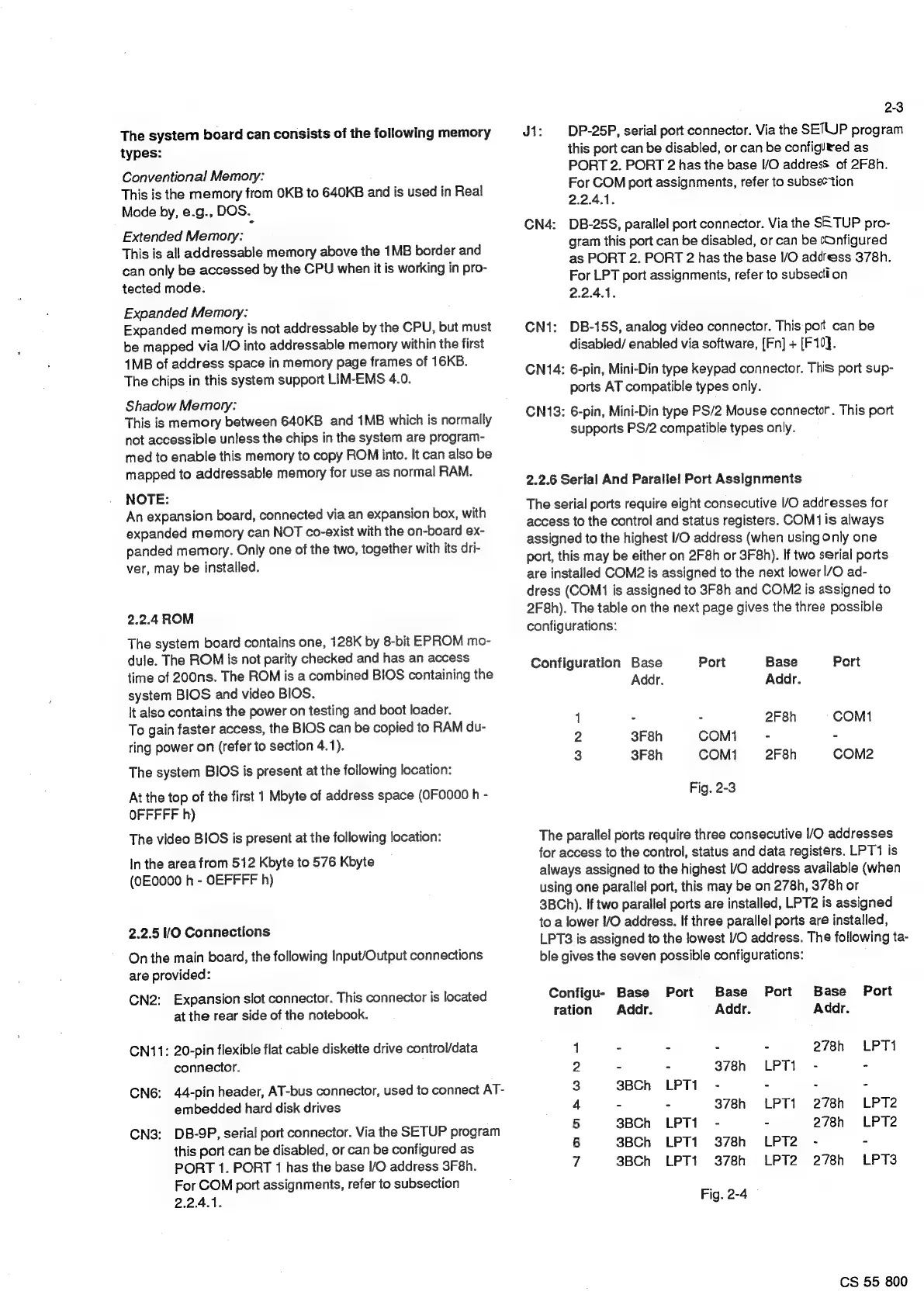
The
serial
ports
require
eight
consecutive
I/O
addresses
for
access
to
the
control
and
status
registers.
COM1is
always
assigned
to
the
highest
/O
address
(when
using
only
one
port,
this
may
be
either
on
2F8h
or
3F8h).
If
two
serial
ports
are
installed
COM2
is
assigned
to
the
next
lower
I/O
ad-
dress
(COM1
is
assigned
to
3F8h
and
COM2
is
assigned
to
2F8h).
The
table
on
the
next
page
gives
the
three
possible
configurations:
Configuration
Base
Port
Base
Port
Addr.
Addr.
1
- -
2F8h
COM1
2
3F8h
COMi
-
-
3
3F8h
COM1
2F8h
COM2
Fig.
2-3
The
parallel
ports
require
three
consecutive
I/O
addresses
for
access
to
the
control,
status
and
data
registers.
LPT1
is
always
assigned
to
the
highest
/O
address
available
(when
using
one
parallel
port,
this
may
be
on
278h,
378h
or
3BCh).
If
two
parallel
ports
are
installed,
LPT2
is
assigned
to
a
lower
V/O
address.
If
three
parallel
ports
are
installed,
LPT3
is
assigned
to
the
lowest
I/O
address.
The
following
ta-
ble
gives
the
seven
possible
configurations:
Configu-
Base
Port
Base
Port
Base
Port
ration
Addr.
Addr.
Addr.
1
- - -
-
278h
LPTi
2
-
-
378h
LPT1
-
-
3
3BCh
LPT1
-
-
-
-
4
-
-
378h
LPT1
278h
LPT2
5
3BCh
LPT1
- -
278h
LPT2
6
3BCh
LPT1
378h
LPT2
-
-
7
3BCh
LPT1
378h
LPT2
278h
LPT3
Fig.
2-4
CS
55
800

Related product manuals