ManualAVM
TM
2Page 17/24
Operation
•
LEDs that show the status of valves and vacuum
signals.
•
LED display that shows the current vacuum level
in -kPa or -inHg in the normal position.
•
On AVM™2 units for P6010, there is an option to
blow from a separate port to maximize blow-off
efficiency in the vacuum system.
•
Integrated non-return valve. Maintains vacuum in
case of compressed air or electricity failure.
5.4 With energy-saving function activated
5.4.1 With energy-saving function activated
One way of saving compressed air (energy) is to use
the built-in energy-saving function. It is
recommended in all airtight systems when, for
instance, handling sheet metal. Press the ES button
so that the LED indicator of the energy-saving
function (ES) is lit. As an alternative ES can be
activated via a control signal (Pin No. 8). The control
signal has priority over the manual ES button.
1
2
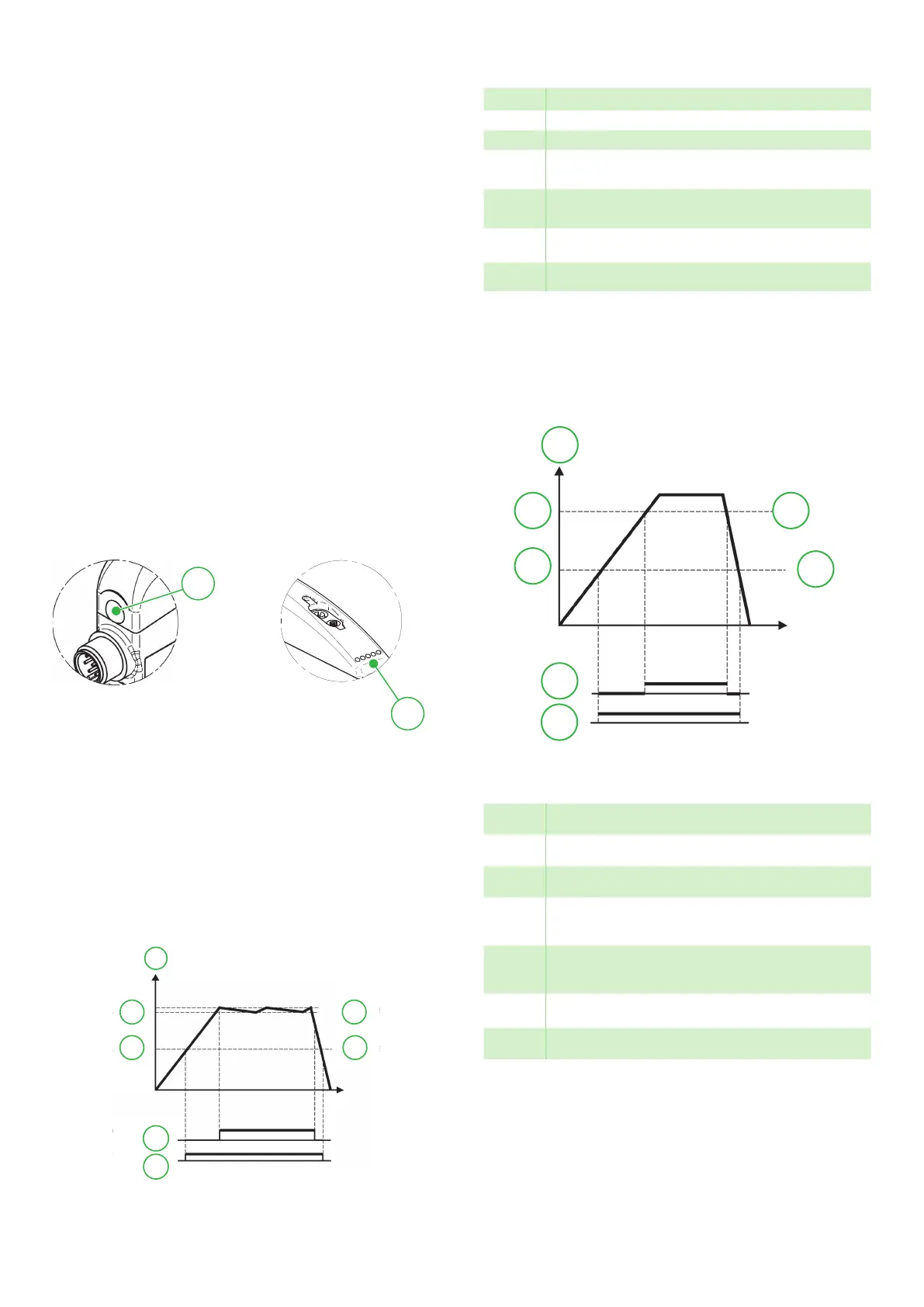
Figure 15 1: ES on/off button, 2: ES.
Valve V2 (blow-off) is controlled directly from the
control input. Signals from the vacuum sensors, S1
and S2 go directly to the outputs. The S2 signal also
controls V1 (vacuum on/off) if the ES button is
activated. When the preset vacuum level for S2 is
reached, the system shuts off the vacuum ejector
and when the vacuum level drops below the start-up
level (S2 minus hysteresis, about 7 -kPa [2 -inHg]),
the ejector automatically restarts.
C
A
F
G
C
D
E
B
Figure 16 With energy-saving function activated.
A
Vacuum
B Level S1
C Level S2
D
Output S2 on
off
E Output S1 on
off
F
Hysteresis 7 kPa
G
Hysteresis 7 kPa
5.5 Without energy-saving function
If the vacuum system is leaking, for instance, when
handling corrugated cardboard material, the
energysaving function should not be used. Inactivate
ES so that the LED for ES is turned off.
A
E
G
D
C F
B
Figure 17 Without energy-saving function activated.
A
Vacuum
B
Level S1
C
Level S2
D
Output S2 on
off
E Output S1 on
off
F
Hysteresis 7 kPa
G
Hysteresis 7 kPa


 To Next Page