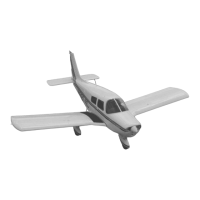
TWIN COMANCHE C.‘R
VMC AND STALL SPEED
More power is available on the operating engine at lower altitudes (if the engine is normally aspirated)
and hence there can be more asymmetric thrust. The Vmc is highest at low altitudes. The Vmc decreases
with altitude and at higher altitudes the airplane will approach a stall speed before reaching Vmc. The most
critical situation occurs at the altitude where the stall speed and Vmc speed coincide. Care should be taken
to avoid this flight condition because at this point loss of directional control could lead to a spin,
SINGLE ENGINE FLIGHT
During single engine flights be sure that the gear and flaps are fully retracted when climbing at the best
single engine climb speed. Speeds above or below the best single engine climb speed will decrease climb
performance. Close the cowl flap on the inoperative engine and trim the airplane to reduce drag.
RECOMMENDED PRACTICE
When operating single engine maintain speed above 90 mph. This
speed, 90 mph, will not provide optimum single engine climb
performance. Optimum single engine climb is obtained at the best
single engine rate of climb speed, 105 mph, with the operating
engine at full throttle, 2700 rpm and the inoperative engine
propeller feathered and cowl flap closed. The gear and wing flaps
must be retracted.
LOADING AND WEIGHT AND BALANCE
CAtJTION
,‘>
,.
It is the responsibility of the owner and pilot to determine that
the gross weight of the airplane is not exceeded and to determine
that the airplane remains within the allowable weight vs center of
gravity envelope while in flight. The owner or pilot must
determine before each flight that the gross weight is not exceeded
and that the center of gravity is within allowable limits. For
weight and balance see the Airplane Flight Manual and Weight and
Balance form supplied with each airplane.
Weight and balance determination should be accomplished with
the Weight and Balance Plotter supplied with the airplane.
The airplane can carry six passengers with less than the fulI fuel
capacity of 90 gallons (without wing tip tanks) and less than the
aliowable baggage. The two rear family seats, if installed, are
designed and placarded to carry not more than 235 lbs. total. With
these two rear family seats removed, the area remaining (baggage)
will carry up to 250 lbs. depending upon airplane loading. It wiIl
carry fewer passengers and baggage with full fuel tanks. As with
any airplane, improper loading will cause undesirable flight
characteristics if.the airplane approaches a critical or marginal
flight condition.
OPERATINGINSTRUCTIONS
ISSUED: June 1,197O PAGE 13


 To Next Page
 Loading...