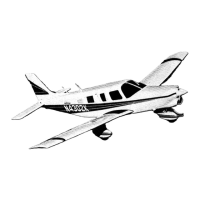
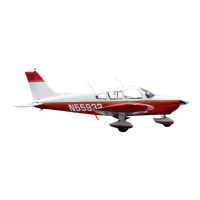
TWIN COMANCHE C/R
1
1
Make sure that
baggage
and/or cargo are secured properly with tie
down straps to avoid an accidental in-flight shift of the center of
gravity or injury to passengers.
With tip tanks installed, the airplane has an allowable gross weight
of 3725 pounds. It is important to remember that any weight in
excess of 3600 pounds however, must be in the form of fuel in the
tip tanks.
ALTERNATE INDtiCTION AIR
When flying in wet, heavy snow or other conditions where the induction air filters may become
clogged, monitor the manifold pressure gauge. A decrease in manifold pressure may indicate a clogged filter.
If the decrease is followed by a slight increase in manifold pressure, this will then indicate that the
automatic alternate induction air system is in operation, and the manifold pressure may then be brought
back to the desired level with the throttle control.
i’
1
A continued drop in manifold pressure would indicate that the automatic induction air system was not
working. In this case, actuate the manual alternate air control, which serves as a backup for the automatic
1
system. A partial regain of manifold pressure will indicate that the manual alternate air induction system is
operating. Throttle controls may be advanced to gain additional manifold pressure.
The manual alternate air control should not be actuated on the ground with the engines operating,
1
because the engines would then be supplied with unfiltered air.
ROUGH AIR FLIGHT
In conditions of extreme turbulence, reduce power to slow the airplane below the design maneuvering
speed of 162 miles per hour.
c
A further reduction of power wiIl ease the stress to which the airplane is subjected by virtue of
turbulence. When flying in extreme turbulence or strong vertical currents, using the autopilot, the
I
altitude-hold mode should not be used. s
I
Secure seat belts and shoulder harness in extreme turbulence.
RADIO OPERATION
li
Communication and navigational equipment controls are located in the center of the instrument panel.
Associated switches are located in a junction box above the radio stack. Circuit breakers for the radios are
located on the lower right sub-panel. Ail sets are turned on by the switch in the control head of each unit.
m
After power is supplied, either one of the transmitters may be operated by moving the selector switch to
the desired position.
PAGE 14
OPERATING RWi’RUCTIONS
ISSUED: March 17.1971
REVISED: February 20,1972


 To Next Page
 Loading...