5
grounded in accordance with best practices. The footprint is 8.25 inches (210 mm) by 6.25 inches (159
mm) with mounting slot locations on a rectangle 7.625 inches (194 mm) in the horizontal and 4.0 inches
(102 mm) in the vertical. See drawing at the end of this document. To avoid an electrical hazard while
operating the unit inside the enclosure, all live parts in the enclosure shall be IP2X or better.
If the control module is mounted external to an enclosure or on an enclosure door, an adequate cover
must be installed over the exposed connectors to achive IP4X protection or better. The door must be
permanently grounded and good electrical contact between the control module and grounded door
must be achieved.
Wiring the Control Module
Probe cable routing must follow best practices to isolate the sensitive probe signals from sources of
interference such as AC mains, variable frequency drives, digital switching signals and other high
current, high voltage or high speed signals. Power wiring to the unit should also follow best pratices to
isolate the low-voltage DC power from AC mains and other high voltage or high current wires. Where
paths must cross, their intersection should be perpendicular.
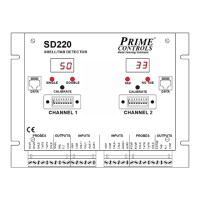
1. Connect +24V DC power between both sets of the +24V and COM terminals of the control
module. The left and right side modules are electrically independent and must be powered
independently. The two +24V terminals are NOT internally connected. The supply must be
capable of delivering 0.250 amps continuously with a startup surge of 0.500 amps for 2
milliseconds.
2. Connect the double detecting transmitter probe wires to the two TMTR terminals on the
channel 1 side of the control module and the double detecting receiving probe wires to the two
RCVR terminals on the channel 1 side of the control module. The probe connections are not
polarized. Connect the shield wires to the terminal labeled SHLD.
Though both the transmitting and receiving probes are identical, it is preferred practice to
choose the transmitting probe as the one that will remain farthest from the track as it moves
and stretches.
On retrofit installations where older three wire probes are installed, cut back and do not
connect the third (white) wire. If in doubt about which wires to use, measure the resistance
between the wires in pairs, and then use the pair that produces the highest resistance reading
(typically 24 ohms).
3. Connect the tab detecting transmitter probe wires to the TMTR terminals on the channel 2 side
of the control module and the tab detecting receiving probe wires to the two RCVR terminals on
the channel 2 side of the control module. Connect the shield wires to the terminals labeled
SHLD.
The precautions regarding choice of transmitter probe are the same for the discharge side as for
the infeed. See above.


 To Next Page