3
If the display flashes alternately “CAL” and “Lo”, the calibration was unsuccessful due to
insufficient signal at the receiving probe. This can be an indication that the probes are too far
apart or that the unit is not set to the appropriate frequency for the material being sensed, e.g.
frequency set to aluminum when steel ends are present. If the display flashes alternately “CAL”
and “Hi”, the receiver signal is too strong indicating nothing between the probes.
If the calibration problem is not resolved and the calibration switch is not pressed again within
30 seconds, calibration mode is aborted and the previous calibration values are reinstated.
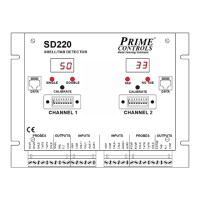
4. Press the CALIBRATE pushbutton on channel 2 of the SD220/SD230 control module and observe
the TAB and NO TAB LEDs flashing alternately and “CAL” on the digital display. If the calibration
is successful, the LED flashing stops in less than 3 seconds and a number between 28 and 33 is
displayed.
If the display begins to alternately flash “CAL” and “Lo”, the calibration was unsuccessful due to
insufficient signal at the receiving probe. This can be an indication that the probes are too far
apart or that the unit is not set to the appropriate frequency for the material being sensed, e.g.
frequency set to aluminum when steel ends are present.
If the calibration problem is not resolved and the calibration switch pressed again within 30
seconds, calibration mode is aborted and the previous calibration values are reinstated.
If both channels calibrate successfully, calibration is complete. The calibration process may also be
initiated through an external switch or signal controlling the CAL+ and CAL- inputs to the SD220/SD230.
Activation of this input performs the same function as pressing the CALIBRATE push-button switch for
the corresponding channel.
Fault Message Interpretation
The SD220/SD230 monitors the probe connections on a continuous basis and reports what it detects to
be disconnected or malfunctioning probes. The probe faults are reported as follows:
Alternately flashing “PR” and “1” - transmitter probe disconnected or failing
Alternately flashing “PR” and “2” - receiver probe disconnected or failing
Alternately flashing “PR” and “3” - both probes disconnected or failing
During calibration:
Alternately flashing “CAL” and “Lo” indicates a low signal at the receiving probe.
Alternately flashing “CAL” and “Hi” indicates the signal at the receiver is too strong, likely no end
between the probes.
The SD220/SD230 performs extensive self-diagnostics at power up and more limited diagnostics while
running. Most fatal faults, if not involving the display subsystem, are reported on the digital displays
through the alternate flashing of “Err” and “nnn” where “nnn” is a one to three digit number indicating


 To Next Page