10
2. Release the pushbutton and the display changes to “0” or “1”.
3. At this point, with each press of the pushbutton the display toggles between “0” and “1”. The 0
selects normal display mode, 1 selects inverted mode..
4. When the desired value is on the display, wait 5 seconds and the display reverts to displaying
the signal value in the selected mode.
Set Quick Calibration Changeover
When TriSense is not enabled (tr = 0) the AUX input may be used to quickly change between sensed
metal types. By default (AU=0), Quick Calibration Changeover is disabled and the AUX input has no
effect on the metal sensing process. When enabled (AU=1), the AUX input works in conjunction with
SW1 (both channels) and SW2 (channel 2 only) to select the target tab and shell material combinations
as presented in the Quick Calibration Changeover section below.
To change the Quick Calibration Changeover setting:
1. Press and hold the calibrate pushbutton until “AU” appears on the display.
2. Release the pushbutton and the display changes to “0” or “1”.
3. At this point, with each press of the pushbutton the display toggles between 0 and 1. The 0
selects normal display mode, 1 selects inverted mode.
4. When the desired value is on the display, wait 5 seconds and the display reverts to displaying
the signal value in the selected mode.
Parameter Ranges
The range of values available for the SD220/SD230 adjustable parameters are as follows:
Parameter Value Ranges
TriSense Operation
(SD230 only)
0 No TriSense (default), 1 TriSense without Flash
Detect, 2 TriSense with Flash Detect (uses AUX input)
10% to 90% for double (default is 35%)
10% to 90% for tab (default is 15%)
0 for signal strength (default), 1 relative thickness
0 AUX does not control sensing mode (default), 1 AUX
controls sensing mode
0% to 90% for off-press sensing only (SW2 On)
10% to 15% for off-press sensing only (SW2 On)
Special Functions
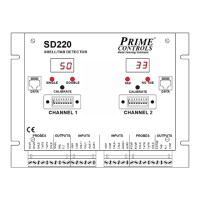
The SD220/SD230 offers two sets of optically isolated inputs on each channel that provide added control
over the unit. These are the remote calibration input terminals labeled CAL+ and CAL- and the sensing
mode inputs labeled AUX+ and AUX-.


 To Next Page