19
SUMMARY OF DIFFERENCES BETWEEN SD200 AND SD220/SD230
+24V and COM to left or right
channel
+24V and COM to both channels
Fault signals are slaved internally
Fault signals must be monitored
independently and must not be
AUX input frequency change
AUX inputs are slaved internally
Both AUX inputs must be driven
externally
Number of configuration
switches
Al tab on steel end sensing
SU parameter set through front
panel
Pd parameter set through front
panel
SD200 TO SD220/SD230 MIGRATION
Replacement of installed SD200 units by SD220/SD230s requires the following wiring changes:
1. +24V and COM must be connected to both channels of the SD220/SD230.
2. SD200 faults for either channel are reported on both fault outputs. The fault signals on the two
channels of the SD220/SD230 are totally independent and must not be wired together.
3. If your installation uses the AUX input to quickly change between calibrations on different shell
materials, it is necessary with the SD220/SD230 to activate the AUX input on both channels
independently. The AUX inputs are not slaved together as in the SD200.
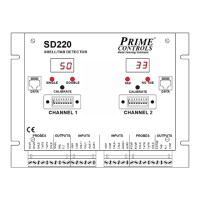
Configuration of the SD220/SD230 has been simplified as compared to the SD200. It is no longer
necessary to remove the cover to change options. These changes include:
1. The DIP switches, now eight per channel instead of four per unit, are accessible through a
window on the front panel.


 To Next Page