© 2016 Proceq SA 15
3.3.1.5 Selecting the Equotip Leeb Impact Device
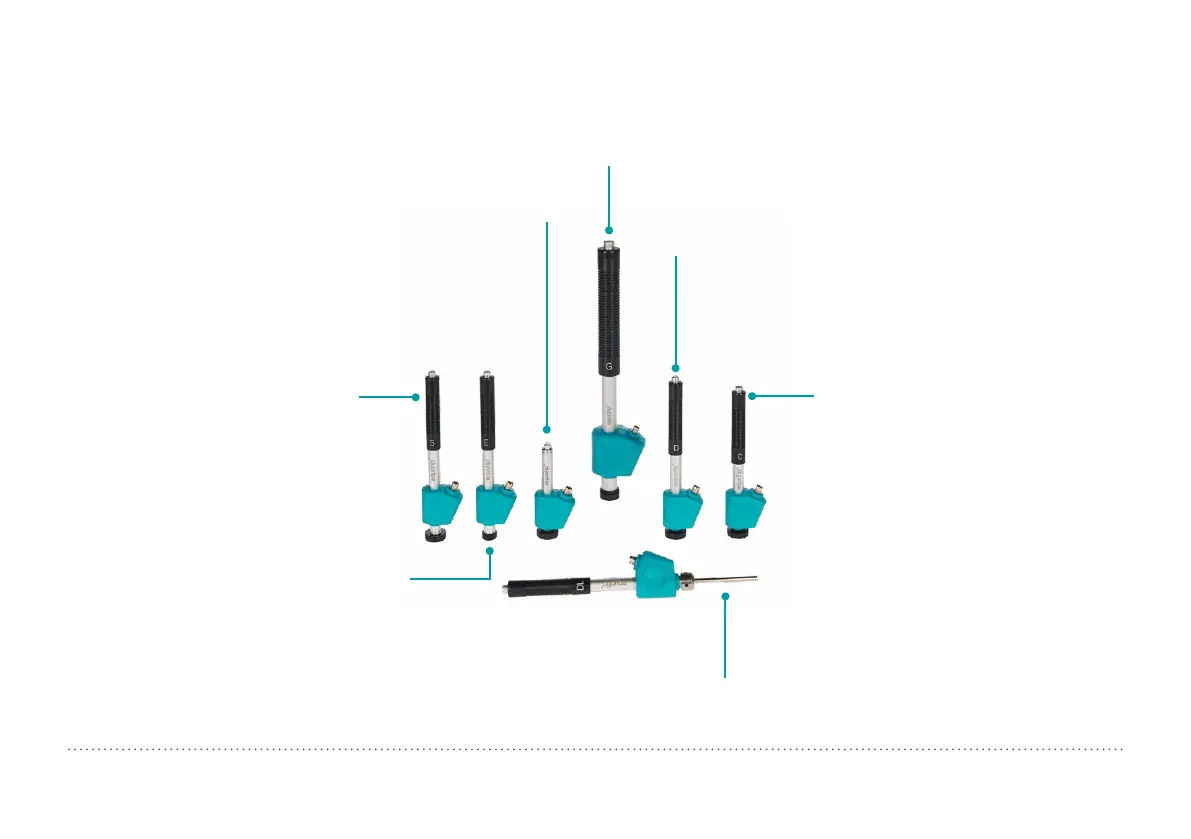
For optimized testing of diverse metallic materials and sample geometries, a range of impact devices are available as per “Table 1: Leeb Test Piece
Requirements”.
Type G: Increased impact energy. For solid and inhomogenous
components, e.g. heavy castings and forgings.
Impact energy: 90 Nmm
Type D: Universal unit. For the majority of
your hardness testing requirements.
Impact energy: 11 Nmm
Type C: Reduced impact energy. Surface
hardened components, coatings, thin
walled or impact sensitive components
(small measuring indentation).
Impact energy: 3 Nmm
Type DL: Slim front section.
For measurements in confined spaces, at the
base of grooves or on recessed surfaces.
Impact energy: 11 Nmm
Type DC: Short device. For use in very
confined spaces, e.g. in holes, cylinders or
for internal measurements on assembled
machines. Impact energy: 11 Nmm
Type S: Si3N4 ball indenter. For testing
especially in the very high hardness range
(in excess of 50 HRC / 650 HV): Tool steels
with high carbide content inclusions.
Impact energy: 11 Nmm
Type E: Diamond ball indenter.
For testing in the very high hardness
range (in excess of 50 HRC / 650 HV):
Tool steels with high carbide content
inclusions. More durable than type S.
Impact energy: 11 Nmm
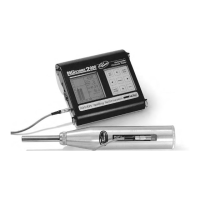
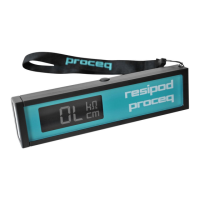
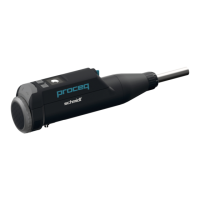
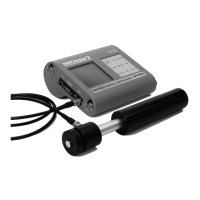
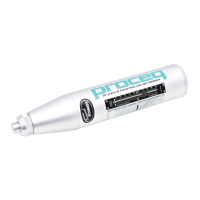
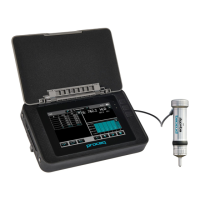
Figure 13: Equotip Leeb Impact Devices




 To Next Page