OPERATING
INSTRUCTIONS
S2
LABEL
SEWER -
MODEL
S2 LS2N - RANGE
1/4"
-
2"
For
maximum
operating
efficiency
use
theshortest
Clamp
Arm,
Clamp
Footand
Adjustable
Slide,
listed
below,
for
the shortest sewing range
that
will accommodate your labels.
SEWING
RANGE
CLAMP
FOOT
CLAMP
ARM
ADJUSTABLE
SLIDE
1/4"
to
7/8"
1/4"
to
5/8"
to
2"
20-0650-0-406
20-0650-0-606
20-0650-0-706
20-0649-1405
20-0649-1-605
20-0649-0-705
20-0240-0-405
20-0240-0-605
20-0240-0-705
SINGLE OR
TWO
ROW
STITCHING
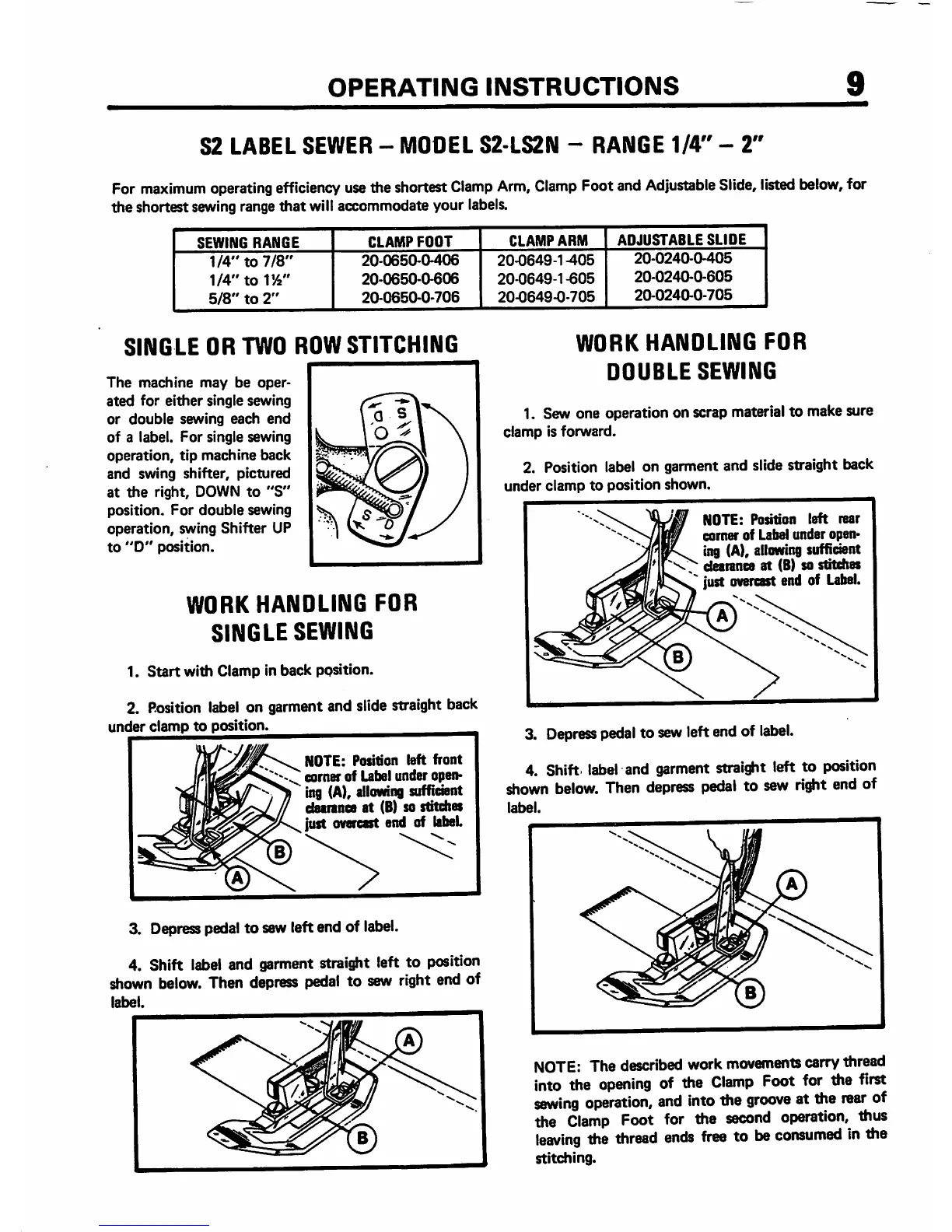
The
machine
may
be
oper
ated
for
either
single
sewing
or
double
sewing
each
end
of
a label.
For
single sewing
operation,
tip
machine
back
and
swing
shifter,
pictured
at
the
right, DOWN
to
"S"
position.
For
double
sewing
operation, swing
Shifter
UP
to
"D"
position.
WORK HANOLING
FOR
SINGLE SEWING
1.
Start
with Clamp in back position.
2. Position
label
on garment and slidestraight back
under clamp to position.
NOTE: Position left front
corner of Label under open
ing
(A),
allowing
sufficient
dearanoe at (B) so stitches
just
overcast
end of label
3.
Depress
pedal to sew left end of label.
4. Shift
label
and garment straight left to position
shown
below.
Then
depress
pedal
to
sew
right end of
label.
WORK
HANOLING
FOR
DOUBLE
SEWING
1. Sew one operation on scrap material to make sure
clamp is forward.
2. Position label on garment and slide straight back
under clamp
to
position shown.
NOTE: Position loft rear
corner of Label under open
ing
(A),
allowing
sufficient
deaiance at (B) so stitches
just
overcast
end
of
Label.
3.
Depress
pedal
to
sew
leftendof
label.
4. Shift
label
and garment straight left to position
shown
below.
Then
depress
pedal
to sew ric^t end of
label.
NOTE:
The
described
work
movements
carrythread
into
the
opening
of the
Clamp
Foot
for die
first
sewing
operation,
and
into
the
groove
at
the
rear
of
the
Clamp
Foot
for
the
second
operation,
thus
leaving
the
thread
ends
free
to
be
consumed
in
the
stitching.



 To Next Page