2.96
ENG_UD77931_2
Régulateur de vitesse adaptatif (XFK - Renault)
In all circumstances, the standby is con-
firmed when the warning lights appear
in grey and the message “Adaptive
Cruise Ctl Disconnected” appears on
the instrument panel.
STOP AND GO ADAPTIVE CRUISE CONTROL (6/14)
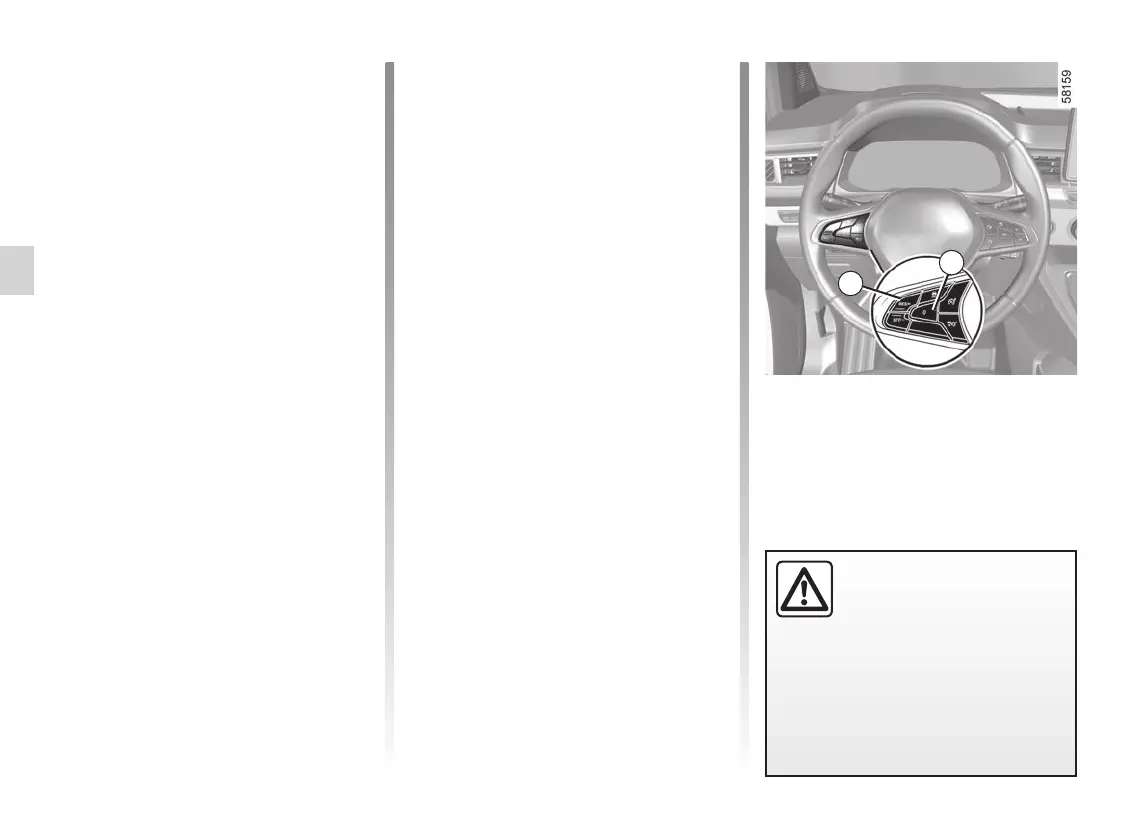
4
7
Putting the Stop and Go
adaptive cruise control in
standby or switching it off
does not cause a rapid re-
duction in speed: you must brake
by applying the brake pedal if nec-
essary.
Putting the function on
standby
You can set the function to standby
when:
– you press switch 4 (0);
– you apply the brake pedal while the
vehicle is moving.
The function is deactivated by the
system if:
– you put the gear control in P or N po-
sition;
– you engage the reverse gear;
– you unbuckle the driver’s seatbelt;
– you open one of the opening ele-
ments;
– you press the engine start/stop
button;
– the slope is too steep;
– the vehicle speed is above 84 mph
(135 km/h);
– certain driving aids and correction
devices are triggered (active emer-
gency braking, ABS, ESC.).
Stop and start
If the vehicle in front slows down, the
system adapts its speed, if necessary
to a complete stop (e.g. in heavy traf-
fic). The vehicle stops a few metres
from the vehicle in front.
When the vehicle in front sets off again:
– if the stop does not exceed about
three seconds, the vehicle sets off
automatically without any action by
the driver;
– if the stop exceeds about three sec-
onds, you must apply the accelera-
tor pedal or press button 7 (RES/+) in
order for the vehicle to set off again.
The message “Press RES/+ or ac-
celerate” appears on the instrument
panel to confirm.
If the stop exceeds about three min-
utes, the electronic parking brake is
automatically applied and the Stop
and Go adaptive cruise control is de-
activated. The
warning light disap-
pears to confirm that the function is de-
activated.






 To Next Page