TYRES
6
344 - Practical advice
Tyres
Tyre and wheel safety
The tyres are the only contact between
thevehicleandtheroad,soitises-
sential to keep them in good condition.
You must make sure that your tyres
con-formtolocalroadtrafficregula-
tions.
Maintaining the tyres
The tyres must be in good condition
and the treads must have sufficient
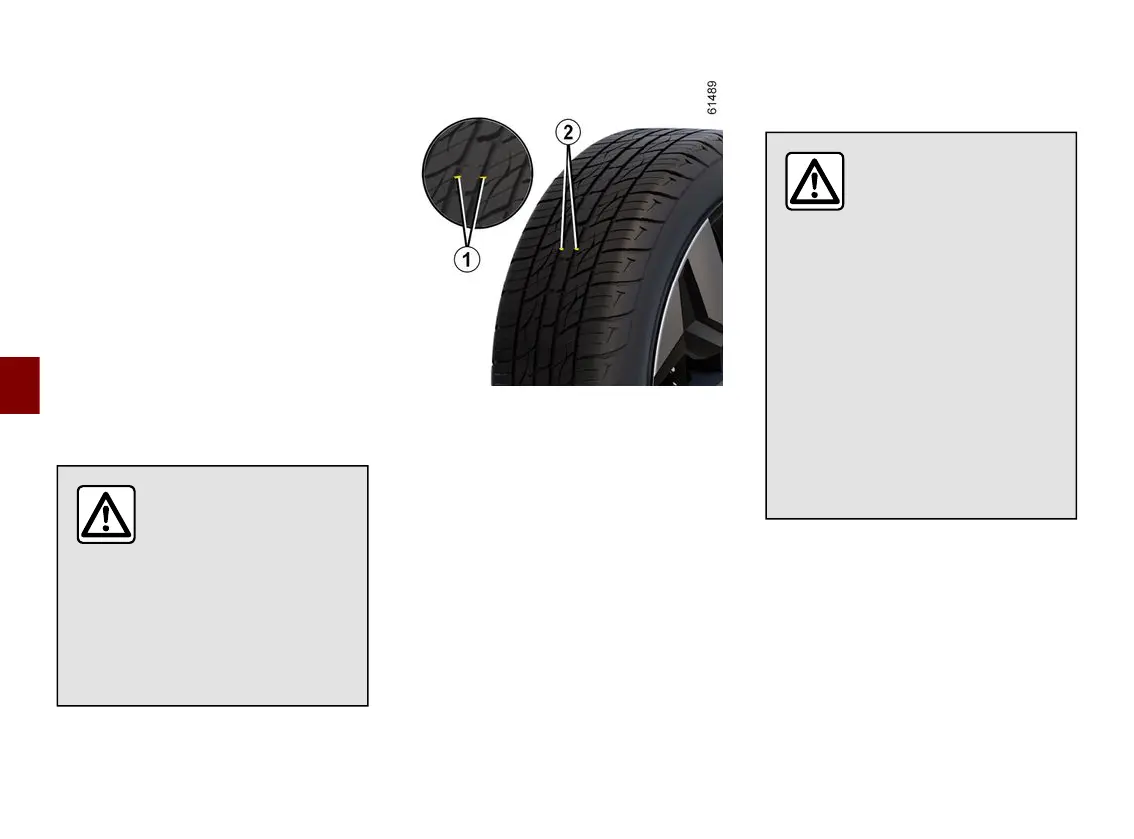
depth: tyres approved by our Technical
Department have wear warning strips
1
which are indicators moulded into
the tread at several points.
Incidents which occur
when driving, such as
striking the kerb, may
damage the tyres and
wheel rims, and could also lead to
misalignment of the front or rear
axle geometry. In this case, have
the condition of these checked by
an approved dealer.
When the tyre tread has been worn to
the level of the wear indicators these
become visible
2
: it will then be
necessary to replace your tyres as
the tread depth will be 1.6 mm at
most, resulting in poor road-holding
on wet roads.
An overloaded vehicle, long journeys
by motorway, particularly in very hot
weather, or continual driving on poorly
surfaced minor roads will lead to more
rapid tyre wear and affect safety.
Tyre pressures
Adhere to the tyre pressures (including
the emergency spare wheel). The tyre
pressures should be checked at least
once a month and additionally before
anylongjourney(refertothelabelaf-
fixed to the edge of the driver's door).
Incorrect tyre pres
sures lead to abnormal
tyre wear and unusually
hot running. These are
factors which may seriously affect
safety and lead to:
– poor road holding;
– the risk of blow-outs or of
throwing a tread.
The pressure depends on the
load and the speed of use. Adjust
the pressure according to the
conditionsofuse(refertothela-
bel affixed to the edge of the
driver's door).
Pressures should be checked when
thetyresarecold.Ignorehigherpres-
sures which may be reached in hot
weather or after driving at high speed.
If tyre pressures cannot be checked
when the tyres are cold, assume an
increase of 0.2 to 0.3bar(or3PSI).
Never deflate a hot tyre.



 To Next Page