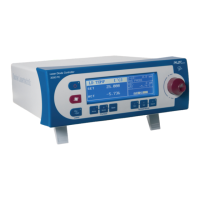
Operation Manual LB2001
Sacher Lasertechnik
GmbH
_____________________________________________________________________________________________________
Adress:
Sacher Lasertechnik GmbH
Rudolf-Breitscheid-Str. 1-5
D-35037 Marburg, Germany
Tel.: +49 (6421) 305-0
Fax.: +49 (6421) 305-299
EMail: contact@sacher-laser.com
Web: http://www.sacher-laser.com
Sacher Lasertechnik, LLC
5765 Equador Way
Buena Park, CA 90620, USA
Tel.: 1-714-670-7605
Fax: 1-714-670-7662
Email: sales@sacher-
laser.com
Page 13
Version:
Preliminary 2011-01-01
4. Getting Started
4.1. General
This chapter explains the typical setup and operation of the LB2001 Servo Controller. This
chapter should help less experienced users rapidly adapt the LB2001 to their specific servo
application. Keep in mind that while the LB2001 has a flexible architecture that lends itself
well to many feedback control applications, not all types of operation can be adequately
addressed in this manual. The following are general guidelines for operating the LB2001, and
some deviation from these procedures may be required to meet specific application needs.
Demanding applications will require familiarity with feedback control theory and good
characterization of all system components.
The primary function of the LB2001 is to condition an input signal from a detector and to
provide an output signal to a transducer that controls a system parameter. The output control
signal forces the system parameter to a desired value regardless of external disturbances, such
as thermal fluctuations or mechanical noise, which invariably affect the system. The
difference between the desired value and the actual value of the controlled parameter is
typically called the error signal. For instance, the parameter to be controlled might be the
intensity of a diode laser that has its optical output detected by a photodiode. The LB2001
generates an error signal from the photodiode signal and then filters this error signal to
provide a control signal that changes the injection current to the diode laser such that a stable
optical power is maintained.
4.2.
Typical Setup
The LB2001 is designed to easily integrate with other instruments and devices. This section
describes the various electrical signal connections that might be made to and from the
LB2001. Some typical signal connections between common instruments are shown in Figure
3. Pay careful attention not to exceed any damage thresholds when making connections
between instruments.
NOTE: Before powering the LB2001, make sure that the fuse and voltage settings are correct
for your region’s wallplug electrical power (see the Electrical Fuse & Voltage Selection
section of Chapter 1.)
Detector output to LB2001 input: To provide feedback, the parameter to be stabilized
must first be detected. For example, a simple photodiode might suffice for detecting
optical intensity. For instances where the laser wavelength is stabilized,
spectrometers based on atomic/molecular or interferometer resonances are needed
to detect optical wavelength shifts. The common characteristic of all detectors is that
they produce a nonzero slope that is locally monotonic around the desired lock point.
The input section of the LB2001 is a high-impedance, differential amplifier stage that
offers flexibility in interfacing to many types of detector outputs.


 To Next Page