EasyManua.ls Logo

Sammy Atomiswave - User Manual

Sammy Atomiswave
27 pages
Print Icon
To Next Page IconTo Next Page
Loading...
ATOMISHAUE..
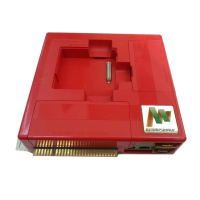
<System Board>
Instruction Manual
Z\Caution
Read through these instructions before using the product to
ensure
that you fully understand them
so
you
can
use
the
-
product safely.
After reading, keep the manual in
a
prede-
termined position for ready reference.
2
Sammy
Question and Answer IconNeed help?

Do you have a question about the Sammy Atomiswave and is the answer not in the manual?

Summary

Introduction

Product Specifications

Details of physical dimensions and contact information for Sammy Corporation.

Safety Precautions

Safety Levels of Danger

Classification of hazardous situations based on danger, warning, caution, and importance levels.

Pictorial Safety Symbols

Explanation of symbols used to alert users to safety practices.

User and Handling Precautions

User Roles

Defines qualified users for maintenance and troubleshooting tasks.

Handling Precautions

Instructions for safely handling the system board and cartridges.

Component Identification

Component Names

Diagram and labels identifying key components of the Atomiswave system board.

Accessory List

List of included accessories, notably the instruction manual itself.

Component Descriptions

JAMMA Connector Description

Detailed pinout information for the 56-pin JAMMA edge terminal.

Other Component Descriptions

Speaker Volume and Modem Terminal

Description of the speaker volume control and the SRL modem connection terminal.

DIP Switch (SW) Functions

Explanation of the DIP switch functions for system configuration.

Output Connectors

Stereo Speaker Output

Details on the stereo speaker output connector and its usage.

VGA Output (VDO)

Information about the VGA output connector for connecting a VGA monitor.

Cartridge Slots

ROM Cartridge Slot

Location and purpose of the slot for software title-specific ROM cartridges.

Expansion Cartridge Slots

Description of slots for attaching optional expansion cartridges.

ROM Cartridge Operations

Attaching and Detaching ROM Cartridges

Step-by-step instructions for inserting and removing ROM cartridges safely.

System Board Installation Notes

Exhaust Heat Fan Opening Clearance

Note on maintaining clearance for the exhaust heat fan opening to prevent overheating.

System Menu Configuration

System Menu Overview

Introduction to the system menu for operational tests and configuration.

System Menu Operations

How to navigate the system menu using test and service switches.

System Menu Displays

Screens for System Menu, Test Mode, and sub-menus like Color, Cross Hatch, I/O.

System Menu Test Functions

Details on Color, Cross Hatch, I/O, Sound, and Memory diagnostic tests.

Coin Settings Display

Configuring game mode, player mode, and coin chute types.

Coin Chute Type Details

Details on setting coin chutes for common mode, including credit rates.

Coin Rate Patterns

Lists preset patterns and combinations for coin rates in normal mode.

Advanced Coin Rate Patterns

Lists preset patterns for advanced coin rate settings.

Advanced Settings Display

Accessing advanced options for coin chute settings beyond normal presets.

System Settings

Configuring area, language, advertise sound, audio mode, and sound volume.

Clock and Game Settings

Configuring game-specific parameters and resetting to factory defaults.

Bookkeeping Data

Displays total time, play time, coin counts, credits, and game start counts.

Backup Clear Functions

Clearing high scores, credits, bookkeeping, and resetting all settings.

Network Settings

Options for configuring network play and board-to-board communication.

Overview

The Atomiswave system board is a JAMIMA-compliant (56-pin edge terminal) product designed for arcade gaming. It functions as the core system for running various software titles, offering a range of features for both game operation and system management.

Function Description:

The Atomiswave system board serves as the central processing unit for arcade games, supporting software title-specific ROM cartridges and optional expansion cartridges. It integrates essential components for game operation, including video and audio outputs, input/output (I/O) connections for player controls, and a modem connection terminal for potential network functionalities. The board is designed to be housed within an arcade cabinet, connecting to the cabinet's power supply, monitor, speakers, and control panel via a JAMMA connector.

Usage Features:

The system board offers several user-configurable features accessible through a comprehensive system menu. This menu allows operators to manage various aspects of the game and system.

  • Game Mode and Coin Settings: Operators can choose between coin-operated play and free play. For coin-operated games, the system supports both common and individual coin chute types. In common mode, a single credit count is displayed, aggregating coins from all chutes, useful for single-player games or cabinets with multiple coin types. In individual mode, each player's credits are displayed separately, suitable for multi-player setups where each player has a dedicated coin chute. The system allows for detailed configuration of coin-to-credit rates, with a selection of preset patterns and combinations available in both "NORMAL" and "ADVANCE" settings.
  • Player Mode: The system supports simultaneous play for two to four players, with coin chutes allocated accordingly (1P/2P to Chute A, 3P/4P to Chute B for four players).
  • System Configuration: The system menu includes settings for the region (Japan, North America, Europe, etc.), language (Japanese, English, Spanish, Portuguese, Italian, depending on software), and audio preferences.
  • Audio Control: The speaker volume can be adjusted directly on the board via a dedicated knob. Within the system menu, operators can set the audio mode to stereo or monaural and fine-tune the output sound volume across 16 levels (0-15). An "Advertise Sound" option allows enabling or disabling sound during the demo screen, though coin sound remains active regardless.
  • Video Output: The board provides a VGA output terminal (D-sub 15-pin) for connecting to a VGA monitor (31 kHz). A DIP switch (SW-1) allows switching between 31kHz and 15kHz monitor frequencies, with the OFF setting for regular JAMMA cabinets and ON for VGA monitors.
  • Modem Connection: A modem connection terminal (SRL) is available for potential communication functionalities, although its specific use may depend on the software title.
  • System Menu Access: The system menu can be accessed by pressing the test switch or by powering on the board with DIP SW-2 set to ON. If a cabinet lacks a test switch, the 1P start button can function as both a test switch (brief press) and a service switch (long press) when DIP SW-2 is ON.
  • Test Modes: The system menu offers various test modes to diagnose hardware functionality:
    • Color Test: Displays red, green, blue, and white color bars with 16 shades of brightness to check monitor calibration.
    • Cross Hatch: Displays a crosshatch pattern for screen alignment.
    • I/O Test: Verifies the functionality of player inputs (buttons, levers) and switches, with corresponding fields changing from OFF to ON when activated.
    • Sound Test: Allows testing the right, left, and center speakers individually or together, and playing/stopping a beep sound.
    • Memory Test: Runs a read/write test on the RAM modules, indicating "GOOD" or "BAD" results. This test must complete before exiting the screen.
  • Clock Settings: The system includes a clock that can be set via the system menu, allowing adjustment of year, month, day, hour, and minute.
  • Network Settings (Option): For network-ready games, this option allows configuring network connections.

Maintenance Features:

The Atomiswave system board incorporates features and guidelines to facilitate maintenance and ensure safe operation.

  • ROM Cartridge Management: Software titles are loaded via ROM cartridges. The manual provides clear instructions for attaching and detaching these cartridges, emphasizing the need to switch off power beforehand to prevent electrical shock or damage. When a new cartridge is attached, backup data is cleared, and settings are reset to factory defaults, ensuring a clean slate for new games.
  • Heat Management: The board includes an exhaust heat fan opening to prevent overheating. It is crucial to mount the system board with at least 5 cm of clearance from the rear to avoid blocking this opening. Dust deposition around the board should also be avoided, as it can lead to short circuits and potential ignition.
  • Bookkeeping: An SRAM module on the motherboard stores credit information even when power is off. The bookkeeping screen displays total time, total play time, coin counts (for chutes A and B, and total), coin credit, service credit, total credit, and start counts (normal, continue, network). This data is vital for operational tracking and financial management. Values are displayed in up to eight digits, with a "+" indicating a looping item that has exceeded its maximum count and reset to zero.
  • Backup Clear: This function allows operators to clear high scores, credits, and bookkeeping data, and reset all settings to factory defaults (ALL CLEAR). This is useful for resetting game data or preparing the board for new operations.
  • Safety Precautions: The manual outlines various safety precautions, classifying potential hazards into "DANGER," "WARNING," "CAUTION," and "IMPORTANT" levels. These cover risks such as electrical shock, property damage, injury, and degraded product performance. Prohibited actions (e.g., unauthorized modifications, dropping the board) and required actions (e.g., turning off power before handling components, ensuring proper ventilation) are clearly indicated with pictorials.
  • Qualified Personnel: The manual stresses that only "Shop Servicepersons" or "Technicians" should perform parts replacement, maintenance, inspection, and troubleshooting. These individuals are defined by their experience and knowledge in maintaining and repairing AM equipment.

Sammy Atomiswave Specifications

General IconGeneral
Release Year2003
Audio OutputStereo
RAM16 MB
StorageROM Cartridge
Resolution640x480
Video OutputVGA
I/O PortsJAMMA
Power SupplyJAMMA standard
SoundYamaha AICA 32-bit ARM7 RISC @ 45 MHz, 64-channel ADPCM