24 EB 8359-2 EN
Mounting and start-up
5.4 Pneumatic connections
Risk of injury by possible movement of the
actuator stem after connecting the signal
pressure.
Do not touch or block the actuator stem.
The pneumatic connections are optionally
designed as a bore with ¼NPT or
ISO288/1-G¼ thread. Customary ttings
for metal or copper tubing or plastic hoses
can be used.
Risk of malfunction due to failure to comply
with required air quality.
− Only use supply air that is dry and free of
oil and dust.
− Read the maintenance instructions for up-
stream pressure reducing stations.
− Blow through all air pipes and hoses
thoroughly before connecting them.
5.4.1 Pressure gauges
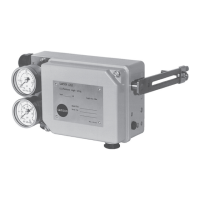
To monitor the positioner, we recommend in-
stalling pressure gauges for the supply air
and signal pressure (see accessories in sec
-
tion3.1).
5.4.2 Supply pressure
The required supply air pressure depends on
the bench range and the actuator's direction
of action (fail-safe action).
WARNING
!
NOTICE
!
The bench range is written on the nameplate
either as the bench range or signal pressure
range. The operating direction is marked FA
or FE or by a symbol.
Actuator stem extends (FA)
Fail-close
(for globe and angle valves)
Required supply pressure =
Upper bench range value + 0.2 bar,
minimum 1.4 bar
Actuator stem retracts (FE)
Fail-open
(for globe and angle valves)
For tight-closing valves, the maximum signal
pressure pst
max
is roughly estimated as fol-
lows:
pst
max
= F +
d² · π · ∆p
[bar]
4 · A
d = Seat diameter [cm]
∆p = Differential pressure across the valve
[bar]
A = Actuator area [cm²]
F = Upper bench range value [bar]
If there are no specications, calculate as
follows:
Required supply pressure =
Upper bench range value + 1bar
The positioner output pressure is routed to
the top or bottom diaphragm case of the
actuator as shown in Fig.6 to Fig.9.


 To Next Page