Section 2 - Introduction to CCD Cameras
Page 30
2.4.2. Double Correlated Sampling Readout
During readout, the charge stored in a pixel is stored temporarily on a capacitor. This capacitor
converts the optically generated charge to a voltage level for the output amplifier to sense.
When the readout process for the previous pixel is completed, the capacitor is drained and the
next charge shifted, read, and so on. However, each time the capacitor is drained, some
residual charge remains.
This residual charge is actually the dominant noise source in CCD readout electronics.
This residual charge may be measured before the next charge is shifted in, and the actual
difference calculated. This is called double correlated sampling. It produces more accurate data
at the expense of slightly longer read out times (two measurements are made instead of one).
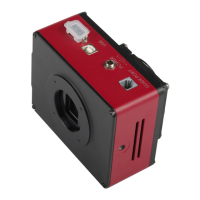
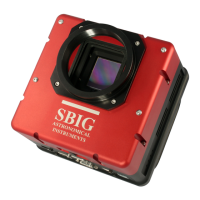
The ST-7XE, ST-8XE, ST-9XE, ST-10XE, ST-10XME and ST-2000XM utilize double correlated
sampling to produce the lowest possible readout noise. At 10e
-
to 15e
-
rms per read these
cameras are unsurpassed in performance.
2.4.3. Dark Frames
No matter how much care is taken to reduce all sources of unwanted noise, some will remain.
Fortunately, however, due to the nature of electronic imaging and the use of computers for
storing and manipulating data, this remaining noise can be drastically reduced by the
subtraction of a dark frame from the raw light image. A dark frame is simply an image taken at
the same temperature and for the same duration as the light frame with the source of light to
the CCD blocked so that you get a "picture" of the dark. This dark frame will contain an image
of the noise caused by dark current (thermal noise) and other fixed pattern noise such as read
out noise. When the dark frame is subtracted from the light frame, this pattern noise is
removed from the resulting image. The improvement is dramatic for exposures of more than a
minute, eliminating the many "hot" pixels one often sees across the image, which are simply
pixels with higher dark current than average.
2.4.4. Flat Field Images
Another way to compensate for certain unwanted optical effects is to take a "flat field image"
and use it to correct for variations in pixel response uniformity across the area of your dark-
subtracted image. You take a flat field image of a spatially uniform source and use the
measured variations in the flat field image to correct for the same unwanted variations in your
images. The Flat Field command allows you to correct for the effects of vignetting and
nonuniform pixel responsivity across the CCD array.
The Flat Field command is very useful for removing the effects of vignetting that may
occur when using a field compression lens and the fixed pattern responsivity variations present
in all CCDs. It is often difficult to visually tell the difference between a corrected and
uncorrected image if there is little vignetting, so you must decide whether to take the time to
correct any or all of your dark-subtracted images. It is always recommended for images that are
intended for accurate photometric measurements.
Appendix D describes how to take a good flat field. It's not that easy, but we have
found a technique that works well for us.


 To Next Page