Section 2 - Introduction to CCD Cameras
Page 34
number of electrons produced when photons of any wavelength happen to strike its sensitive
layers.
Of course, there are color video cameras, and a number of novel techniques have been
developed to make the CCD chip "see" color. The most common way implemented on
commercial cameras is to partition the pixels into groups of three, one pixel in each triplet
"seeing" only red, green or blue light. The results can be displayed in color. The overall image
will suffer a reduction in resolution on account of the process. A newer and more complicated
approach in video cameras has been to place three CCD chips in the camera and split the
incoming light into three beams. The images from each of the three chips, in red, green and
blue light is combined to form a color image. Resolution is maintained. For normal video
modes, where there is usually plenty of light and individual exposures are measured in small
fractions of a second, these techniques work quite well. However, for astronomical work,
exposures are usually measured in seconds or minutes. Light is usually scarce. Sensitivity and
resolution are at a premium. The most efficient way of imaging under these conditions is to
utilize all of the pixels, collecting as many photons of any wavelength, as much of the time as
possible.
In order to produce color images in astronomy, the most common technique is to take
three images of the same object using a special set of filters and then recombine the images
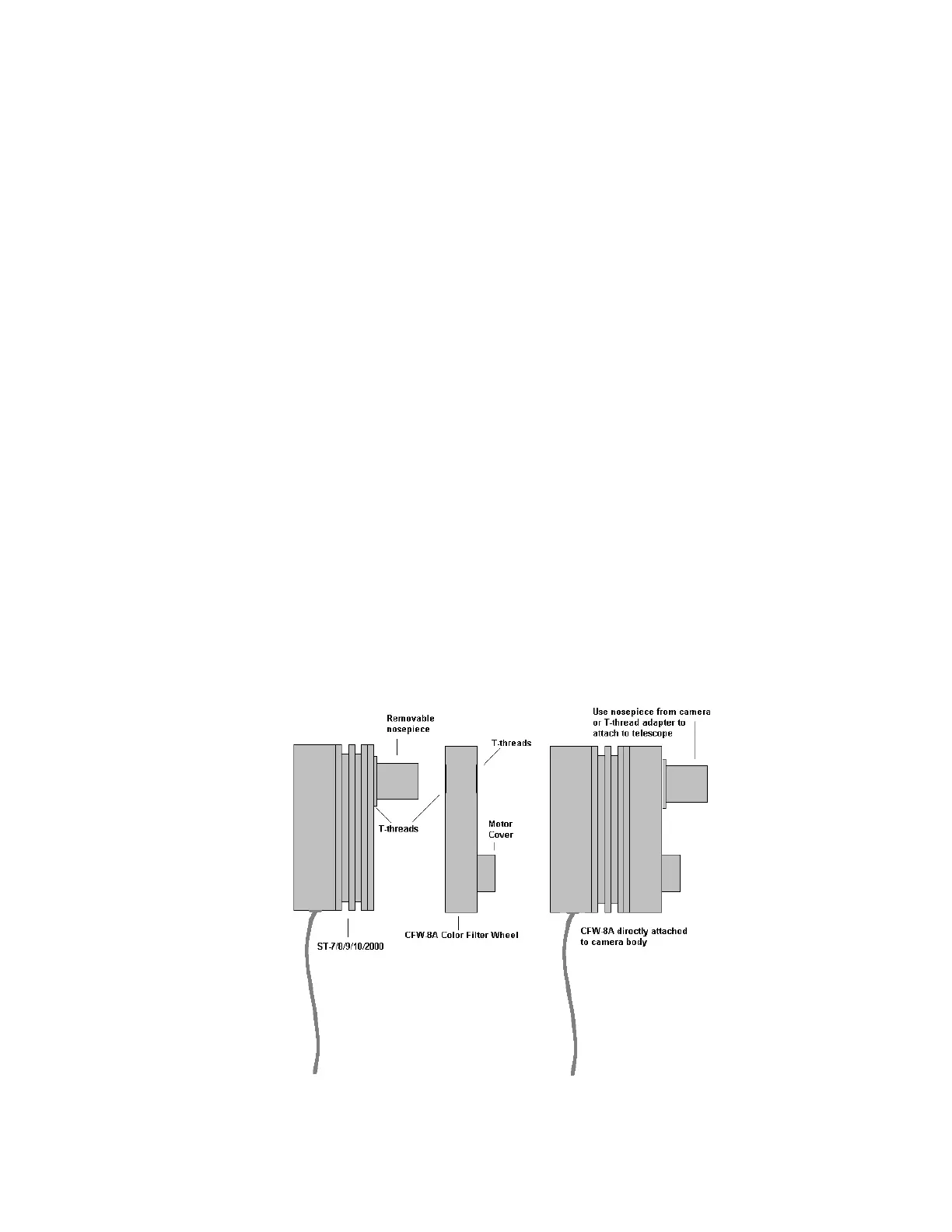
electronically to produce a color composite or RGB color image. SBIG offers as an option an
integrated motorized color filter wheel. The CFW8A color filter wheel is attached to the front of
the camera in such a way that light entering the camera passes through the colored filter before
it strikes the CCD. An object is then exposed using a red filter. The wheel is commanded to
insert the green filter in place, and another image taken. Finally a blue image is taken. When
all three images have been saved, they may be merged into a single color image using SBIG or
third party color software.



 To Next Page